Shooting a landscape, it's tempting to focus at infinity on the assumption that this guarantees everything far away stays sharp. But then the foreground rock or flower a meter or two away turns out slightly soft. Focusing at infinity wastes half your depth of field on empty space beyond infinity that was never going to be in the frame anyway. Hyperfocal distance is the exact focus point that eliminates that waste, stretching your depth of field from the nearest possible point all the way to infinity at a given aperture.
What hyperfocal distance actually is
Hyperfocal distance is the specific focus distance where everything from half that distance out to infinity falls within acceptable sharpness. If the hyperfocal distance works out to 2 meters, focusing at 2 meters keeps everything from 1 meter (half of 2m) to infinity sharp. Compared to simply focusing at infinity, focusing at the hyperfocal distance puts your near-side depth of field to actual use instead of throwing it away, so you end up covering a much wider range of the scene. What makes this useful in practice is that it's calculable ahead of time from just three things you already know before you press the shutter: focal length, aperture, and sensor size.
The formula and a worked example
Hyperfocal distance (H) depends on focal length (f), aperture (N), and the circle of confusion (c) — a value set by sensor size. The formula is H = f² / (N × c) + f. For full-frame sensors, the circle of confusion is typically taken as roughly 0.03mm. Take a 24mm lens at f/11 on full frame: H = 24² / (11 × 0.03) + 24 ≈ 1,769mm, or about 1.77m. Focus at 1.77m and everything from roughly 0.89m (half of that) to infinity falls inside your depth of field. Since the circle of confusion scales down with a smaller sensor, an APS-C crop body (circle of confusion around 0.02mm) using a 16mm lens at f/11 — the equivalent field of view to 24mm on full frame — works out to H ≈ 1,180mm, or about 1.18m. In other words, crop sensors land at a shorter hyperfocal distance for the same equivalent field of view, which works in your favor for depth of field.
A real scenario: keeping a riverside rock and the mountains behind it sharp
Say you're shooting a riverside landscape with a 24mm lens, a moss-covered rock about 1 meter away in the foreground, and mountains in the distance. Focus at the f/11 hyperfocal distance calculated above — 1.77m — and everything from about 0.89m to infinity lands inside the depth of field, so both the 1-meter rock and the distant ridgeline come out sharp. Focus at infinity instead, and the near edge of your depth of field shifts further out than 0.89m, putting that 1-meter rock right at the boundary or outside it, likely soft. Stopping down further to f/16 would pull the hyperfocal distance even closer, which helps close subjects, but pushes you toward diffraction softening that can cost you resolution across the whole frame — so it's usually better to calculate the hyperfocal distance you actually need rather than reflexively closing the aperture further.
The common mistake: focusing at infinity, or zooming in on live view
The most common landscape-photography mistake is assuming that "everything far away in frame" requires focusing at infinity. As shown above, that wastes half your depth of field on space beyond infinity that was never in the shot to begin with, pushing foreground subjects out of the sharp range. A second common mistake is zooming in on live view to nail critical focus on one specific subject — say, the nearest flower — and shooting from there. That subject itself will be tack sharp, but because depth of field extends symmetrically-ish around wherever you focus, the total usable depth across the frame often ends up narrower than what hyperfocal focusing would have given you.
Using hyperfocal distance in the field
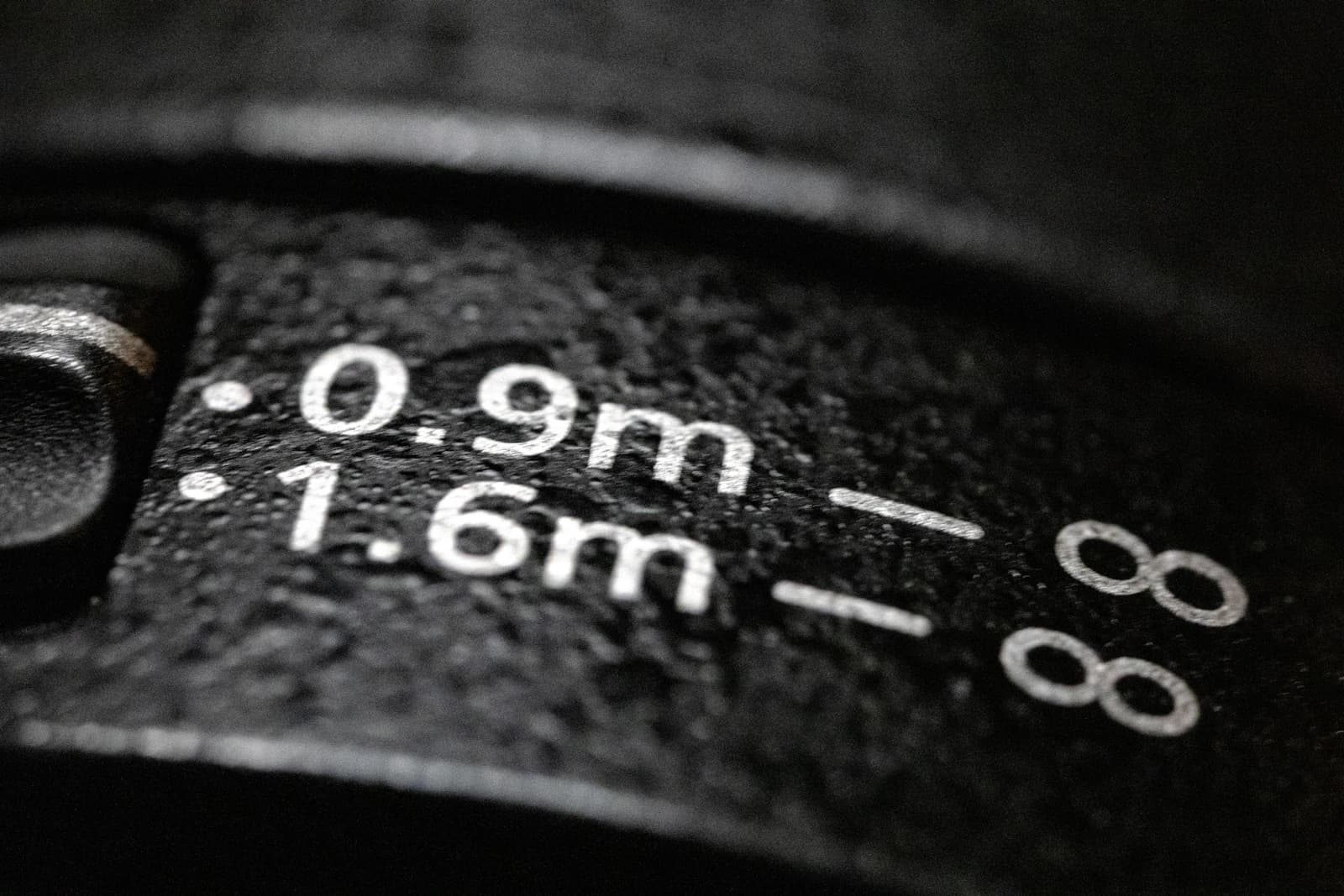
Running the formula in your head every time you shoot isn't realistic, so a few practical shortcuts cover most situations. Older manual lenses print a depth-of-field scale on the barrel — read off where the marking for your chosen aperture lines up with the infinity symbol, and that distance is your hyperfocal distance. Modern autofocus lenses usually skip that scale, so a hyperfocal-distance calculator app, or a pre-saved table for your common focal lengths and apertures, lets you punch in the numbers on location and get the distance instantly. When precise distance measurement isn't practical, estimating by eye and stopping down by an extra stop or two — f/13 or f/16 instead of f/11 — is a reasonable way to buy margin for error.
Checklist
- Focus at the hyperfocal distance rather than at infinity to make full use of your depth of field from near to far.
- Calculate the actual distance with H = f² / (N × c) + f for your specific lens, aperture, and sensor.
- Remember that crop sensors land at a shorter hyperfocal distance than full frame at an equivalent field of view.
- Before you shoot, estimate the distance to your nearest subject and confirm it falls within the resulting depth of field.
- Rather than reflexively stopping down further, pick the widest aperture that still satisfies the hyperfocal distance you need, since diffraction can erode sharpness past a certain point.