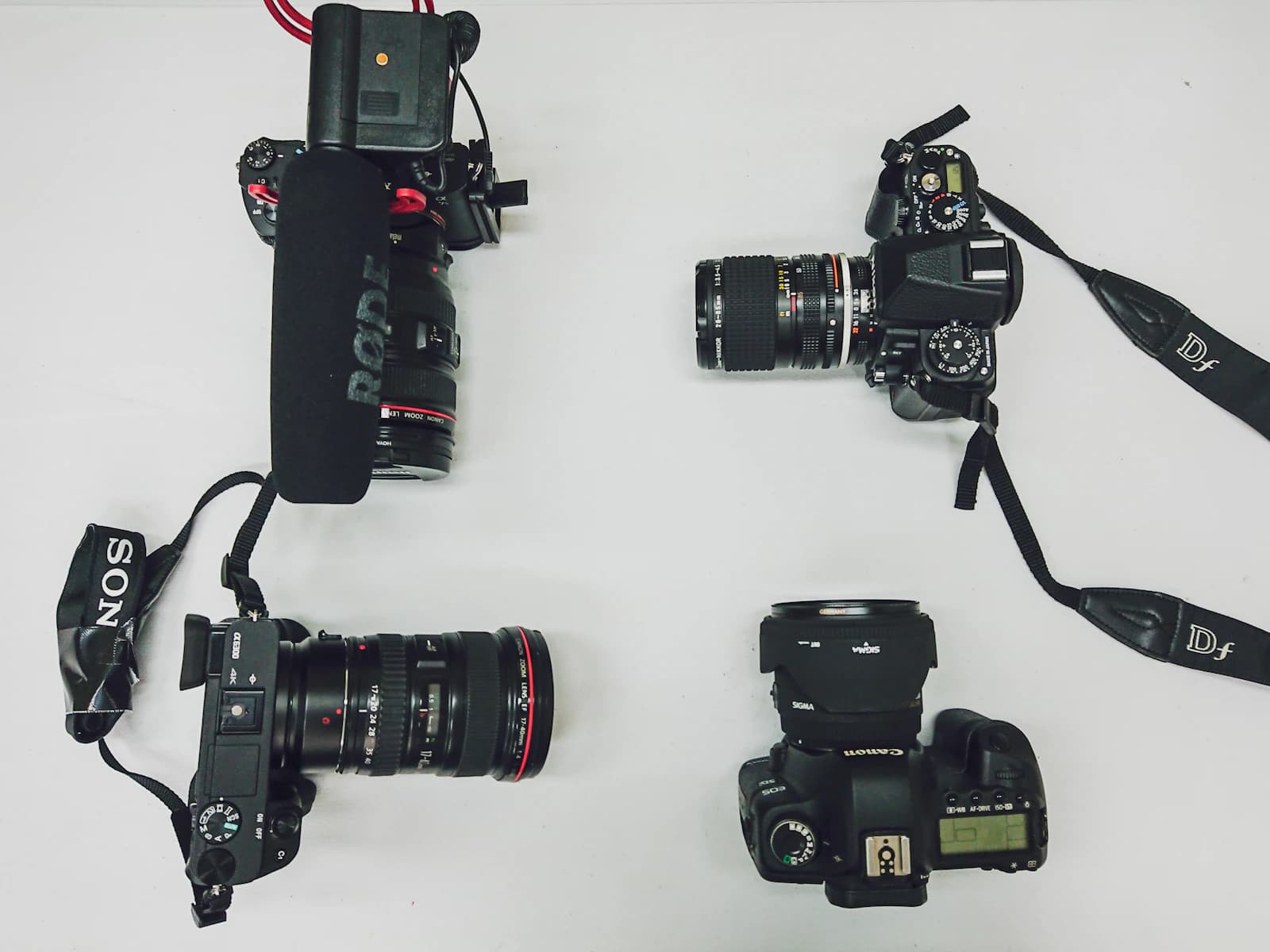
Choosing between mirrorless and DSLR often gets reduced to "mirrorless is smaller, DSLR has better battery life," but the real differences start with something more fundamental — what you're actually looking at through the viewfinder — and ripple outward into autofocus performance, burst shooting, and how a camera handles fast-moving subjects. Understanding what the two designs actually do differently makes the choice clearer than a spec sheet ever could.
The fundamental difference: where the light goes
A DSLR bounces light coming through the lens off a mirror and up into an optical viewfinder (OVF). Press the shutter and the mirror flips up out of the way for the split second the exposure takes, blacking out the viewfinder for that instant. Mirrorless cameras have no mirror at all — light hits the sensor directly, and the sensor's live feed is what you see in the electronic viewfinder (EVF) or on the rear screen. That single structural difference is why exposure simulation — seeing your actual exposure, white balance, and depth of field before you shoot — is standard on mirrorless bodies, while a DSLR shows you the optical scene as your eye would see it, not what the sensor will actually record.
Autofocus: coverage and method
DSLR autofocus relies on a dedicated phase-detect AF module tucked behind the mirror, and the area it can actually cover tends to cluster in roughly the center 40% of the frame. Focusing on a subject near the edge usually means falling back on focus-and-recompose. Mirrorless cameras build phase-detect pixels directly into the image sensor (on-sensor phase detection), so on current models autofocus typically covers 90% or more of the frame, tracking eyes, faces, and animals wherever they land in the shot. The gap isn't absolute, though — high-end DSLR phase-detect modules use a dedicated sensor that often still reacts faster in low light, and early mirrorless generations had a real weakness in low-light on-sensor AF speed.
Burst rate and viewfinder blackout
Without a mirror to flip, mirrorless cameras aren't limited by mechanical shutter mechanics, and with an electronic shutter many can burst at 20 frames per second or faster — critically, without the viewfinder blacking out between frames. DSLRs need the mirror to physically move for every single frame, which puts a practical ceiling around 10 fps, and the viewfinder briefly goes dark on every shot. For sports or wildlife, where the subject is crossing the frame quickly, that blackout-free tracking is the real-world difference between keeping your eye on the subject continuously and losing it between frames.
Size, weight, and battery life
Without a mirror and pentaprism (or pentamirror) assembly, mirrorless bodies tend to run lighter and thinner than DSLRs in the same class — a full-frame DSLR body often sits around 800g while a comparable full-frame mirrorless body comes in closer to the 600g range. That advantage gets eaten into significantly by battery life, though. Running an EVF and rear screen continuously means mirrorless bodies commonly rate in the 300-400 shot range on the CIPA standard, while DSLRs, whose OVF draws almost no power, often rate 800-1200 shots on the same measure. For travel or long days shooting outdoors, that difference shows up directly in how many spare batteries you need to carry.
The common misconception: "mirrorless is strictly better"
It's true that camera makers are pouring development into mirrorless systems, but that doesn't mean shooting a DSLR is a mistake. Used DSLR bodies and lenses on the secondhand market often deliver excellent value, and an optical viewfinder shows a real-time, zero-lag view of the scene with no power draw — something photographers who need to react instantly in bright outdoor light still value. The flip side — "mirrorless is always lighter" — is only half true too: while bodies shrink, fast mirrorless-native lenses (especially bright standard and telephoto primes) sometimes weigh more than their DSLR-mount predecessors, narrowing the total system weight gap in practice.
Which one fits your shooting
For sports and wildlife where you're tracking a fast subject with your eye, or for work with a heavy video component, blackout-free bursts and wide AF coverage give mirrorless a real practical edge. For long trips where battery swaps are inconvenient, for building out a lens collection on a budget (used DSLR glass tends to run cheaper), or if you already own a DSLR lens collection, sticking with or extending an existing DSLR system — including through a mount adapter — can still be the more sensible call.
Practical checklist
- If you're shooting all day outdoors without a chance to swap batteries, check the CIPA shot rating and carry at least 2-3 spares for a mirrorless body.
- For fast subjects you need to track continuously, confirm the body supports blackout-free burst shooting.
- If you already own lenses, check real-world reviews of autofocus speed with a mount adapter before deciding to switch systems.
- For frequent low-light work, compare on-sensor AF low-light sensitivity (the EV rating) across specs before assuming newer always means better.
- After a shoot, check the camera model and lens recorded in the EXIF data to separate body limitations from other causes when a shot doesn't turn out as expected.