Food ordered while traveling cools quickly, so there is little time to think about the photo. That makes food photography a shoot where you have to decide within a few seconds from what distance, at what angle, and how close to shoot. This post is a record of those three decisions, organized with real photos and their settings.
It contains 7 photos of food ordered in Thailand on April 30, 2025, with the shooting settings (EXIF) of each. Fried rice, a stir-fried shrimp dish in sauce, and glossy chicken wings are shot in steps from full shots to close-ups, all with the wide-angle lens I had brought for landscape photography. The point of this post is that there is a way to get close even without a dedicated macro lens.
(사진을 클릭하면 원본 크기로 볼 수 있습니다)
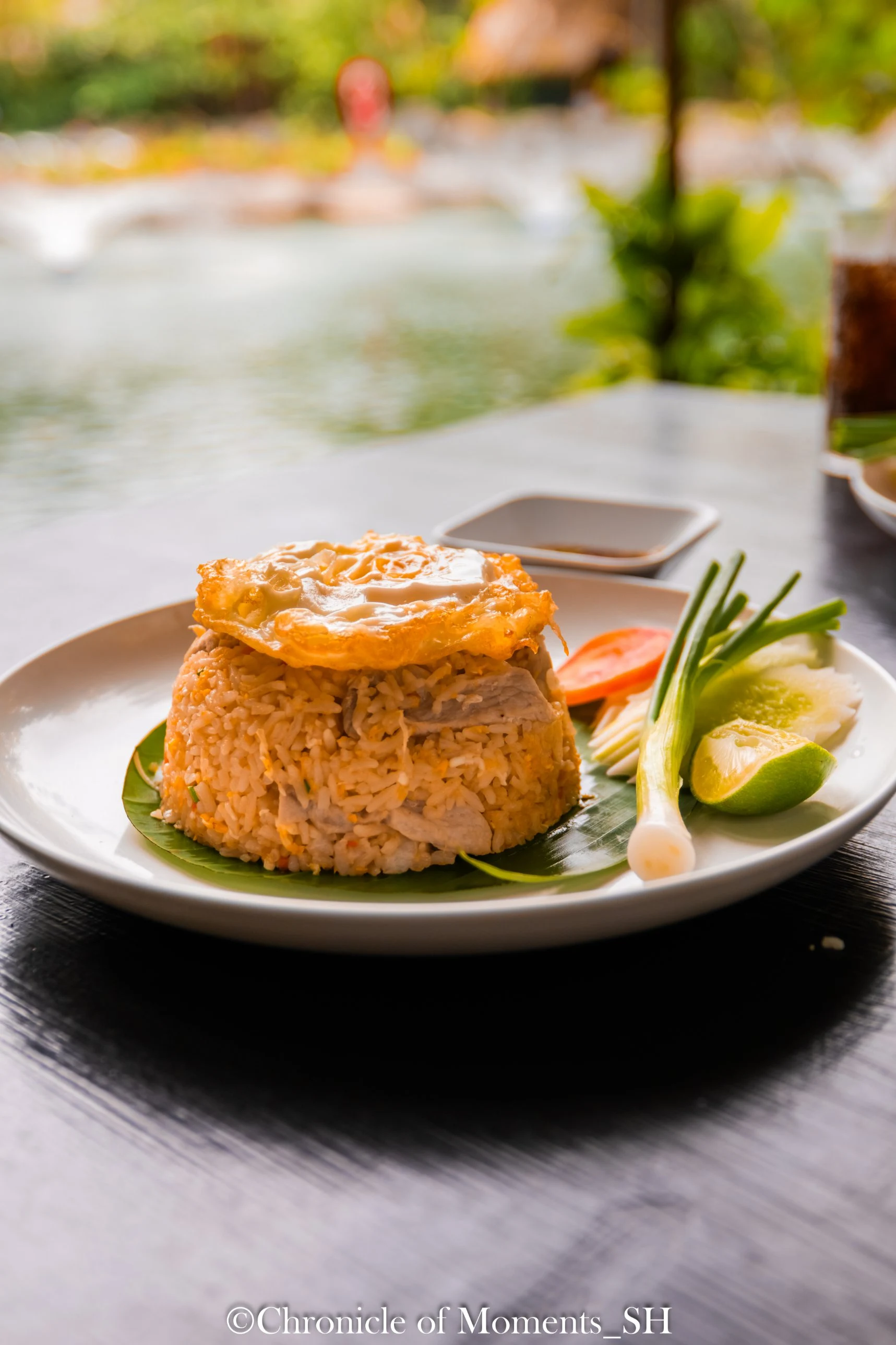
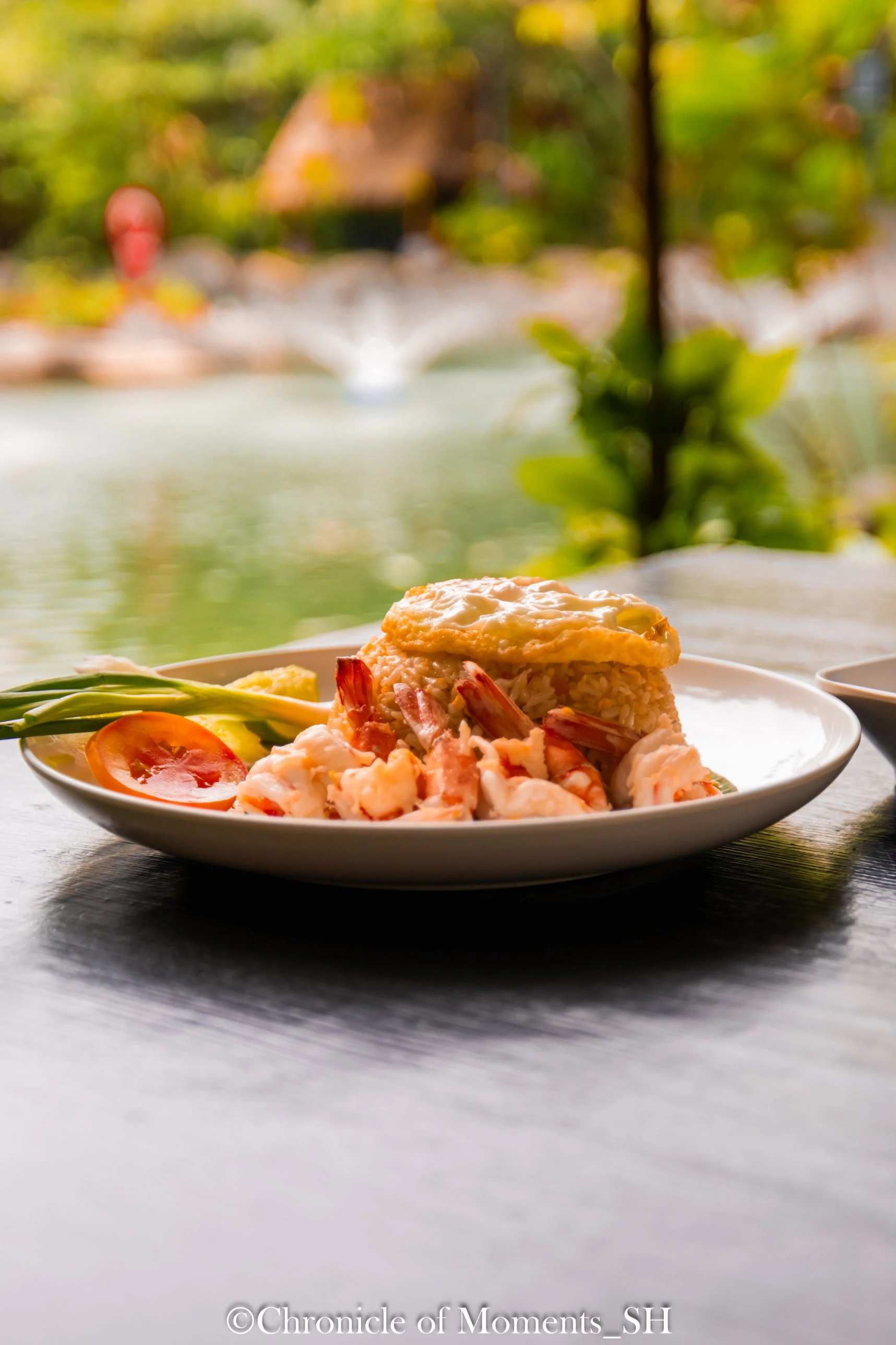
These two fried rice photos were taken about 30 seconds apart at the same table. The left one is at 26mm and the right one at 35mm, and the plate and the pond, fountain, and green garden behind it all fit in one frame. It can feel as if the right answer in food photography is to shoot only the plate large, but including the background like this also leaves a record of the setting where the food was eaten.
Shooting Food with a Wide-Angle Lens
The lens for this shoot was the Canon RF15-35mm F2.8 L IS USM, the wide-angle lens I had prepared for landscape photography, and I used it to shoot the food. Standard or short-telephoto angles of view are generally said to be used for food, but that day I simply tried shooting food with that wide-angle lens. One thing I confirmed in the process: every lens has a minimum focusing distance, the closest distance at which it can focus, and if you get this distance right, even a lens without a macro function can shoot as close as possible, almost like a macro shot.
The camera is a Canon EOS R7 with an APS-C sensor, so multiplying the focal length by 1.6 gives the full-frame equivalent angle of view. 26mm corresponds to about 42mm and 35mm to about 56mm, so the angle of view in these photos is closer to standard than to wide. Even on a wide-angle zoom, using the 35mm end gives an angle of view that works comfortably for food, and the distortion that makes the plate edge look bent was not large. You can check the conversion yourself with the Crop Factor Calculator.
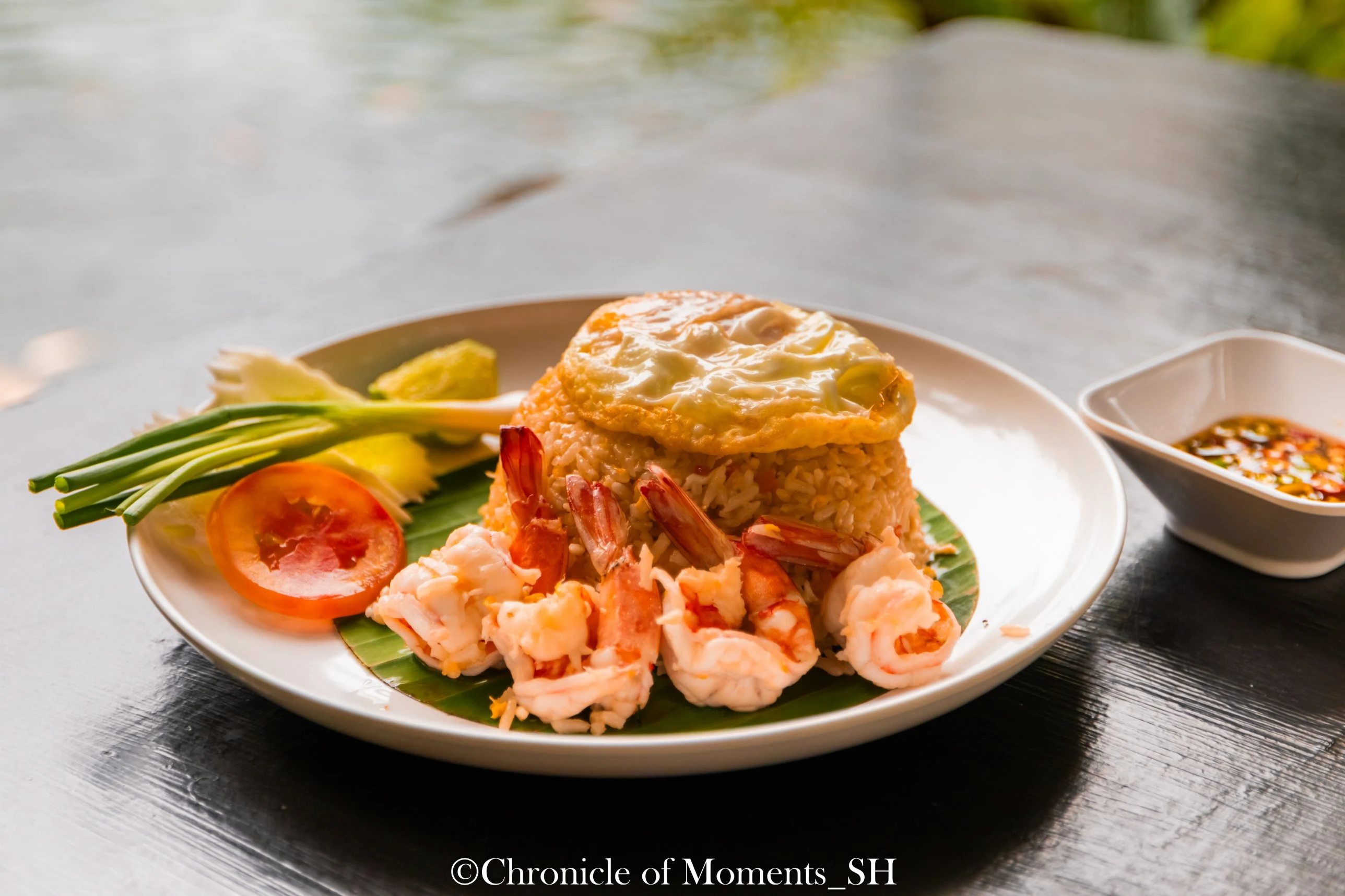
Canon EOS R7 · RF15-35mm F2.8 L IS USM · 35mm · F2.8 · ISO 100 · 1/500 s · 2025-04-30
(Click the photo to view it at full size)
The photo above is the shrimp fried rice shot looking slightly down on the plate. The red of the shrimp tails, the yellow of the fried egg, and the green of the banana leaf separate clearly into different colors on the plate. The composition of this shot is that the lens is brought close to the plate while the sauce bowl still fits in the same frame.
The Minimum Focusing Distance Is the Key to Close-Up Shots
The minimum focusing distance is the closest distance at which focus can be achieved, and it is measured not from the front of the lens but from the sensor position inside the camera (the ⌀ mark on the top of the body). So the real gap between the front of the lens and the subject is shorter than the number in the specifications. In Canon's official specifications, this lens's closest focusing distance is listed as 0.28m and its maximum magnification as 0.21x.
A maximum magnification of 0.21x means that the image formed on the sensor is 0.21 times the size of the real subject. The R7's sensor is about 22.3mm wide and 14.8mm high, so calculating from that, the area that fits in the frame at the closest distance is about 10.6cm wide and 7cm high. That is about the size where one or two shrimp and a spoonful of rice fill the frame, and for food photography that is enough to look like a close-up.
| Item | Typical wide-angle or standard lens | Macro lens |
|---|---|---|
| Maximum magnification | Often around 0.1x to 0.3x | Often 1x (life size) |
| Minimum focusing distance | Listed per lens in the specifications | Can get much closer |
| Use in food photography | Whole plate to close-up | Extreme enlargement of small details |
| Advantage | Possible with a lens you already own | Can enlarge even very small subjects |
The values in this table are general tendencies and differ by lens, so it is a good idea to first check the minimum focusing distance and maximum magnification in your own lens's specification sheet. Macro photography as a whole is covered separately in Macro Photography Basics: Magnification, Focus, and Light.
The closer you get, the thinner the range in focus (the depth of field) becomes. If you calculate with a maximum magnification of 0.21x, F2.8, an APS-C sensor, and an assumed circle of confusion of 0.019mm, the depth that is in focus is only about 3mm. It is an approximate value I calculated myself, but it is clear that the closer you shoot, the more "where you place the focus" becomes the whole photo. The principle is explained in detail in Why Macro Depth of Field Doesn't Behave Like Standard Depth of Field.
One Plate, Two Angles
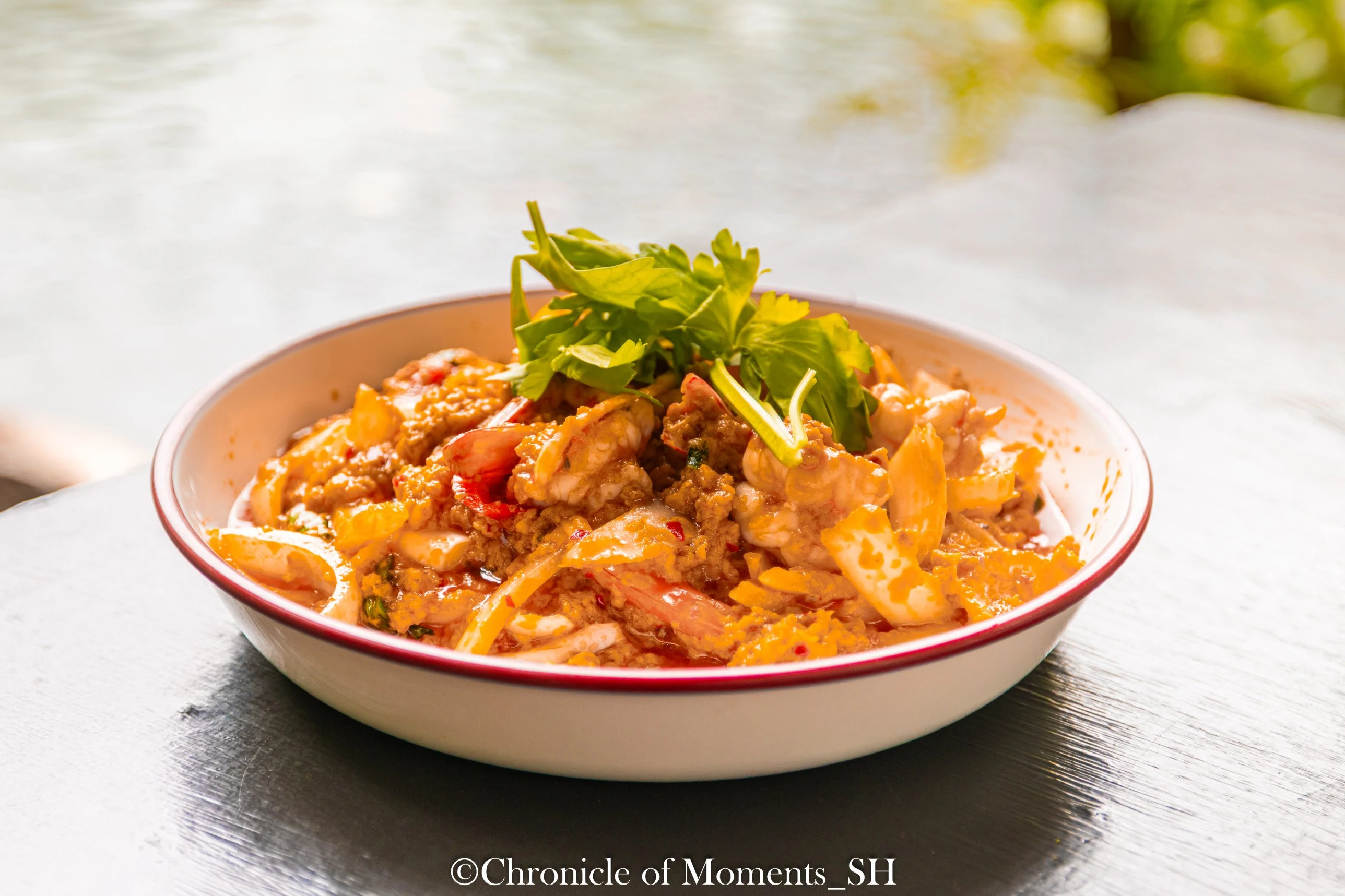
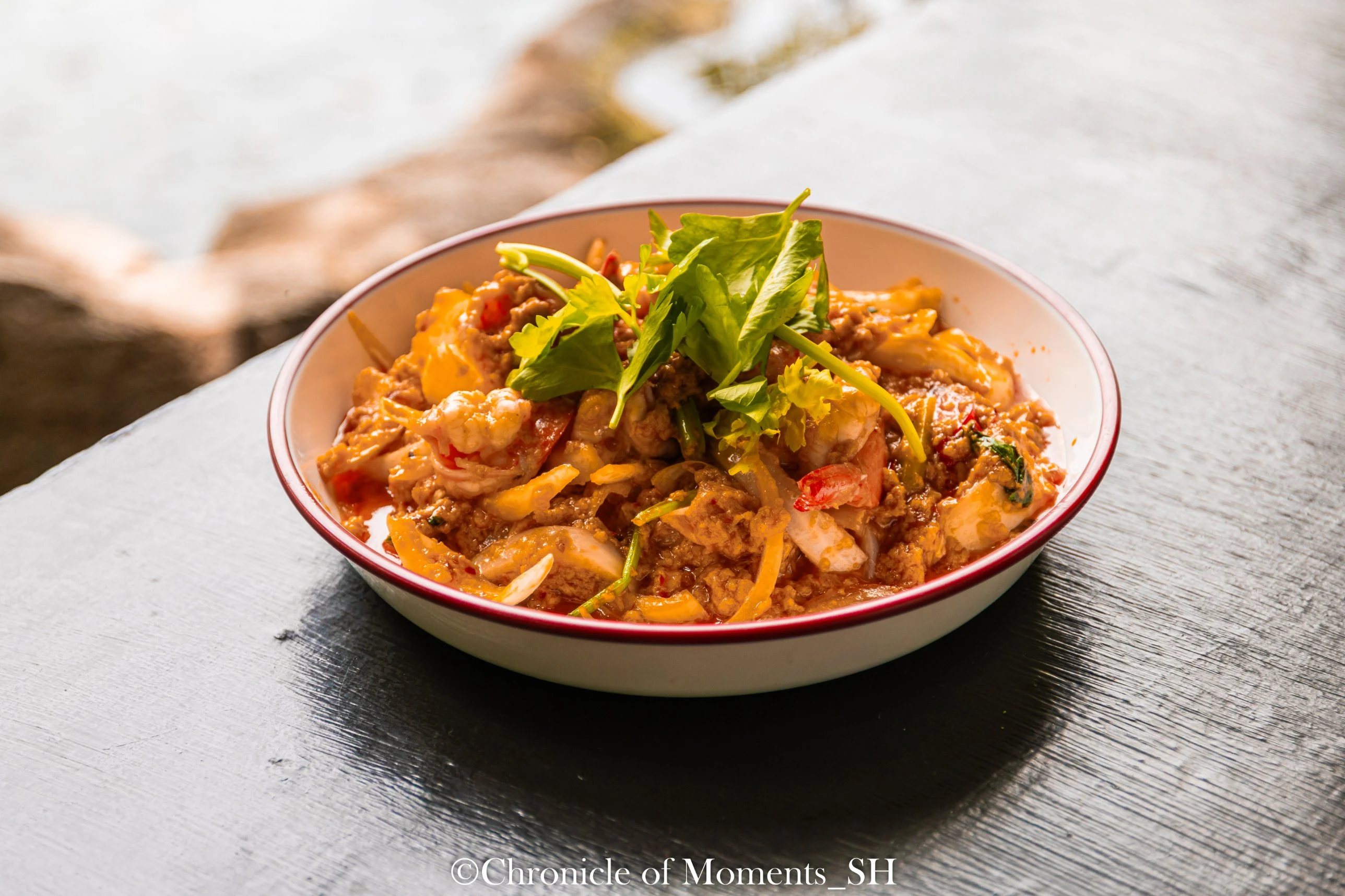
(사진을 클릭하면 원본 크기로 볼 수 있습니다)
These are two shots of the same bowl taken 17 seconds apart. The left one was taken from a low angle close to eye level, so the side of the bowl and the green leaves on top of the sauce show together, and the right one was taken looking down at an angle, so the shapes of the ingredients are visible at a glance. Even for the same food, lowering the angle brings out height and volume, and raising the angle brings out the arrangement and colors of the ingredients. In food photography distance and angle move as a pair, so before moving closer it works better to try two or three different angles first.
These two photos have the same shutter speed of 1/320 s, and the same aperture and ISO, yet the impression is quite different. General tips for composition are covered first in 5 Composition Checks Before You Press the Shutter.
A Close-Up Taken by Getting Near
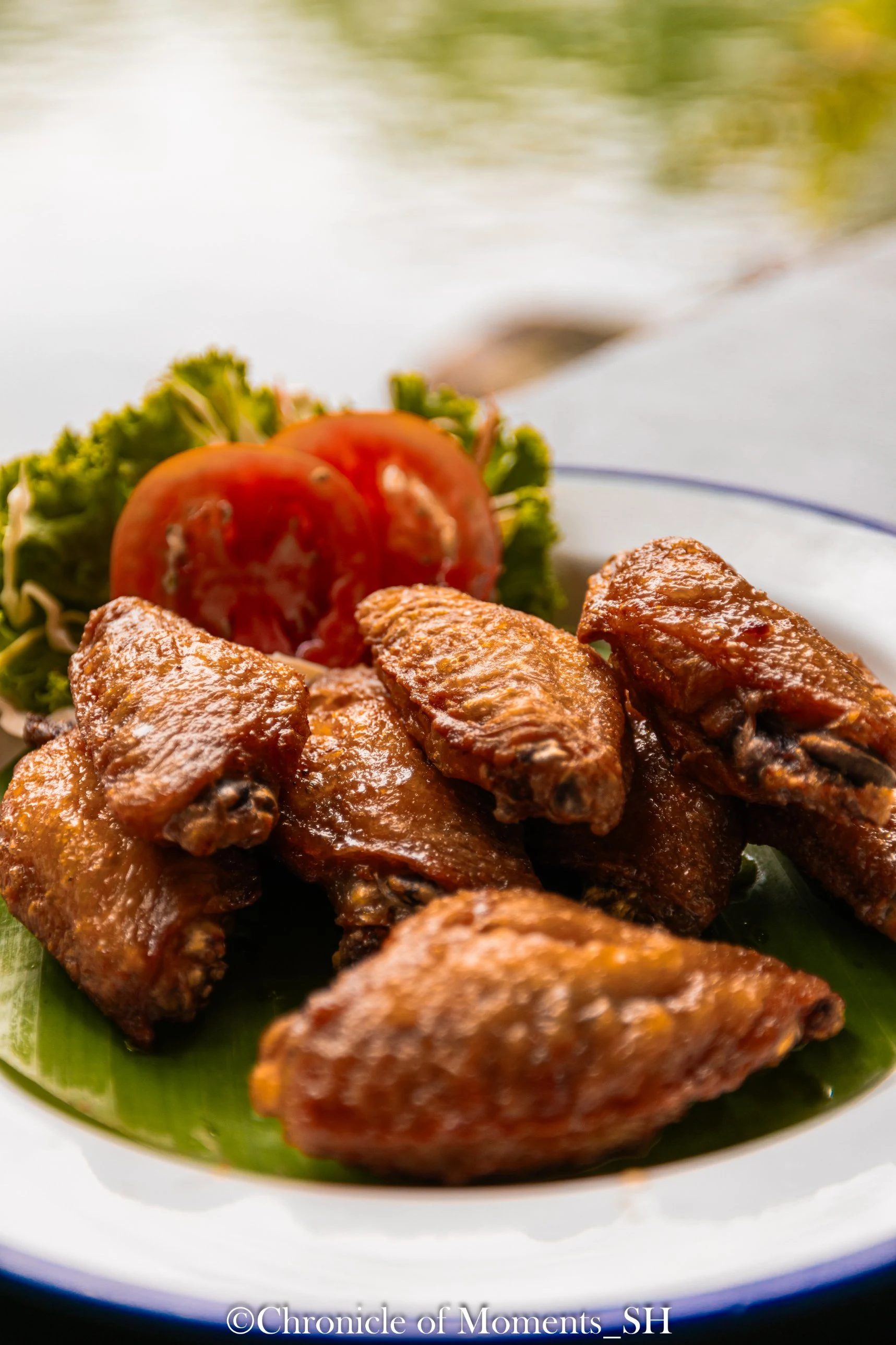
Canon EOS R7 · RF15-35mm F2.8 L IS USM · 35mm · F2.8 · ISO 100 · 1/400 s · 2025-04-30
(Click the photo to view it at full size)
This is the photo taken closest in this series. You can see the grain of the wing surface, the gloss of the sauce, and even the cracks in the skin, while the tomato and lettuce behind soften out of focus. Because the focus was placed on the tip of the front wing, what is in front of and behind it blurs naturally, and the eye gathers on one spot. It is a photo where the point above, that the range in focus becomes thinner the closer you get, can be seen as it is.
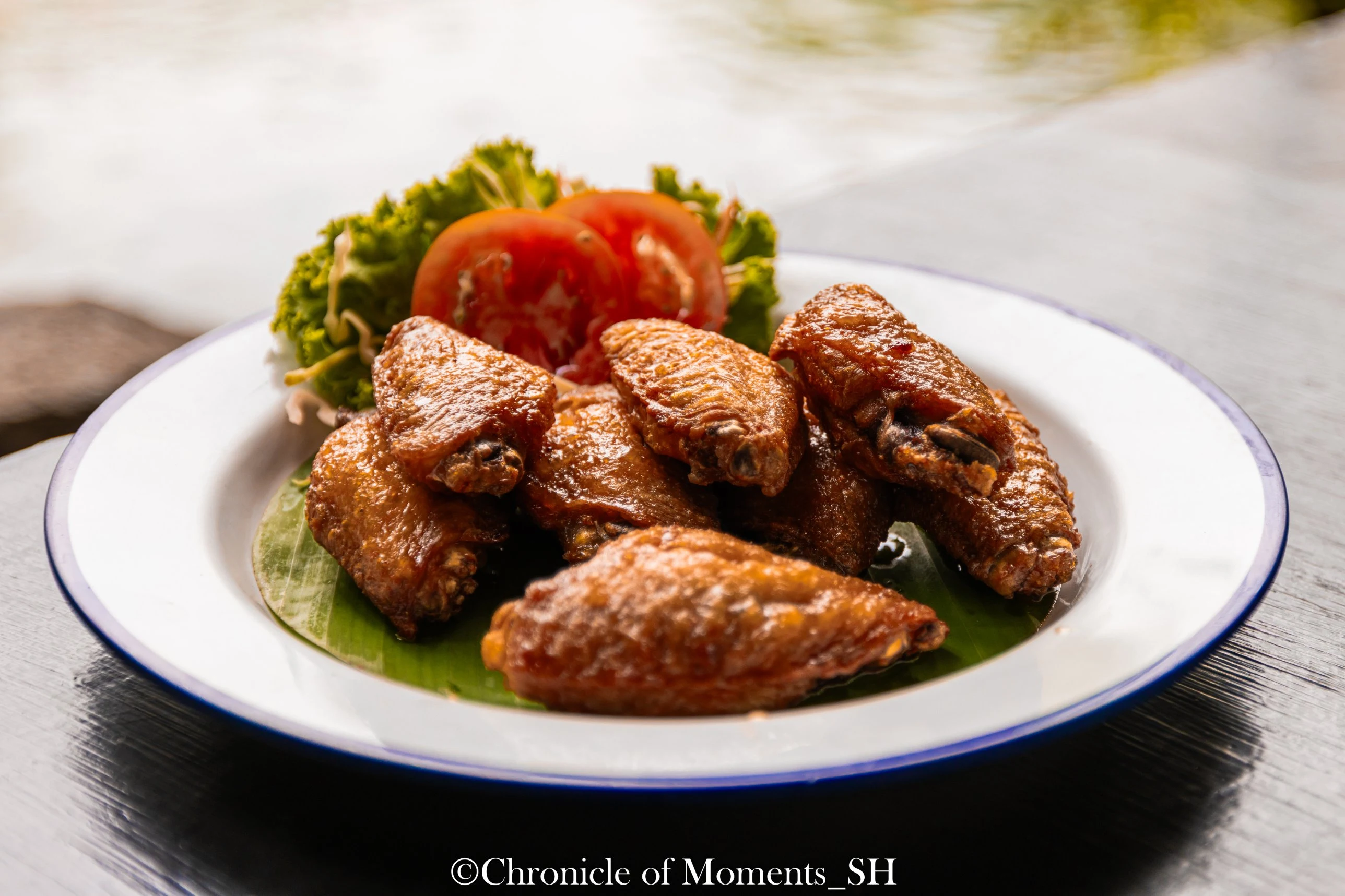
Canon EOS R7 · RF15-35mm F2.8 L IS USM · 35mm · F2.8 · ISO 100 · 1/400 s · 2025-04-30
(Click the photo to view it at full size)
This is the same plate seven seconds later, taken one step back so that the whole plate is visible. Put side by side, the close-up and this full shot tell different things: one conveys "taste and texture," the other "the presentation and atmosphere." The convenience of shooting food with a wide-angle zoom is that I got both photos from the same spot, simply by changing my body position and without changing lenses.
Blur the Background, Make the Plate Stand Out
All 7 photos in this post were taken at F2.8 and ISO 100. Opening the aperture fully makes the range in focus thin, so the pond and garden behind the plate turn into soft blobs of light. This is also why the outline of the fountain in the fried rice photos is blurred so that only its shape can be recognized. It is a way to keep the scenery in the background while letting the eye rest on the plate. How the range in focus changes is covered in Understanding Depth of Field: Aperture, Focal Length, and Distance.
Because it was a bright place, the shutter speed came out between 1/320 s and 1/500 s even at ISO 100 and F2.8. Food does not move, but when you shoot handheld from up close even small shake is magnified, so this shutter speed was a stable choice. What a bright lens changes in dark places is covered in Why a Bright (Wide-Aperture) Lens Helps for Indoor Photography.
Because this shoot was entirely at F2.8, I could not include a comparison between apertures. If you want the whole plate sharp, the usual approach is to stop down one or two stops and try around F4 or F5.6. The focus method also matters when shooting close, so see Focus Modes Explained: AF-S vs AF-C vs Manual Focus as well.
The Settings of All 7 Photos at a Glance
| Photo | Lens · Focal length | Aperture | Shutter speed | ISO | Time |
|---|---|---|---|---|---|
| Fried rice with fried egg (vertical) | RF15-35mm · 26mm | F2.8 | 1/500 s | 100 | 14:09 |
| Shrimp fried rice (vertical) | RF15-35mm · 35mm | F2.8 | 1/500 s | 100 | 14:10 |
| Shrimp fried rice (horizontal) | RF15-35mm · 35mm | F2.8 | 1/500 s | 100 | 14:10 |
| Shrimp stir-fry in sauce (low angle) | RF15-35mm · 35mm | F2.8 | 1/320 s | 100 | 14:11 |
| Shrimp stir-fry in sauce (from above at an angle) | RF15-35mm · 35mm | F2.8 | 1/320 s | 100 | 14:11 |
| Chicken wings close-up | RF15-35mm · 35mm | F2.8 | 1/400 s | 100 | 14:14 |
| Chicken wings full shot | RF15-35mm · 35mm | F2.8 | 1/400 s | 100 | 14:14 |
By the shooting times, the whole series from the first photo to the last took a little over five minutes. Because you have to change angle and distance before the dish cools, it helps to build the habit of securing both a full shot and a close-up within a few frames per plate.
Checklist
- Did you check your lens's minimum focusing distance and maximum magnification in its specification sheet?
- Do you remember that the minimum focusing distance is measured from the sensor position (the ⌀ mark), not from the front of the lens?
- Before moving closer, did you try changing the angle three ways: low, at an angle, and from above?
- Did you decide which part of the plate to focus on (such as the nearest ingredient) before shooting?
- Is your lens or your body casting a shadow over the plate?
Common Mistakes: Pushing Closer Than the Minimum Focusing Distance
The most common mistake is to keep moving in even though the lens cannot focus. When you get closer than a lens's minimum focusing distance, it will not focus and the camera hunts for focus. In that case, step back and find the point where focus locks, and if you want a larger image, it is better to crop the photo later. The next is going too close with a wide-angle lens so that the plate edge looks bent or the lens casts a shadow on the food. Using the longer end of the zoom range (35mm in this shoot) and shifting your position slightly solves most of it.
Shooting without deciding where to focus is another common mistake. At close distances where the depth of field becomes only a few millimeters, if focus lands behind the plate, the very part you most want to show becomes blurry. It is safer to use touch AF or single-point AF and assign focus to the nearest ingredient or the most striking part.
FAQ
Can I take close-up food photos without a macro lens?
Yes. These photos were taken with a wide-angle zoom lens without a macro function. If you get as close as the lens's minimum focusing distance, you can fill the frame with part of the plate. However, macro lenses often enlarge up to 1x (life size), so if you want to fill the frame with a very small subject, a dedicated lens is more advantageous.
Where is the minimum focusing distance measured from?
It is measured from the position of the camera sensor, not from the front end of the lens. The ⌀-shaped mark on the top of the camera shows the sensor position. So the real gap between the front of the lens and the subject is shorter than the number in the specifications.
Doesn't shooting food with a wide-angle lens cause distortion?
The closer you get and the wider the angle of view, the more the edges look stretched. These photos were taken at 26 to 35mm (about 42 to 56mm in full-frame equivalent), so the distortion was not noticeable. At the widest angle such as 15mm, getting right up to the plate can make distortion larger.
What aperture is best for food photos?
If you want a blurred background, open the aperture, and if you want the whole plate sharp, stop down one or two stops. This shoot was entirely at F2.8, so the background blurred strongly, and in the photos taken close the range in focus was very thin.
Putting It Together
If you divide food photography into full shots, middle shots, and close-ups, you can get several scenes from a single plate. This shoot confirmed that even without a dedicated macro lens, if you know the minimum focusing distance of the lens you own and get close within it, you can capture almost like a macro shot. The distance is measured from the sensor, and since the depth of field gets thinner as you get closer, it is important to decide the focus position first. Use the settings in this post as a reference and try shooting one plate at three distances and angles at your next meal.
Copyright Notice
All photos used in this post are works taken directly by the site operator (Chronicle of Moments_SH). Photographs are protected as photographic works under Article 4(1)(ix) of the Korean Copyright Act, and copyright arises from the moment of shooting without any registration or other procedure (Article 10(2)).
Without the copyright holder's prior permission, it is prohibited to reproduce the photos in this post (Article 16), to post or transmit them on blogs, forums, social media, or communities (public transmission, Article 18), or to modify or edit them into derivative works (Article 22). Removing or altering the copyright notice and frame in a photo can also infringe the right of attribution (Article 12) and the right to integrity (Article 13). Uses the law permits, such as fair quotation of a published work (Article 28) or use within a private or domestic scope (Article 30), are exceptions.
Unauthorized use can lead to injunction claims (Article 123) and damages claims (Article 125), and can be punished by imprisonment of up to 5 years or a fine of up to 50 million won (Article 136(1)). For-profit or habitual infringement can be punished even without a complaint (Article 140).
Photo-use inquiries: skysmoga@gmail.com
© Chronicle of Moments_SH. All rights reserved.