Last September I took photos at 'House of Benedict Pattaya', an art cafe near Pattaya, Thailand. It was a tall interior where sunlight comes in through a skylight, with a spiral staircase, a water channel, and bulb lights here and there. But once I raised the camera, the space was darker than I expected the farther I moved from the skylight. Our eyes adapt to the dark quickly, but a camera does not. In this post I'll go through why a bright lens helps indoors where light is limited, and how you can still shoot without one, with real EXIF. Every photo in this post was shot handheld, without a tripod.
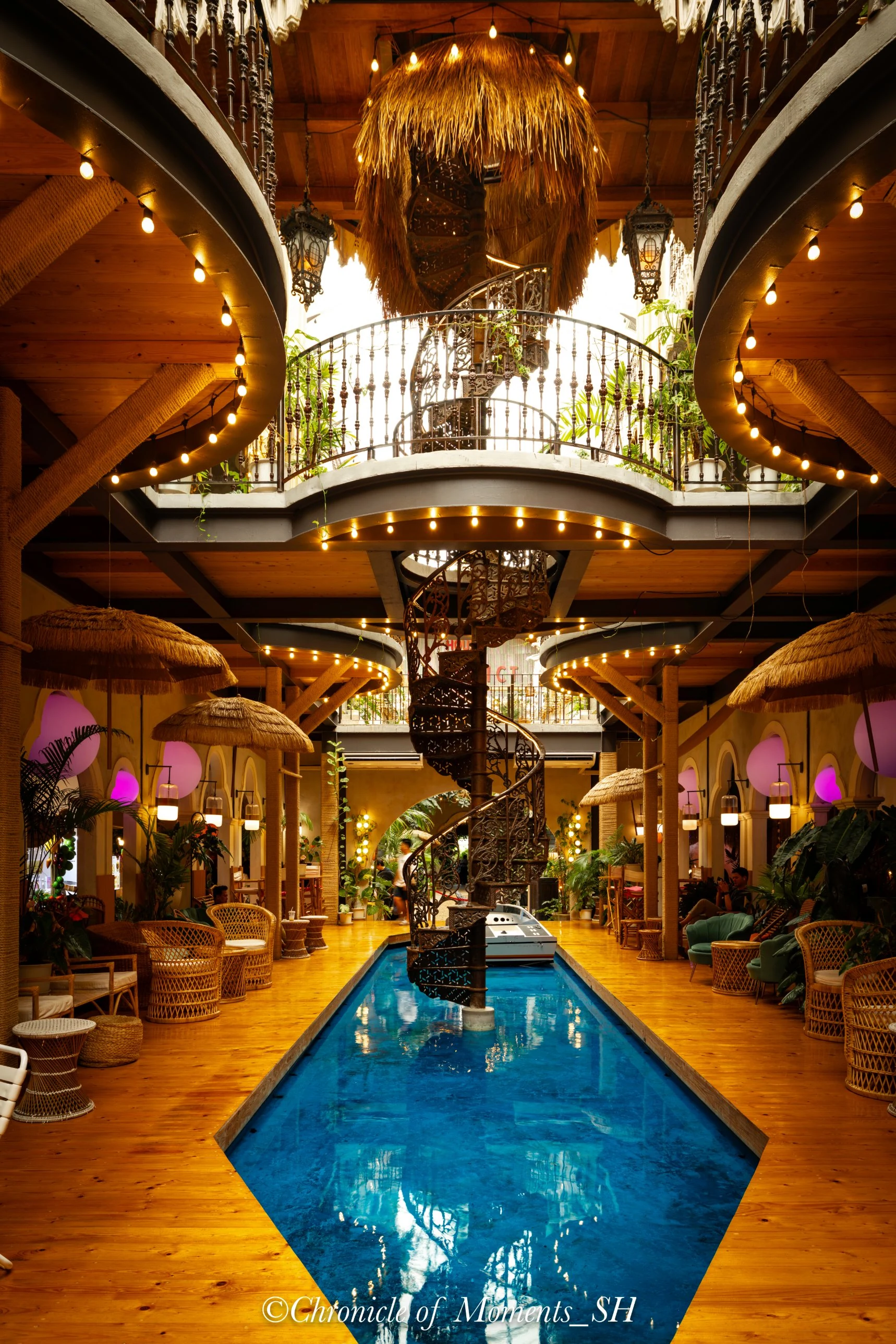
Canon EOS R5 Mark II · RF15-35mm F2.8 L IS USM · 22mm · F5.6 · ISO 50 · 1/10 s
(Click the photo to view it at full size)
The Short Answer
Indoors there is often less light than outdoors. If you can set up lighting yourself, as in a studio, there is no problem, but in ordinary indoor shooting you usually cannot use lights or a speedlight. In that case a lens with a low f-number (a bright lens) is the surest way to gather light. That does not mean you can't shoot indoors with an f4 or slower lens, not at all. You can shoot just fine by adjusting ISO and shutter speed. The catch is that the shutter speed gets slower, so you need to watch out for camera shake.
Why Does a Low f-Number Help?
The aperture is the size of the opening that lets light in inside the lens. The lower the number, the wider the opening, so more light reaches the sensor in the same amount of time. Each step of aperture (1 stop) doubles or halves the amount of light.
| Lens maximum aperture | Light gathered vs. an f4 lens |
|---|---|
| f2.8 | about 2x (1 stop) |
| f1.8 | about 5x (about 2.3 stops) |
| f1.4 | about 8x (3 stops) |
An f1.4 lens gathers almost 8 times as much light as an f4 lens. In a dark interior that difference turns directly into shutter speed or ISO. In the same scene you can use a faster shutter speed, so there is less shake, and a lower ISO, so there is less noise.
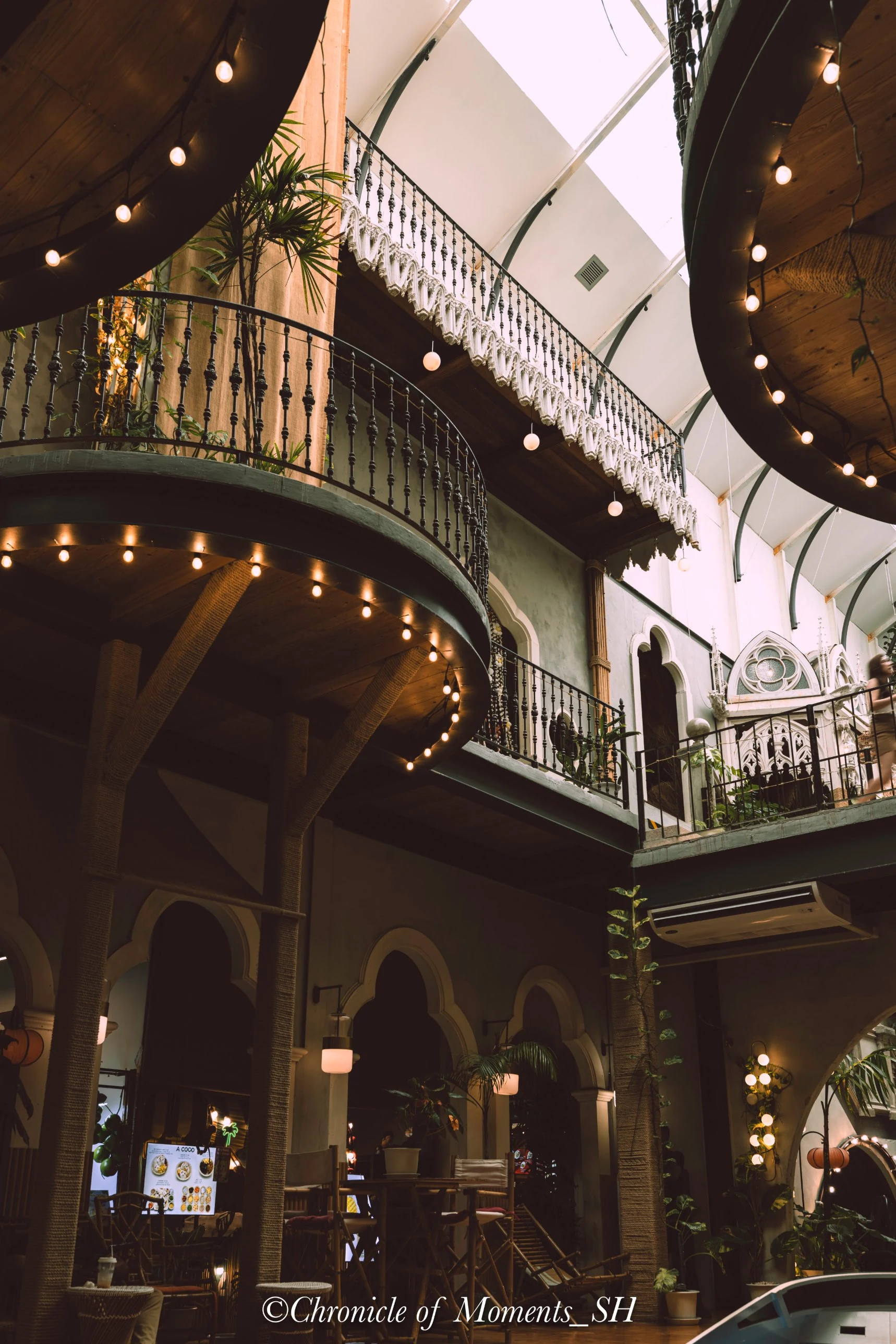
Canon EOS R5 Mark II · RF15-35mm F2.8 L IS USM · 29mm · F5.6 · ISO 50 · 1/25 s
(Click the photo to view it at full size)
How Bright Are Different Lenses?
It varies by lens, but primes include models with low aperture numbers such as f1.2, f1.4, and f1.8. Many zoom lenses open up to f2.8 at most. The lineup differs by brand and mount, so I recommend checking each lens's maximum aperture on the official site of the camera brand you use.
A bright lens does more than gather light. When you open the aperture, the difference between the in-focus area and the background grows, and the background blurs softly. A cluttered background gets tidied up, and lights turn into round bokeh balls that lift the mood.
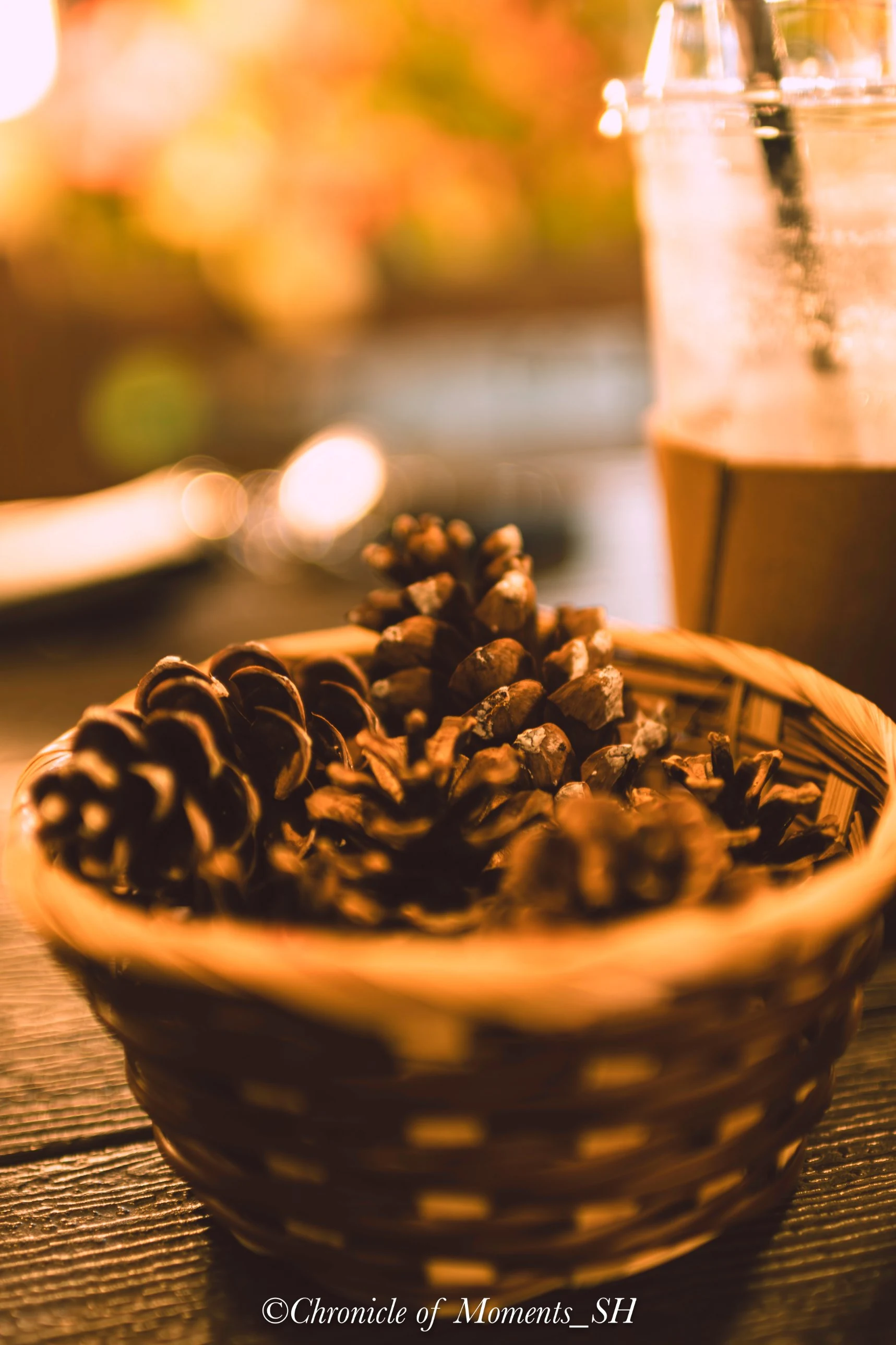
Canon EOS R7 · 30mm F1.4 DC HSM | Art 013 · 30mm · F1.4 · ISO 100 · 1/10 s
(Click the photo to view it at full size)
This photo was taken on a cafe terrace at night, not indoors. It is not an interior, but it shows well what choices you need to make to get exposure when light is short, so I included it. I opened the aperture to f1.4 and shot at ISO 100, 1/10 s. With an f4 lens, the same brightness would have needed about 0.8 s at ISO 100, or 1/10 s at ISO 800 (a 3-stop difference). Thanks to the bright lens I could keep the ISO low and still blur the background softly.
However, opening the aperture a lot makes the range in focus (depth of field) very shallow. The eyes of a person may be in focus while the tip of the nose is soft, so you need the habit of checking after the shot. If you want to estimate depth of field in advance, check it with the Diffraction & DoF Calculator.
You Can Shoot Just Fine with an f4 or Slower Lens
You don't need to give up on indoor shooting because you have no bright lens. Make up for the missing light with ISO and shutter speed. For example, ISO 400–800 with a shutter speed of about 1/10 s works in many interiors.
Exposure is a balance of aperture × shutter speed × ISO. Below are the combinations that give the same brightness as a photo I took in this cafe with the RF50mm F1.4 (F1.4, ISO 50, 1/200 s).
| Aperture | ISO | Shutter speed |
|---|---|---|
| f1.4 | 50 | 1/200 s |
| f2 | 50 | 1/100 s |
| f2.8 | 50 | 1/50 s |
| f4 | 50 | 1/25 s |
| f5.6 | 50 | about 1/12 s |
To keep the same 1/200 s with an f4 lens, raise ISO from 50 to 400, a 3-stop increase. In other words, ISO 400, 1/200 s on an f4 lens is the same brightness as this photo. If the math is a hassle, the Exposure Stop Calculator shows equivalent exposure combinations right away.
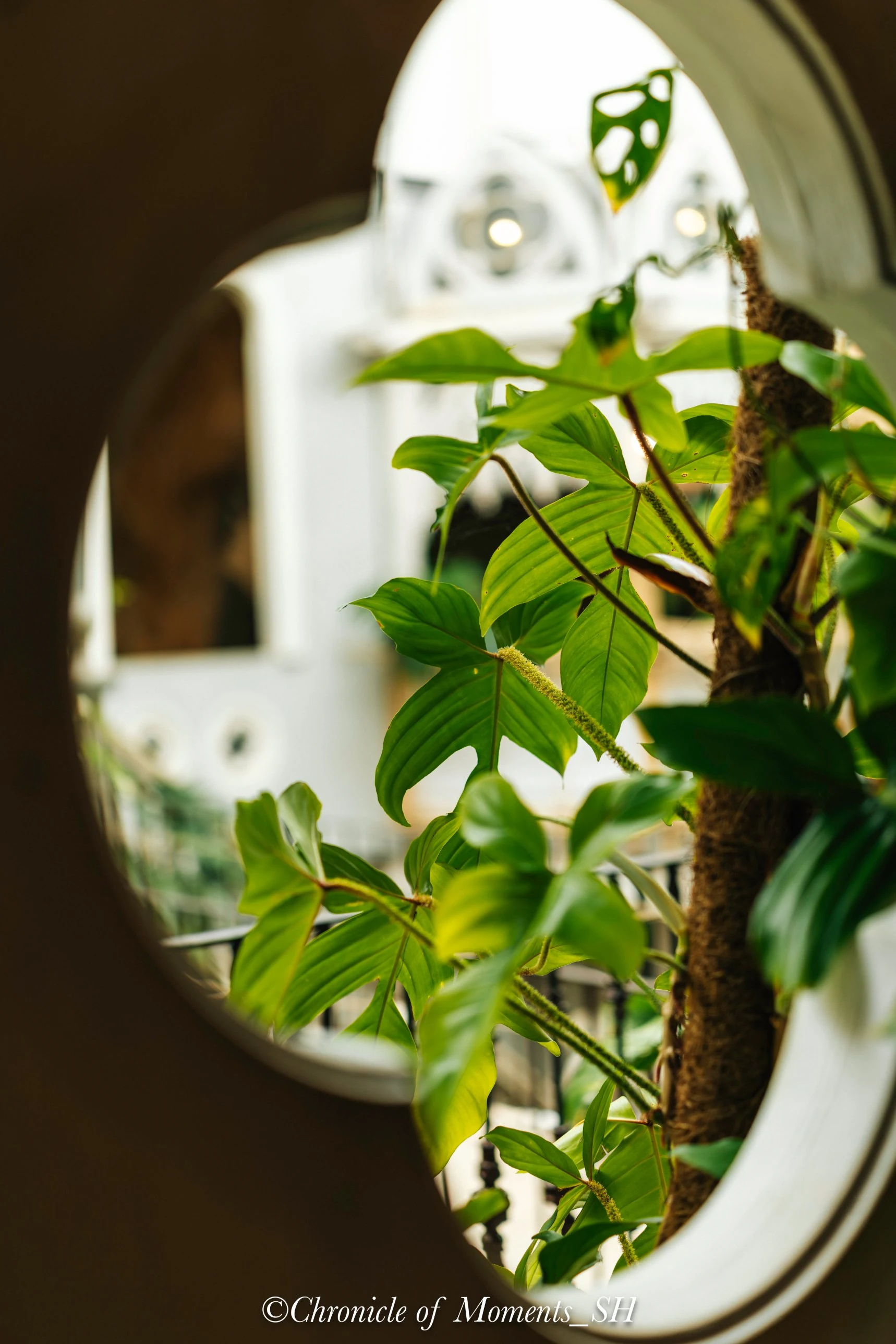
Canon EOS R5 Mark II · RF50mm F1.4 L VCM · 50mm · F1.4 · ISO 50 · 1/200 s
(Click the photo to view it at full size)
What is interesting is the first overview photo taken in the same cafe (F5.6, ISO 50, 1/10 s). Convert that exposure as in the table above and it is almost the same brightness as F1.4 at 1/200 s. In other words, even in the same interior, depending on which aperture you use, the shutter speed can be 1/200 s or 1/10 s. When you want the whole space sharp with a wide angle, stop down to F5.6; when you want to emphasize one spot, like props or plants, open to F1.4 to secure a fast shutter speed. Choose to suit the situation.
What to Watch For When the Shutter Speed Gets Slow
When the shutter speed gets slow, the thing to watch most is camera shake. For handheld shooting, "1 / focal length seconds" is generally known as a safe guide. With a 50mm lens that is about 1/50 s. Once you drop to around 1/15 s, as in the photo below, you need to pay much more attention to shake. All the photos in this post were shot handheld without a tripod.
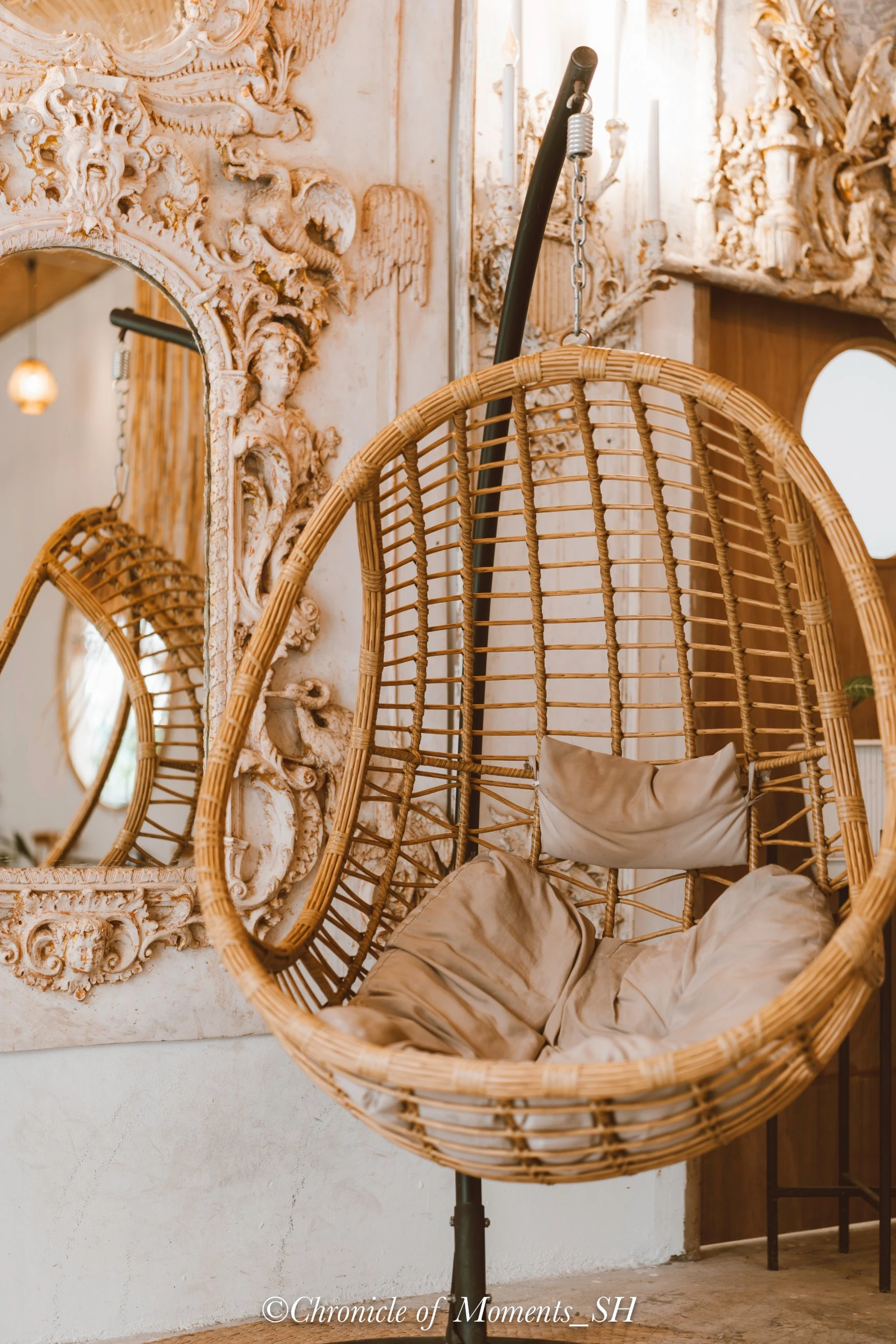
Canon EOS R5 Mark II · RF50mm F1.4 L VCM · 50mm · F1.4 · ISO 50 · 1/15 s
(Click the photo to view it at full size)
When the shutter speed drops to 1/10 s or slower, I recommend using these methods together.
- Steady your body. Tuck both elbows against your body, or lean your body or the camera on a wall, a pillar, or a table, and shake drops a lot.
- Turn on image stabilization. If the camera body or the lens has stabilization, you can shoot at slower shutter speeds. But if the subject moves, stabilization cannot stop that.
- Pick still subjects. If people move, the subject blurs at a slow shutter. Subjects that don't move, such as props, food, and interiors, suit slow-speed shooting.
- Take several shots of the same scene. At a slow shutter, taking a few frames of the same composition in a row lets you pick the sharpest one.
If you are in a place where you can use a tripod or the self-timer, it is even more reliable. See How to Avoid Camera Shake in Long Exposures for details.
So When Do You Really Need a Bright Lens?
For still props or scenery, an f4 lens with adjusted ISO and shutter speed is enough. But when you capture moments where people move, when you need to shoot fast handheld, or when you don't want to raise ISO much, the benefit of a bright lens is clearly bigger. A bright lens also helps when you want to blur the background to build a mood.
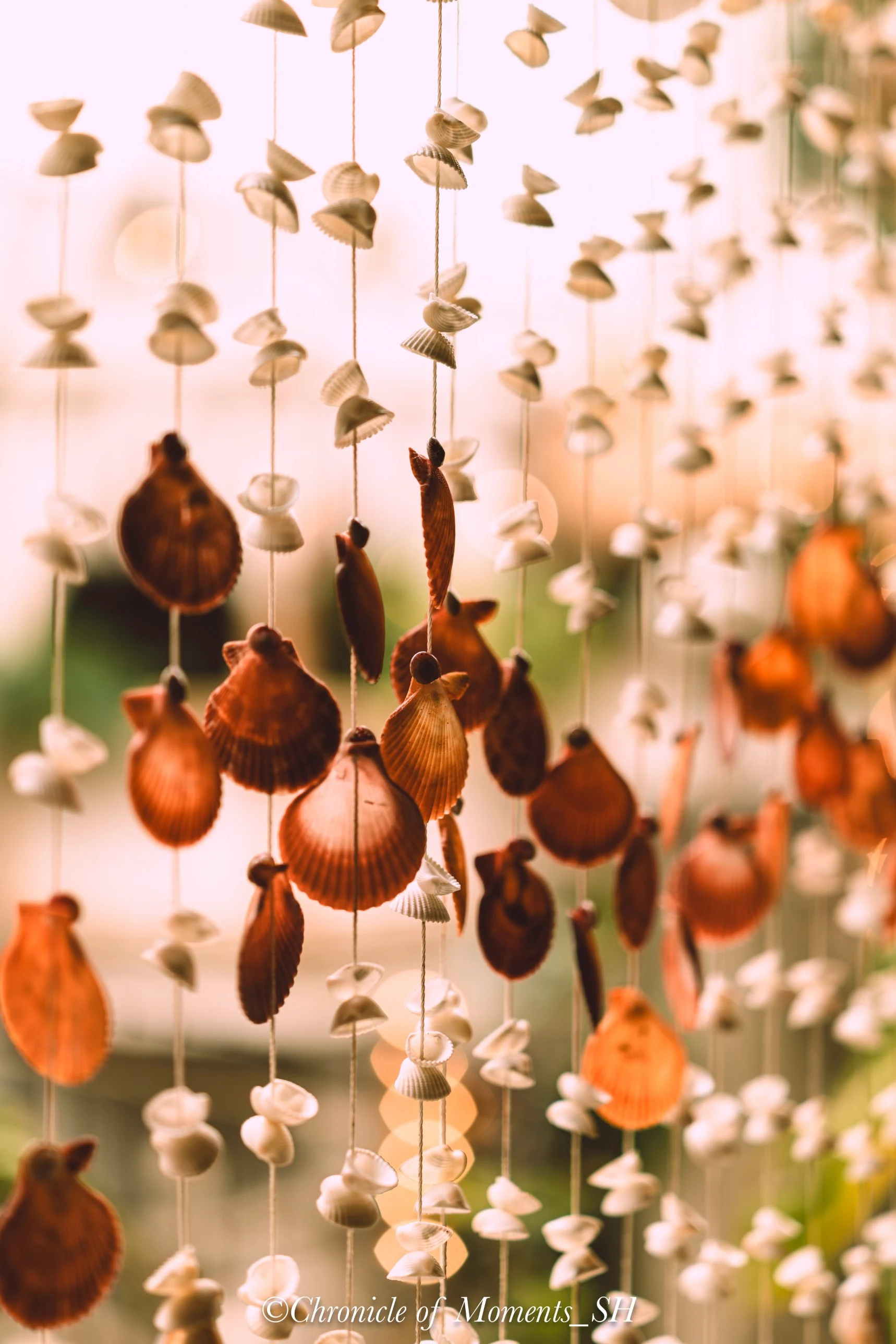
Canon EOS R5 Mark II · RF50mm F1.4 L VCM · 50mm · F1.4 · ISO 50 · 1/250 s
(Click the photo to view it at full size)
FAQ
Is indoor shooting hard with an f4 lens?
No. Raise ISO to 400–800 and slow the shutter speed to about 1/10 s, and many interiors are shootable. Since the shutter speed gets slow, steady your body or use image stabilization to prevent shake.
Which is better indoors, a prime or a zoom?
For gathering light alone, a prime that opens to f1.2–f1.8 has the edge. Many zooms are f2.8 models, one stop or more darker, but they have the advantage of changing the angle of view with one lens. Lineups differ by brand, so check the official site.
Is it always better to open the aperture all the way?
Not necessarily. At maximum aperture the in-focus range gets very shallow, and depending on the lens, sharpness can drop slightly. If there is enough light, try stopping down a step or two, compare the results, and find the value you like.
Does raising ISO hurt image quality a lot?
Noise does increase, but ISO 400–800 is a range most cameras can use without trouble. A blurred photo cannot be recovered, but noise can be reduced to some extent, so in dark interiors I recommend putting shake prevention first.
Make Your Own Photo Frame
The photos in this post have a frame (Classic Dark theme, 2% margin) that shows the camera, lens, focal length, aperture, shutter speed, and ISO under the photo. If you want to make the same look yourself, try ExifLens's EXIF Frame Generator. Upload a photo and it reads the EXIF data automatically to build the frame, and you can pick the theme and margin yourself.
Putting It Together
- In dim interiors, a lens with a low f-number helps you gather light.
- Many primes go f1.2–f1.8 and many zooms are f2.8; check exact specifications on the brand's official site.
- An f4 or slower lens can also shoot at around ISO 400–800 and 1/10 s.
- The slower the shutter speed, the more you need to watch out for shake.
Copyright Notice
All photos used in this post are works taken directly by the site operator (Chronicle of Moments_SH). Photographs are protected as photographic works under Article 4(1)(ix) of the Korean Copyright Act, and copyright arises from the moment of shooting without any registration or other procedure (Article 10(2)).
Without the copyright holder's prior permission, it is prohibited to reproduce the photos in this post (Article 16), to post or transmit them on blogs, forums, social media, or communities (public transmission, Article 18), or to modify or edit them into derivative works (Article 22). Removing or altering the copyright notice and frame in a photo can also infringe the right of attribution (Article 12) and the right to integrity (Article 13). Uses the law permits, such as fair quotation of a published work (Article 28) or use within a private or domestic scope (Article 30), are exceptions.
Unauthorized use can lead to injunction claims (Article 123) and damages claims (Article 125), and can be punished by imprisonment of up to 5 years or a fine of up to 50 million won (Article 136(1)). For-profit or habitual infringement can be punished even without a complaint (Article 140).
Photo-use inquiries: skysmoga@gmail.com
© Chronicle of Moments_SH. All rights reserved.