Back from a trip, sorting through the photos, there are always a few like this. Not a grand view, not a special composition, a street photo that feels a little plain to show anyone. Yet you cannot bring yourself to delete it. The moment you look at it, the air of the road you walked that day comes back with it.
This post contains six photos taken on the streets of Bangkok, Thailand, in December 2024 and May 2025. The dates, places, and times of day all differ, and on their own the photos are nothing special. Even so, every place I passed while traveling felt special to me, so I pressed the shutter as a kind of record, and I have kept every one of those photos to this day because I do not think a single one is useless. Going through the six photos and their shooting settings (EXIF) one by one, I want to sort out what street photography leaves you with.
Spreading Out the Six: One Afternoon on the Street
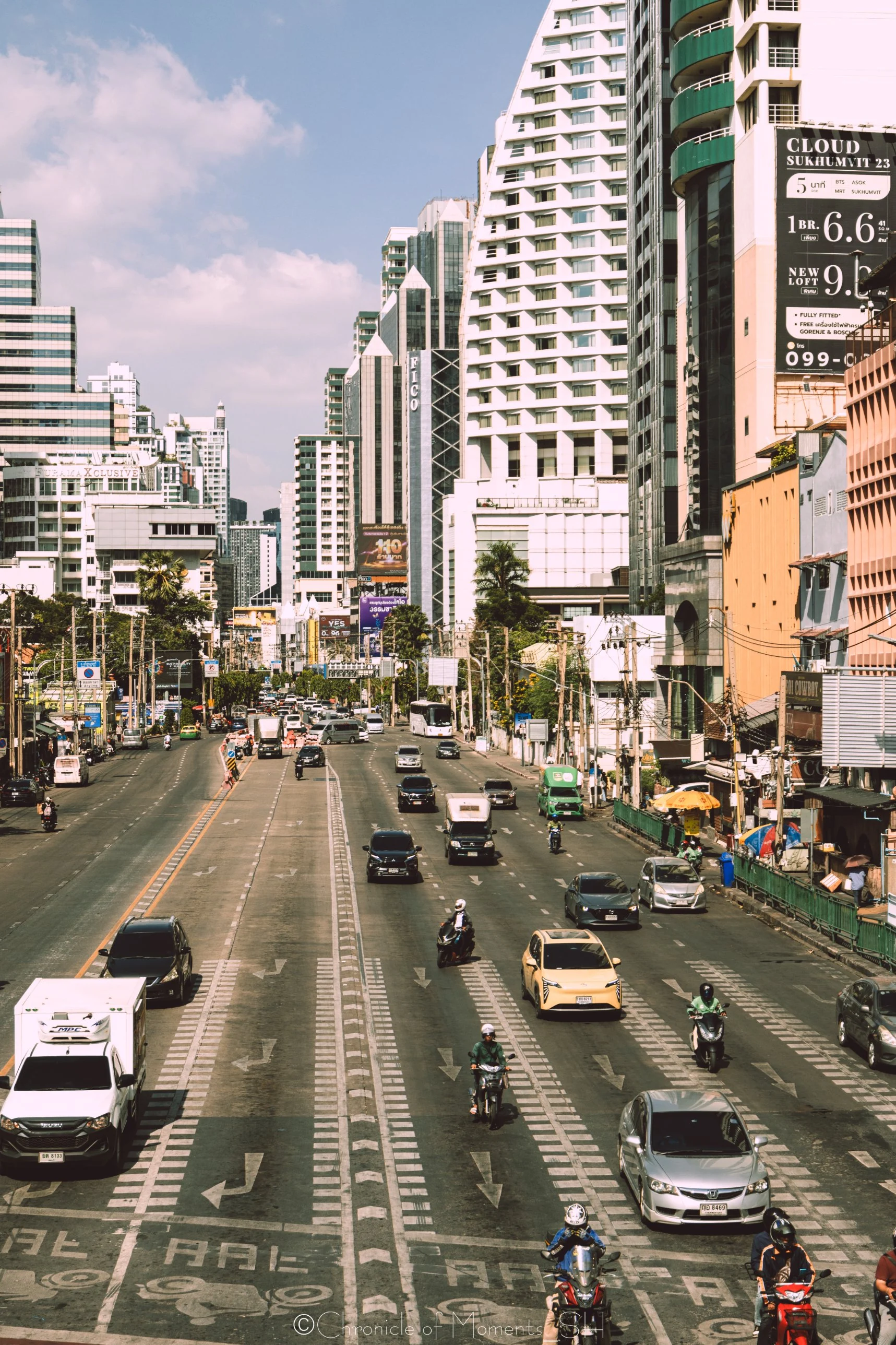
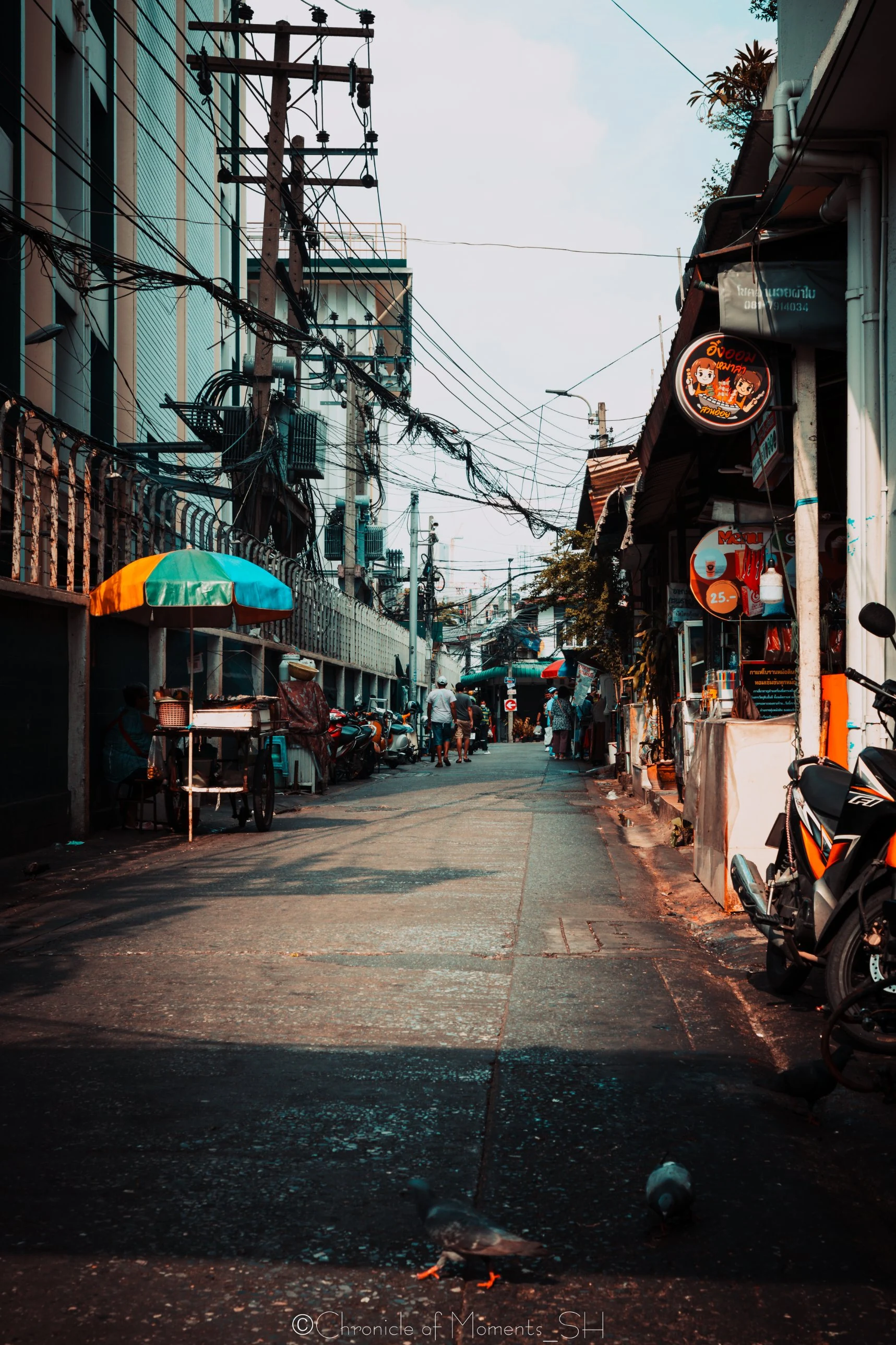
First, two photos from the afternoon of December 4, 2024. One is a wide-open main road, the other a narrow alley with power lines tangled overhead. They were taken only about 50 minutes apart.
(Click a photo to view it at full size)
The photo on the left was taken at 3:28 p.m. at f/2.8 and 1/3200 s. It is a main road in the afternoon sun, and converted to EV100 it comes to about 14.6, close to the 15 of the Sunny 16 rule for a clear day. In the same light, closing the aperture to f/8 would put the shutter speed at about 1/400 s. Whether to leave the aperture open and use a fast shutter, or stop down and use a slower one, comes down to how you want to remember the street.
The photo on the right is an alley at 4:18 p.m., shot at f/8 and 1/125 s. Its EV100 is about 13.0, roughly 1.6 stops darker than the main road. Less light reaches an alley between buildings, and since wires, signs, and walls all fall into one frame, I stopped down to f/8 to hold the front and back evenly. Same lens, same 35mm, yet the aperture values are completely different, and what I was looking at in that moment stays recorded in the settings.
You Can See How Fast the Sun Sinks in EV
Later that day, at 5:07 p.m., a road where motorbikes pass in a long line. The lens differs from the first two photos.
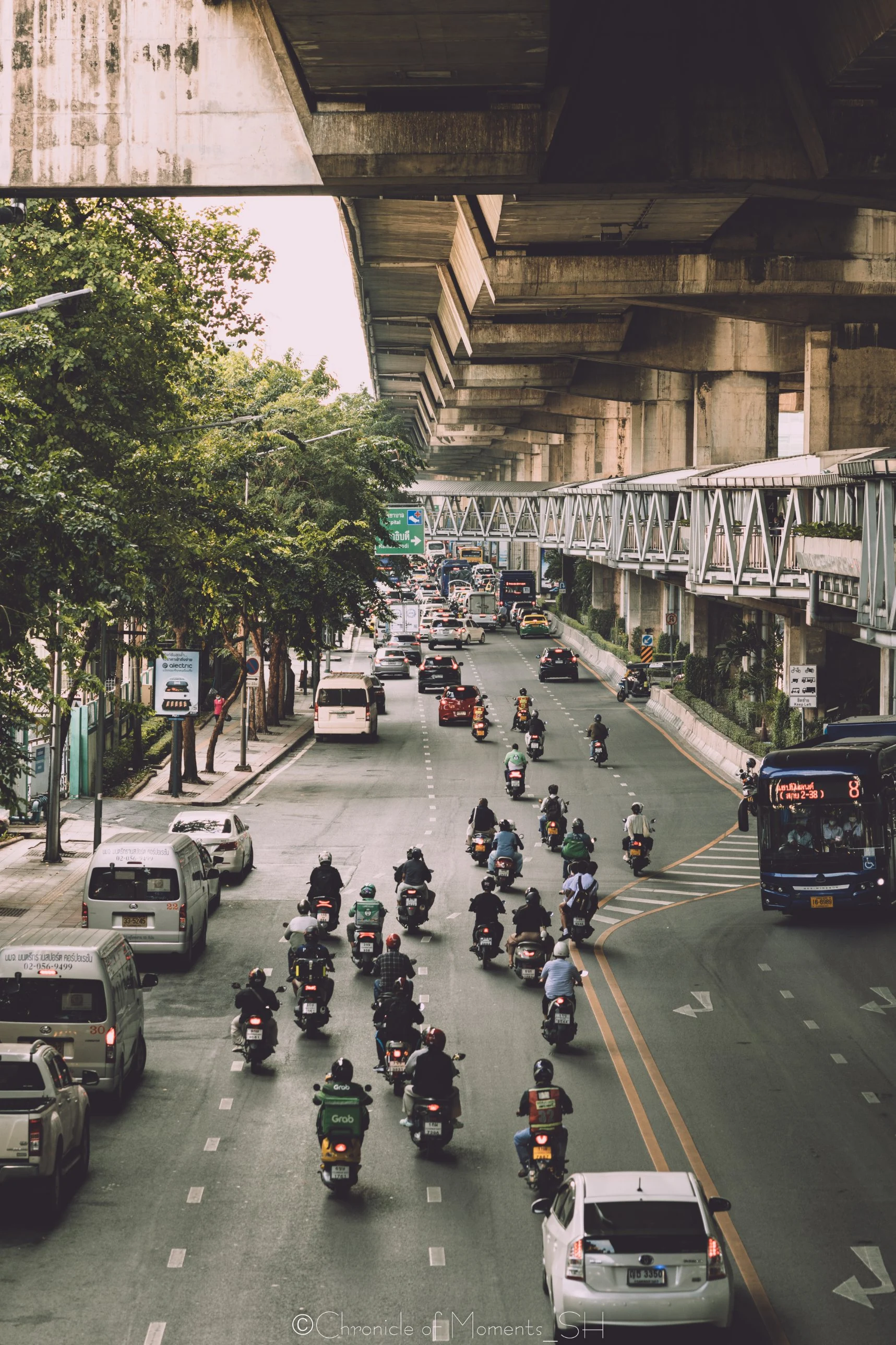
Canon EOS R7 · RF24-70mm F2.8 L IS USM · 70mm · F2.8 · ISO 100 · 1/160 s · 2024-12-04
(Click the photo to view it at full size)
This one was taken with the RF24-70mm pulled all the way to 70mm, at f/2.8 and 1/160 s. EV100 is about 10.3. Compared with the 14.6 at 3:28 p.m., the light dropped by more than 4 stops in under two hours. Viewed one at a time these are just streets on some afternoon, but line up the shooting times with the EXIF and you can read the speed of the setting sun as numbers. That feel is not reserved for people who have shot a great deal. It builds up on its own as you keep recording streets.
For reference, the R7 has an APS-C sensor, so 35mm is about 56mm in full-frame terms and 70mm is about 112mm. At 70mm, 1/160 s is faster than the 1/112 s guideline for handheld shooting, so I could press the shutter on a road full of moving motorbikes without worrying about shake. If the conversion is confusing, you can check it with the field-of-view calculator or the sensor size and crop factor guide.
When Night Falls, the Numbers Change Their Tune
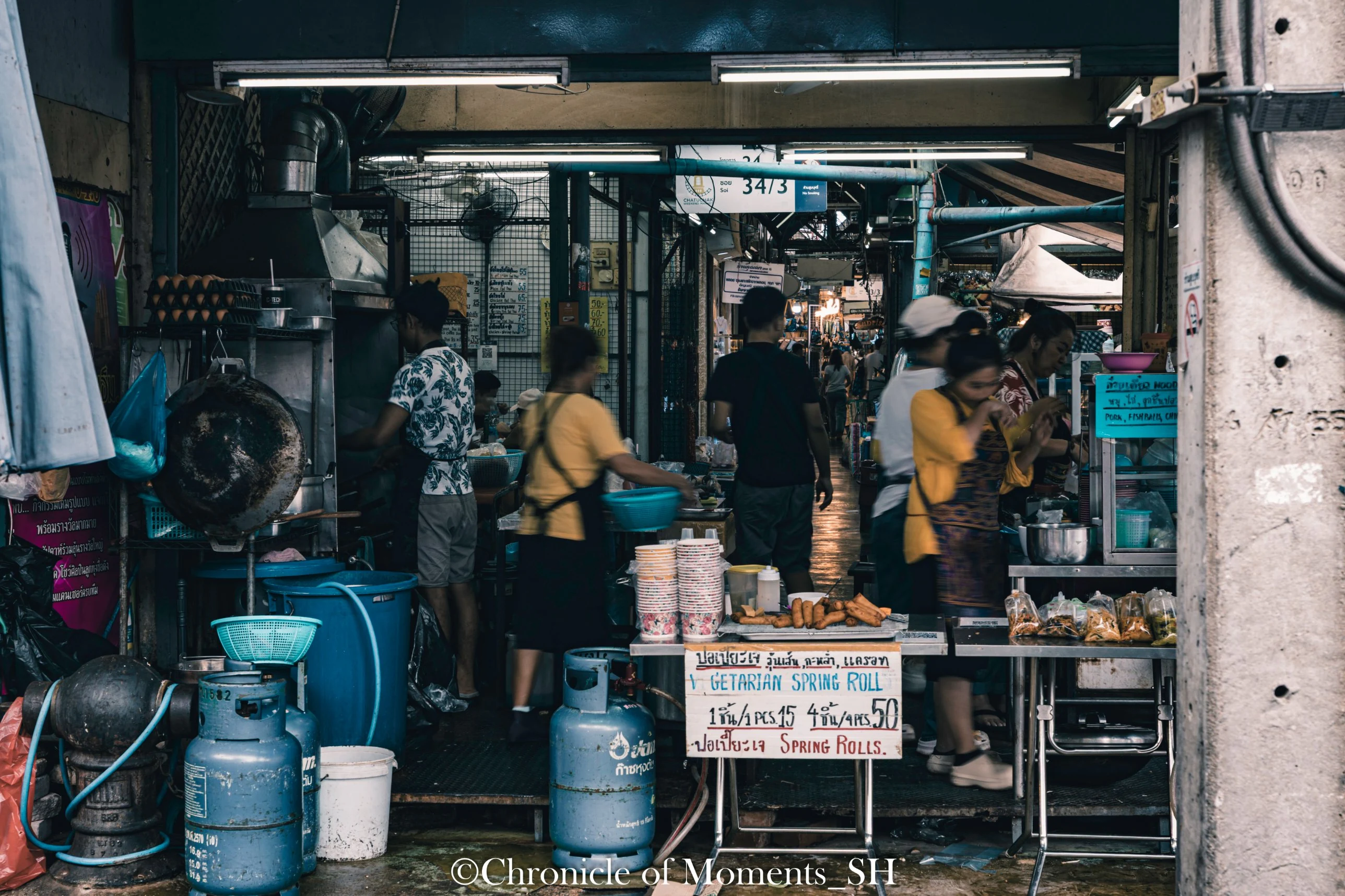
Two photos from the evening of May 25, 2025, taken at 7:29 p.m. and 7:32 p.m. One is a market stall, the other a road where taxis pass.
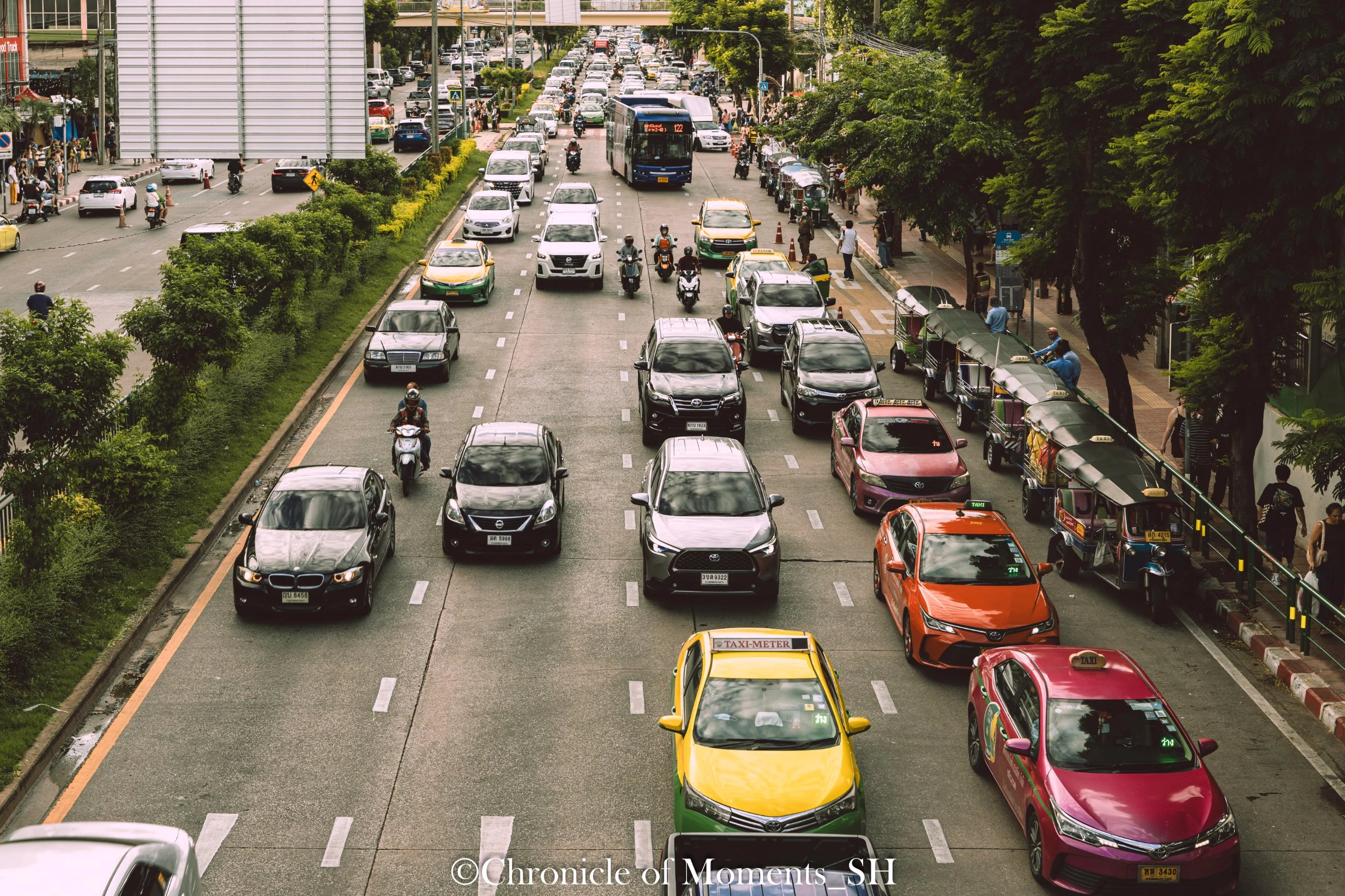
(Click a photo to view it at full size)
Both are f/5.6 and ISO 100, but the shutter speeds, 1/13 s and 1/80 s, differ by nearly 2.6 stops. In those three minutes I had moved to a different place, and the lighting at each place was different. The market stall is fairly dark at about EV100 8.7. Here 1/13 s is roughly 2 stops slower than the 1/56 s shake guideline for 56mm in full-frame terms, a speed at which moving people leave trails and unsteady hands can blur the whole frame. At a speed like this you have to brace your body and hold your breath as you press the shutter. Putting values into the exposure stops calculator makes it easy to see how the steps connect.
Lay the two side by side and you can also see that even the same evening gives each street its own kind of light. A market lined with stalls has lights scattered everywhere, while on a road with traffic, one or two sources such as headlights and street lamps lead the scene. Once you know this difference, you get a sense of what shutter speed to start with the moment you step onto a street.
The Middle of the Night: The Moment You Raise ISO
The last photo goes back a day, to 11:07 p.m. on December 3, 2024.
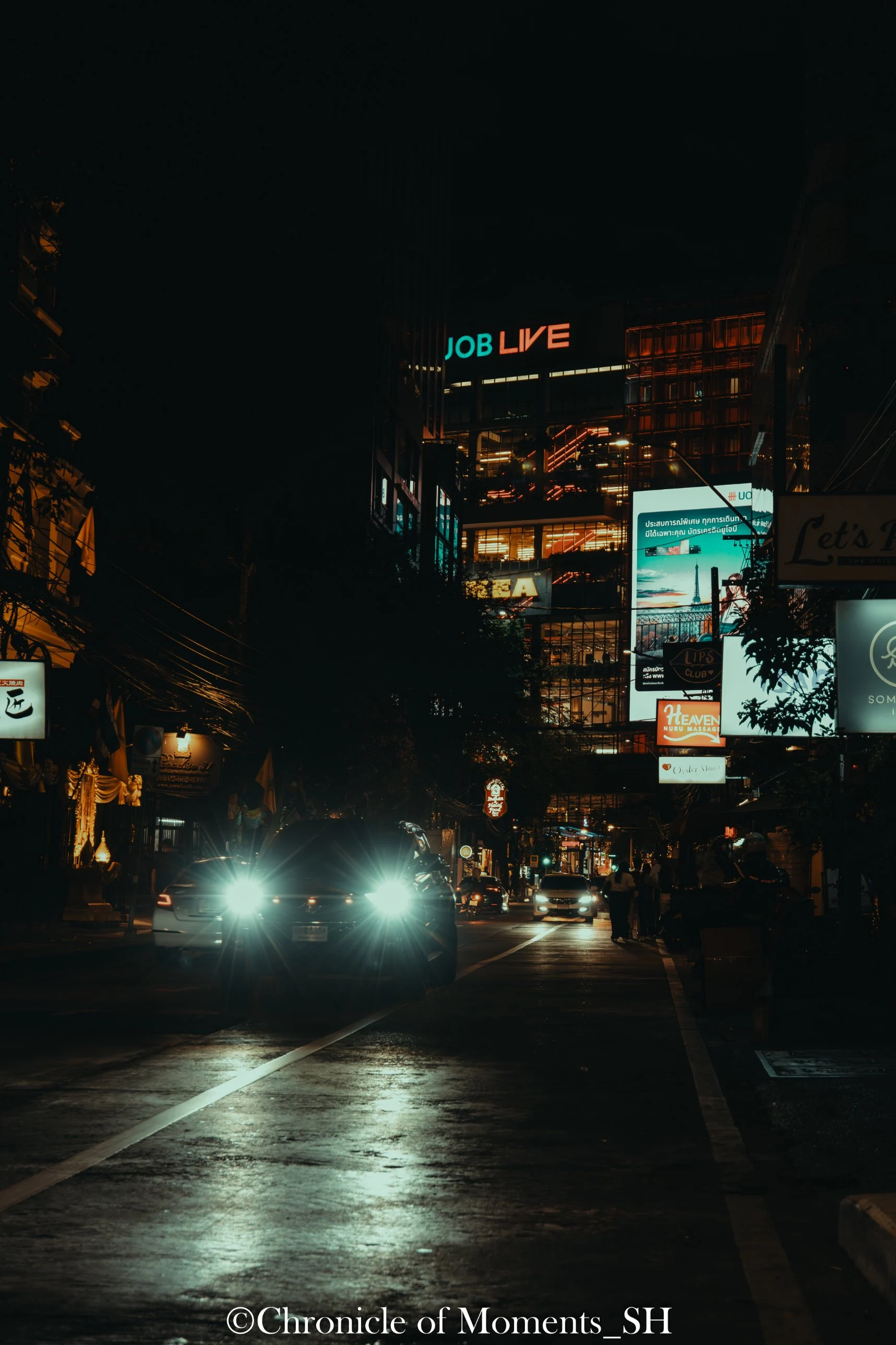
Canon EOS R7 · RF15-35mm F2.8 L IS USM · 35mm · F2.8 · ISO 1000 · 1/60 s · 2024-12-03
(Click the photo to view it at full size)
It is the only one of the six where I raised ISO from 100 to 1000. The aperture is wide open at f/2.8, and the shutter speed is 1/60 s, just past the shake guideline (1/56 s). EV100 comes to about 5.6. Against the 14.6 of the daytime road, this scene is 9 stops darker. In a place this dark, the basic order is to open the aperture, slow the shutter only as far as shake allows, and make up the rest with ISO. When night exposure feels hopeless, the night exposure calculator guide and low-light noise reduction settings can help.
So What Does Street Photography Leave You With?
Looking back over the six, I feel the habit of shooting left more with me than the photos themselves.
The first thing that stays is a record. Even a road you simply passed gets a date and time saved with it once you photograph it. Years later, just seeing the shooting time in the EXIF brings your route back: "so I was here at this hour that day." Everyone has photos of famous sights, but photos of ordinary streets like these are a record that exists only in my own trip.
The second is a feel for exposure. The street is a place where you can meet the midday main road, the shaded alley, dusk, stall lights, and the midnight street all within a day or two. Shoot scenes whose brightness runs from EV 14.6 to 5.6 yourself, and the exposure triangle stops being theory in a manual and becomes a tool familiar to your hands.
The third is an observing eye. Walking along, you start looking around: "the way those wires overlap is interesting," "the moment people pass under that light would be good." The same road is seen far more slowly and in far more detail with a camera in hand. As that observation builds up, the time you spend agonizing over composition shrinks. If you are torn between horizontal and vertical, how to choose between horizontal and vertical photos is also worth a look.
The last is an understanding of your gear. These six were shot with two lenses, the RF15-35mm and the RF24-70mm, and the wide angle suited the main road and the alley, while the compression at 70mm suited the line of motorbikes. If you are wondering which lens to pack for a trip, I compared them in prime or zoom lens for travel.
Street Etiquette and Safety
Street photography takes place in spaces where other people live their daily lives, so there are things to respect. As a rule, do not publish a photo in which a person's face is clearly visible without their consent. Avoid compositions that look into the inside of a shop or a home, and lower the camera right away if a vendor seems uncomfortable. Keep watching your surroundings so that you do not step into the roadway or block a lane where motorbikes pass because you are absorbed in shooting. At night, it is also wise to keep belongings secure so that pricey gear like a camera and lenses does not stand out.
When you put photos online, check the location data too. Smartphone photos often record GPS coordinates, so posting a photo taken near your lodging as it is can expose your movements. The photos in this post also had all shooting-location data removed before upload. The details are covered in GPS data in photos and privacy and the EXIF remover tool.
Checklist
- Have you worked out when the sun sets on the streets you will walk today, and which lens you will need at that hour?
- Have you set the camera's date and time to local time so every photo keeps its shooting time?
- Before stepping into a dark place, did you first check that your shutter speed is above the shake guideline?
- Have you decided to keep photos with a clearly visible face for yourself rather than publish them?
- Did you remove location data such as GPS before posting?
Common Mistake: Waiting Only for a Special Scene
The most common mistake in street photography is leaving the camera in the bag with the thought, "I'll shoot when something worth shooting shows up." Special scenes usually pass by when you are not ready. If you keep shooting ordinary streets, your camera settings become second nature, and when a truly good moment comes, your hands react first. Ordinary travel photos can make you wonder later, "why did I shoot this?", yet over time they often become the ones you look back at most.
Another is carrying daytime settings straight into night streets. As we saw, brightness within a single day can change by nearly 9 stops. If you shoot comfortably at f/8 and 1/125 s in daylight and keep the same settings in a dark alley, the photo will come out shaky or dark. You need the habit of rechecking all three exposure settings each time you move to a new place.
FAQ
What lens is good for street photography?
There is no single answer, but a lens around 35mm (full-frame equivalent) or a zoom ranging from wide to standard is used most. It is close to the view you have when walking, so it captures the atmosphere of the street naturally. Five of the six photos here were also shot at 35mm on APS-C.
I worry about strangers being photographed.
You can avoid publishing photos in which a person's face is clearly recognizable, and compose so that the street's atmosphere, not a person, is the subject. Portrait rights and photography rules differ by country, so it is wise to check the local atmosphere before you travel.
How should I organize ordinary travel photos?
The EXIF keeps the shooting date and time, so simply splitting them into folders by date is enough. If you add the destination name to the folder name, it stays easy to find years later, and the more photos you gather, the more fun it is to retrace them in time order.
How high can I raise ISO on night streets?
It depends on the camera, but if you keep to the order of opening the aperture, slowing the shutter to the shake limit, and only then raising ISO, you will get satisfying results most of the time. For this photo it was ISO 1000 on an APS-C sensor.
Putting It Together
Shooting ordinary streets, again and again, records the time of a trip, builds a feel for changing light, and creates the habit of observing the roads you walk. Lining up the EXIF of the six photos, the scene changed by 9 stops in one day, from EV100 14.6 at midday to 5.6 at midnight, and choosing aperture, shutter speed, and ISO afresh through that change was itself the practice of street photography. To learn more about exposure settings on the street, read the street photography exposure settings guide and how to read ISO, shutter, and aperture in EXIF next.
Copyright Notice
All photos used in this post are works taken directly by the site operator (Chronicle of Moments_SH). Photographs are protected as photographic works under Article 4(1)(ix) of the Korean Copyright Act, and copyright arises from the moment of shooting without any registration or other procedure (Article 10(2)).
Without the copyright holder's prior permission, it is prohibited to reproduce the photos in this post (Article 16), to post or transmit them on blogs, forums, social media, or communities (public transmission, Article 18), or to modify or edit them into derivative works (Article 22). Removing or altering the copyright notice and frame in a photo can also infringe the right of attribution (Article 12) and the right to integrity (Article 13). Uses the law permits, such as fair quotation of a published work (Article 28) or use within a private or domestic scope (Article 30), are exceptions.
Unauthorized use can lead to injunction claims (Article 123) and damages claims (Article 125), and can be punished by imprisonment of up to 5 years or a fine of up to 50 million won (Article 136(1)). For-profit or habitual infringement can be punished even without a complaint (Article 140).
Photo-use inquiries: skysmoga@gmail.com
© Chronicle of Moments_SH. All rights reserved.