I think many people, myself included, assume landscapes are shot with a wide-angle lens. In this post I want to explain how landscape photos are captured differently with wide, standard, and telephoto lenses.
But when I picked the photos for this post and checked their EXIF, 6 of the 8 turned out to be full-frame equivalent 41–77mm. They were landscape photos taken without a wide-angle lens. Let's follow the 8 photos below and go through the differences between lenses.
Why a Wide-Angle Lens Is Treated as the Default for Landscapes
People prefer wide-angle lenses to fit a lot into one photo. On full frame, a 15mm lens has a diagonal field of view of about 111 degrees, 24mm about 84 degrees, 50mm about 47 degrees, and 85mm about 29 degrees. Even standing in the same spot, a wide angle fits a much broader scene into one frame.
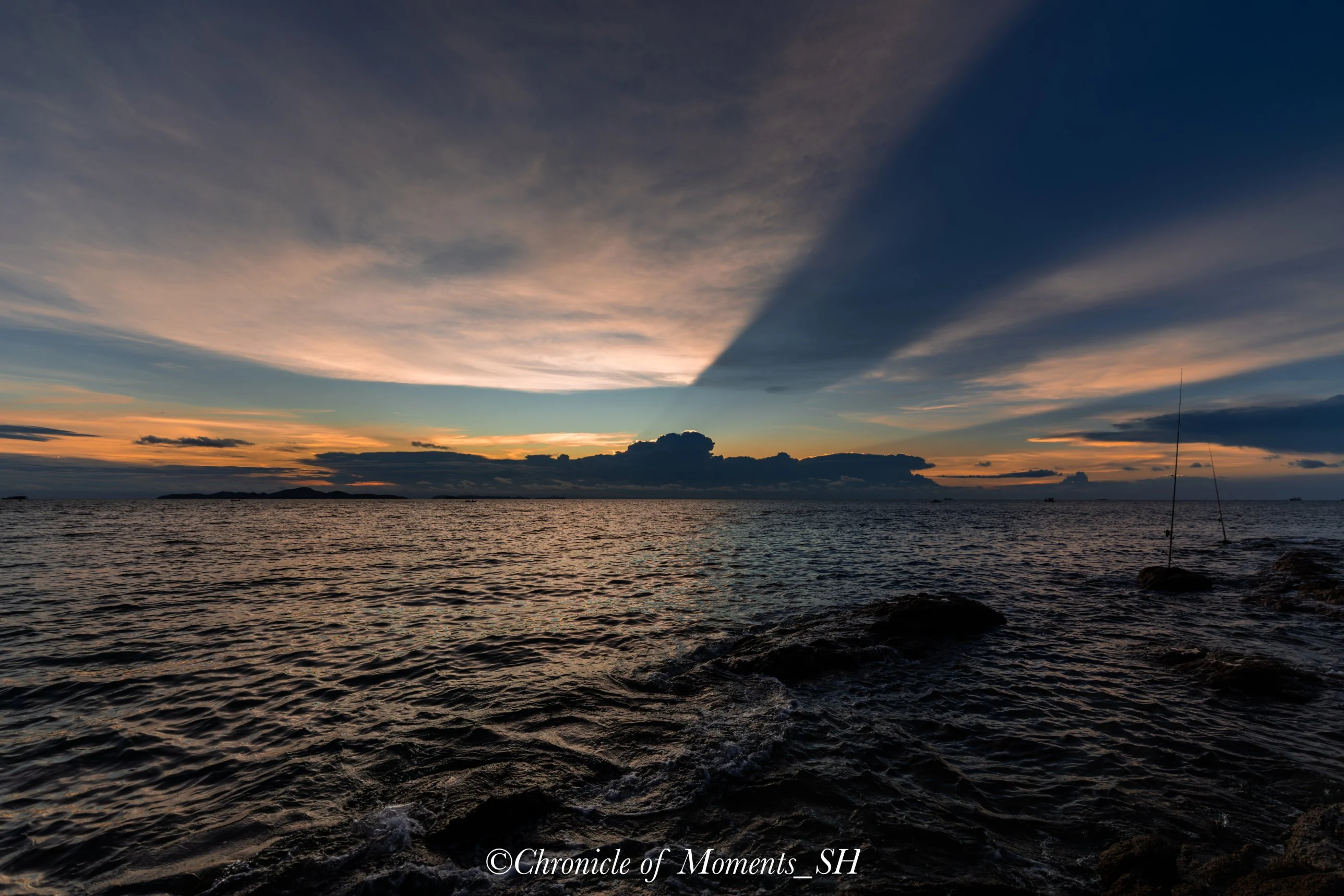
① Canon EOS R5 Mark II · RF15-35mm F2.8 L IS USM · 15mm · f/2.8 · 1/320 s · ISO 50
(Click the photo to view it at full size)
This photo brings the sky, clouds, horizon, waves, and rocks all into one frame. It is easy to include a near foreground and a far sky together, and at the same distance and the same aperture, the shorter the focal length, the deeper the depth of field, which also makes it easier to get the front and back sharp. Add the fact that landscapes are broad scenes, and it is natural that the formula "landscape = wide angle" appears.
However, when you fit a lot into one photo, it is easy to lose your intent. As elements in the frame increase, the eye scatters in many directions, and what the photo is trying to show becomes blurry.
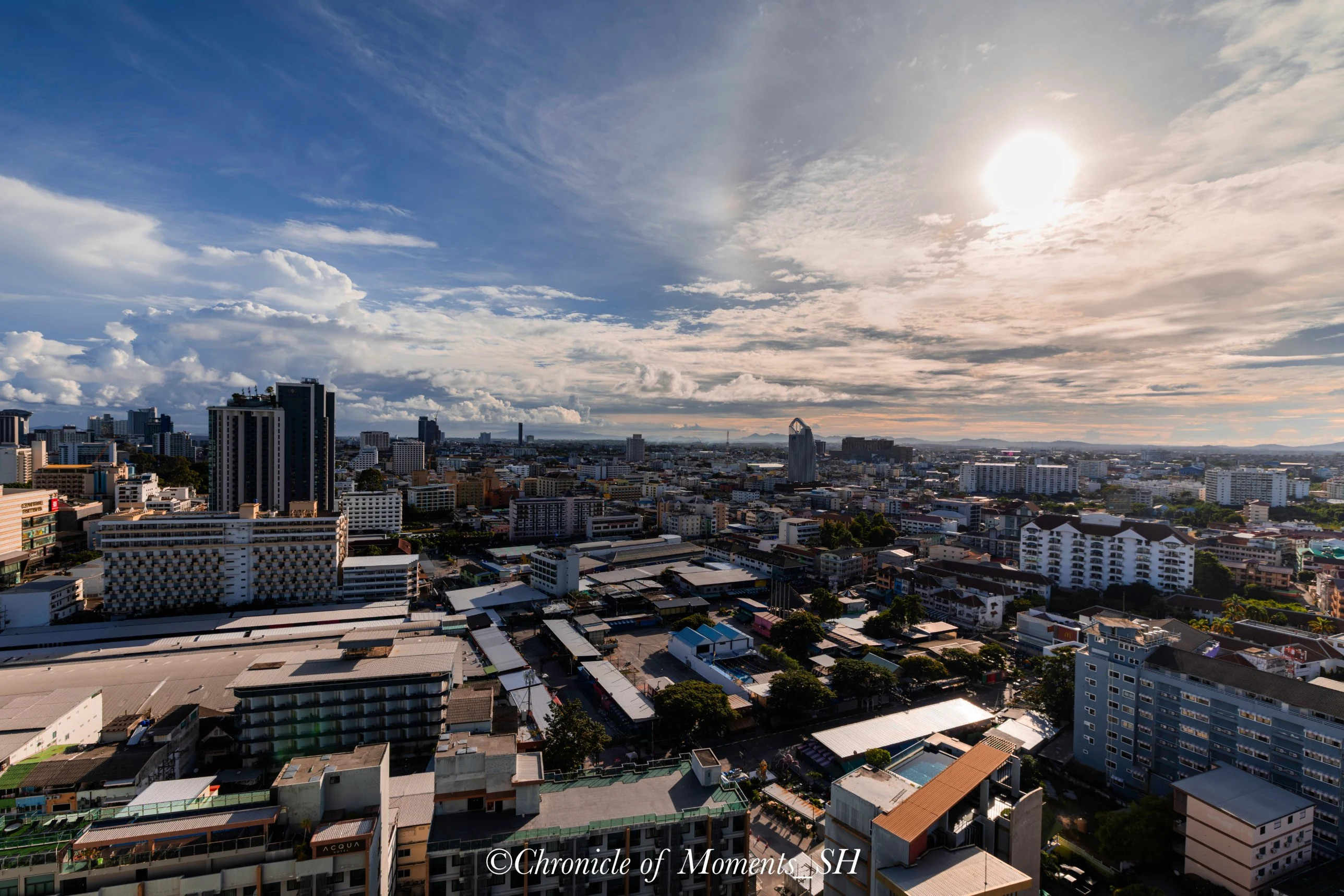
② Canon EOS R5 Mark II · RF15-35mm F2.8 L IS USM · 15mm · f/5.6 · 1/1250 s · ISO 100
(Click the photo to view it at full size)
This is a city seen from above. Since the sky, sun, buildings, and roads all fit in, if you don't decide what the main subject is, the eye has nowhere to go. The burden of tidying up unneeded objects that come in at the edges grows too.
Of course there are clear situations where a wide angle is right: a narrow space where you can't step back, when you want both sky and ground in one frame, or when you want to emphasize the sense of distance between foreground and background. And if your purpose in shooting isn't necessarily to put in some intent, but simply that it looks pretty or to keep how it looked at the moment you shot, there's no problem at all with capturing it wide.
Wide, Standard, Telephoto: How Scenery Gets Captured
| Type | Full-frame equivalent focal length | Diagonal field of view (examples) | What it does in landscapes | Watch out for |
|---|---|---|---|---|
| Wide angle | about 35mm and below | 15mm: about 111° / 24mm: about 84° | Wide space and foreground and background in one frame | Many elements, so intent easily blurs |
| Standard | about 35–70mm | 50mm: about 47° | Natural composition close to what the eye sees | You have to choose what to include |
| Telephoto | about 70mm and above | 135mm: about 18° | Pick part of a distant scene and compress the background | Watch for shake, secure shutter speed |
The dividing lines differ a little from person to person. If you wonder what angle of view your lens has, you can check with the Camera Field of View Calculator. The criteria for choosing wide vs. telephoto are also summarized in the Wide-Angle vs. Telephoto Lens Guide.
The Focal Length Shown on a Photo vs. the Equivalent Focal Length
Comparing the focal length written in EXIF as is can cause misunderstanding. Three of the photos in this post were shot with the Canon EOS R7, which has an APS-C sensor, and with APS-C you multiply the displayed focal length by about 1.6 to get the same angle of view as full frame. The same RF15-35mm lens used at 15mm on the R5 Mark II is an ultra-wide, but photos ③ and ④, used at 31–35mm on the R7, are standard angles of view at 50–56mm equivalent. You can check a photo's EXIF right away by uploading it to ExifLens.
| Photo | Camera | EXIF focal length | Full-frame equivalent (approx.) | Type |
|---|---|---|---|---|
| ① Sunset sky and sea | Canon EOS R5 Mark II | 15mm | 15mm | Wide |
| ② City view | Canon EOS R5 Mark II | 15mm | 15mm | Wide |
| ③ Sky and architecture | Canon EOS R7 | 31mm | 50mm | Standard |
| ④ Sea framed by leaves | Canon EOS R7 | 35mm | 56mm | Standard |
| ⑤ Yacht between islands | Canon EOS R5 Mark II | 41mm | 41mm | Standard |
| ⑥ Rain far away | Canon EOS R5 Mark II | 61mm | 61mm | Standard |
| ⑦ Anchored boat | Canon EOS R5 Mark II | 70mm | 70mm | Standard to telephoto |
| ⑧ Tower across the river | Canon EOS R7 | 48mm | 77mm | Leaning telephoto |
If you wonder how to convert, see the Crop Factor Calculator and the Sensor Size and Crop Factor Guide.
Scenery Captured at Standard Angles
The standard angle of view is said to feel similar to the scene as seen by eye. Because the frame doesn't open all at once the way a wide angle does, the photographer decides first what to include and what to leave out.
③ 50mm equivalent: Focusing on one thing
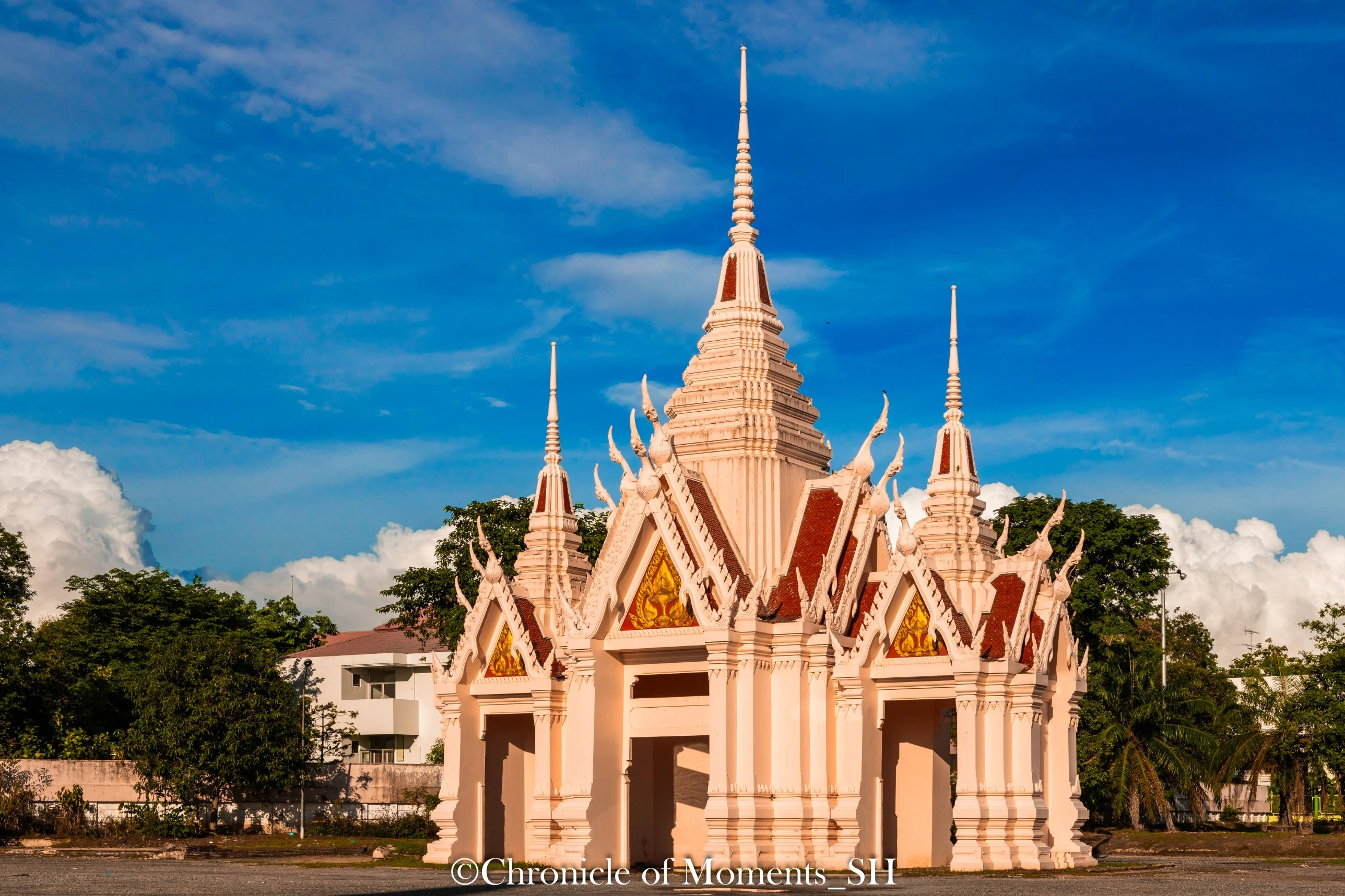
③ Canon EOS R7 · RF15-35mm F2.8 L IS USM · 31mm · f/5.6 · 1/2000 s · ISO 100
(Click the photo to view it at full size)
The building sits in the middle, with a large share given to the sky. Surrounding trees and buildings are visible too, but one thing dominates the frame, so it is clear what the photo is of. A standard angle doesn't exaggerate the foreground as much as a wide angle, so the shape of the building is captured stably.
④ 56mm equivalent: A landscape with a foreground
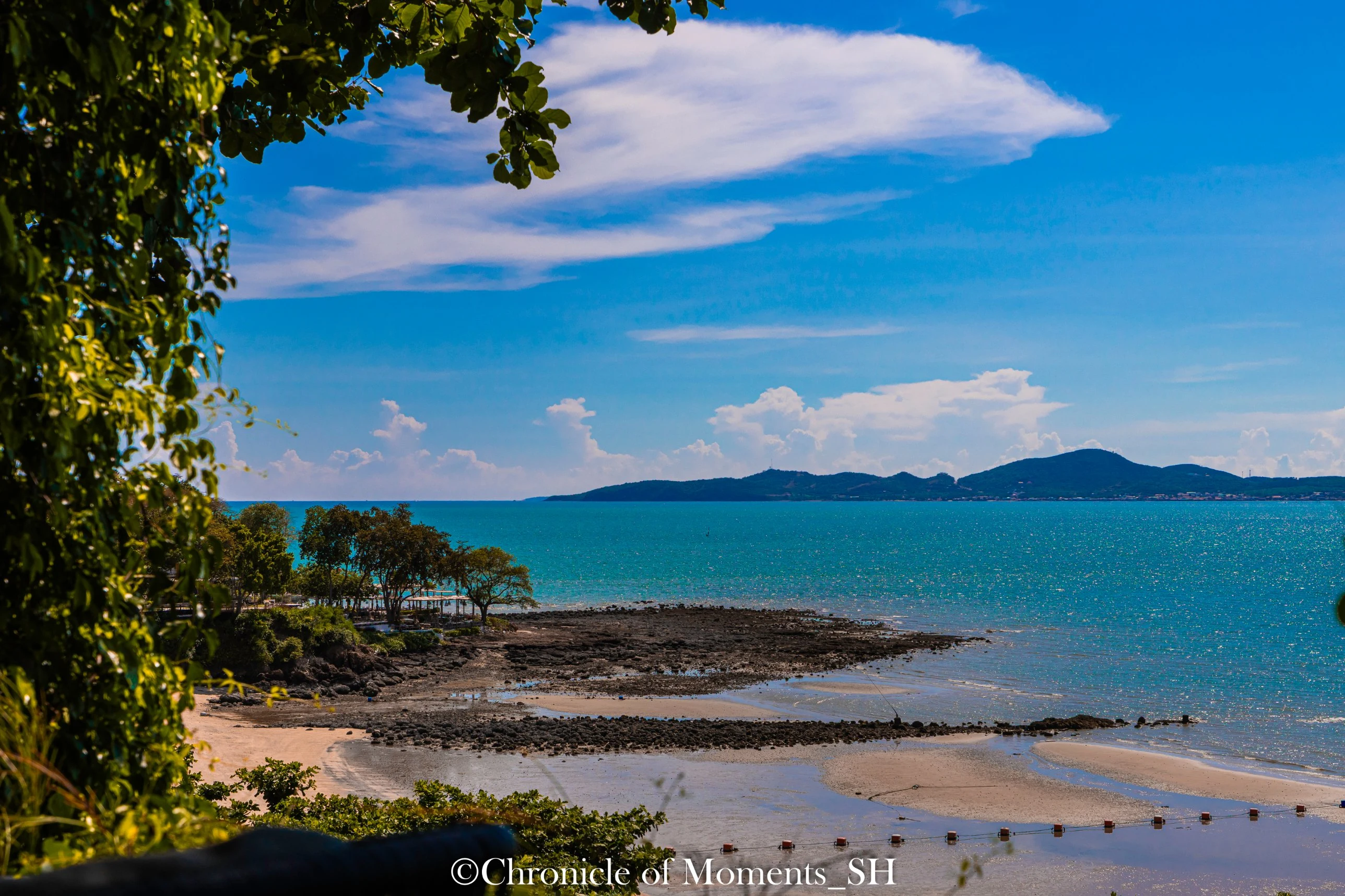
④ Canon EOS R7 · RF15-35mm F2.8 L IS USM · 35mm · f/2.8 · 1/4000 s · ISO 100
(Click the photo to view it at full size)
Leaves sit on the left, and beyond them you can see the sea and distant mountains. The leaves act as a frame, so the eye moves naturally from the leaves to the sea and then to the distant mountains. With a foreground, even a standard angle gets a sense of depth.
There are also scenes where the sky feels wide enough even without shooting wide.
⑤ 41mm equivalent: Composition made by emptiness
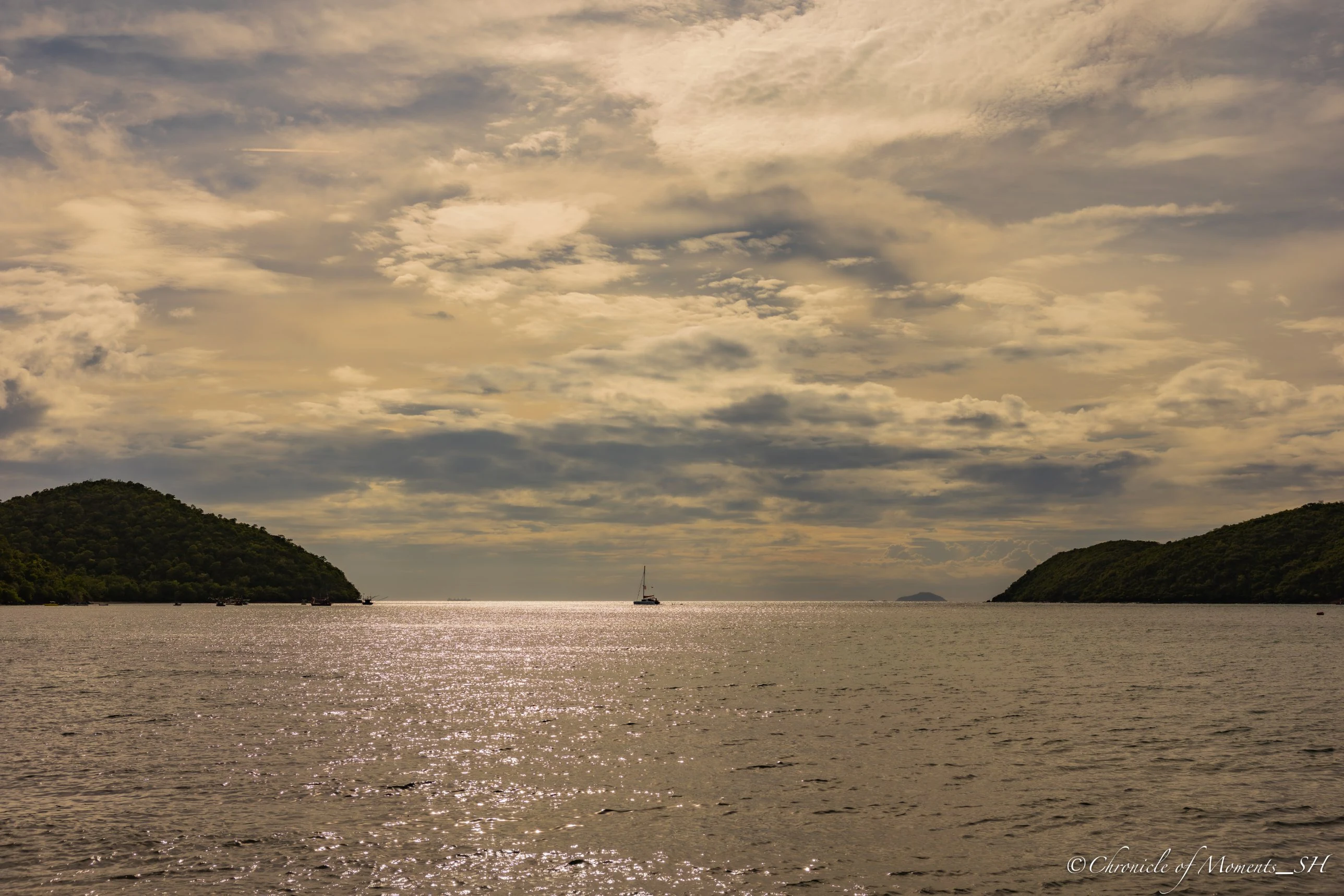
⑤ Canon EOS R5 Mark II · RF24-70mm F2.8 L IS USM · 41mm · f/5.6 · 1/3200 s · ISO 100
(Click the photo to view it at full size)
A small yacht appears between islands on both sides. Even without a wide angle, I could capture the sky and water surface broadly enough, and because most of the frame is empty, the small yacht becomes the main subject.
Zoom in a little more and you can pick out only the part you want to see from a distant scene.
⑥ 61mm equivalent: Picking a distant scene
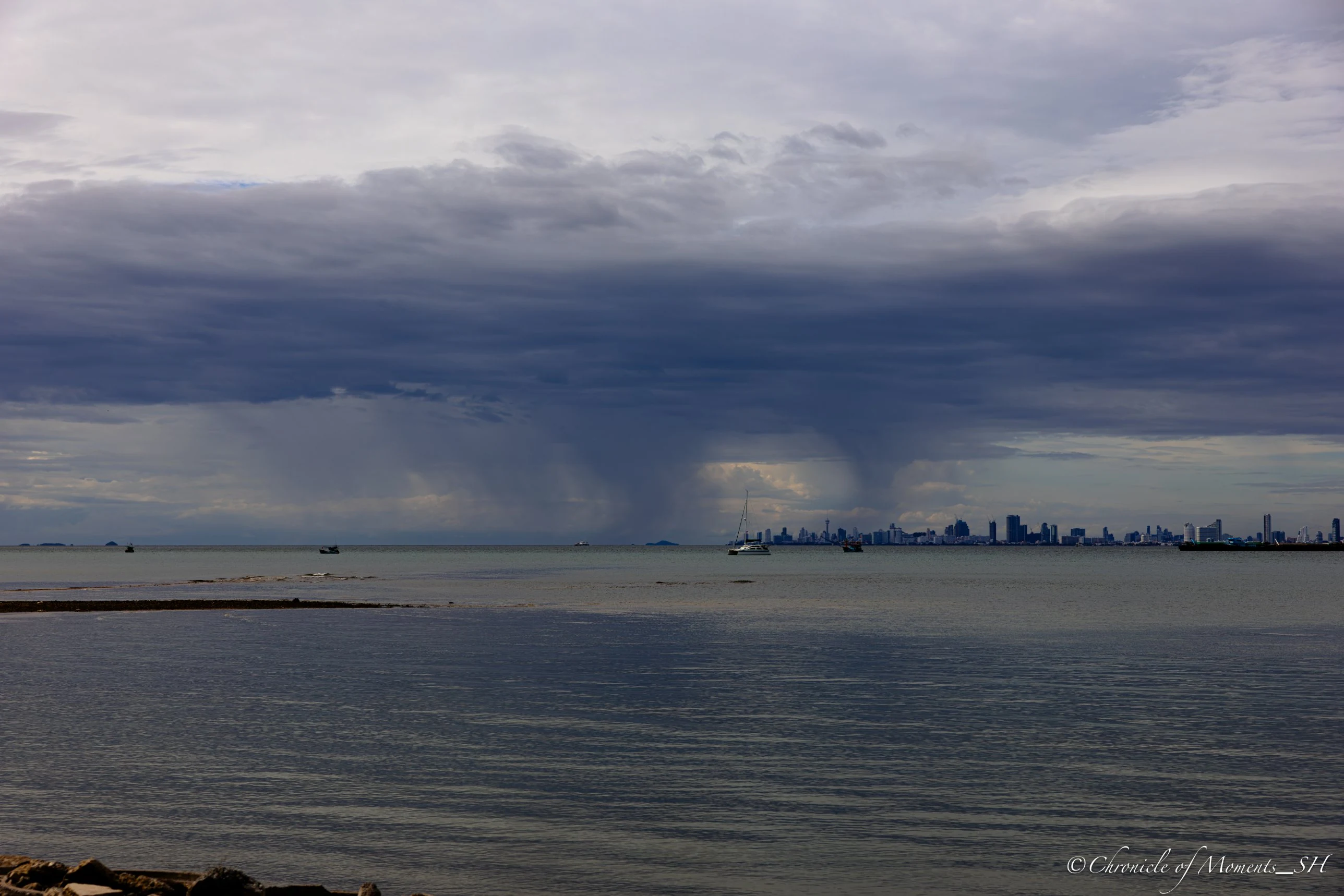
⑥ Canon EOS R5 Mark II · RF24-70mm F2.8 L IS USM · 61mm · f/5.6 · 1/1000 s · ISO 100
(Click the photo to view it at full size)
This photo captures a column of rain far away together with the city skyline. With a wide angle, more of the water surface in front would have come in and scattered the eye. I picked only the part I wanted to see.
What Changes Past 70mm
As the angle of view narrows, less comes into the frame, so the background gets simpler, and the sense of distance between background and subject looks compressed closer. In return, you become more sensitive to shake, so you need to secure a generous shutter speed.
⑦ 70mm equivalent: One subject and a simple background
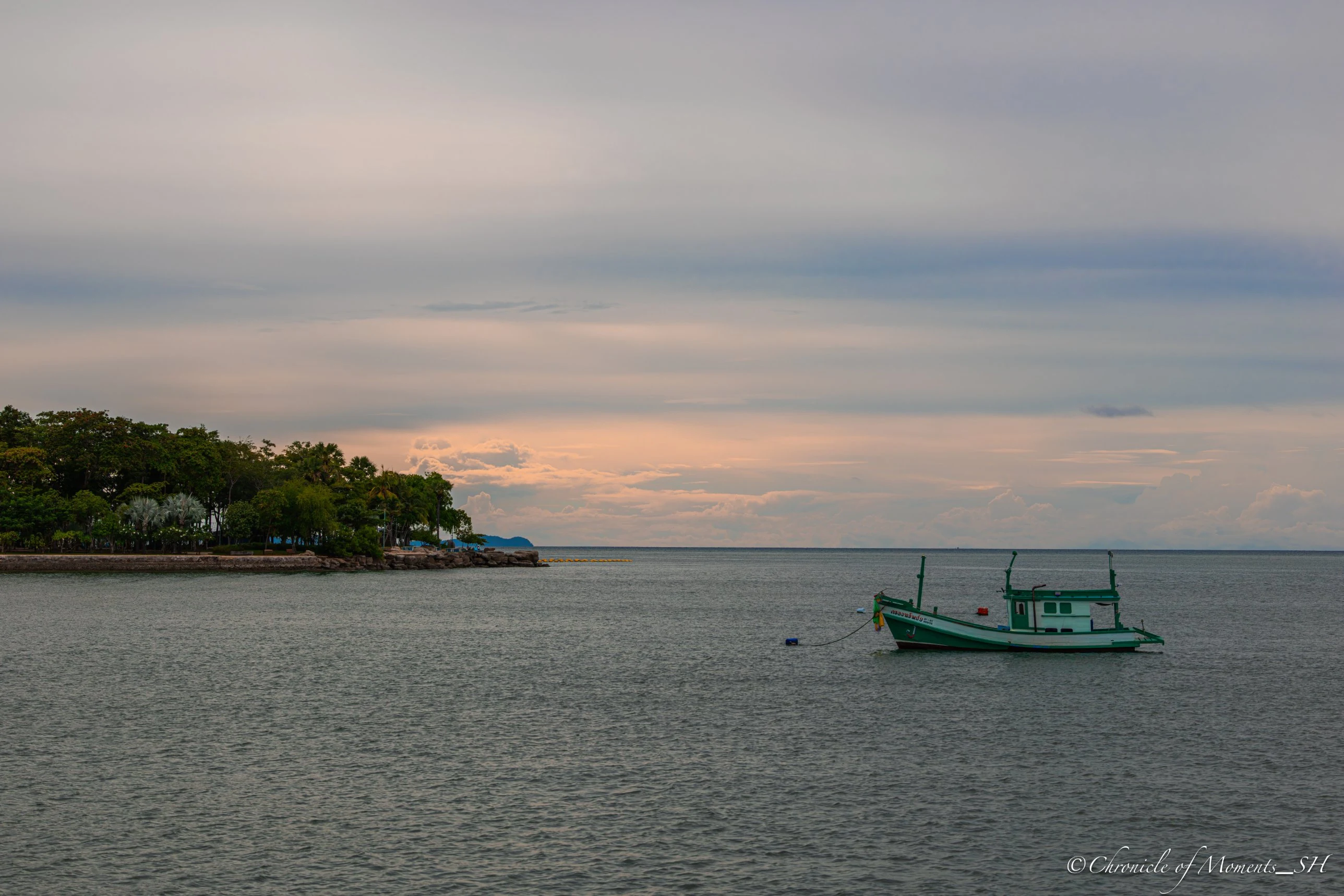
⑦ Canon EOS R5 Mark II · RF70-200mm F2.8 L IS USM · 70mm · f/5.6 · 1/400 s · ISO 50
(Click the photo to view it at full size)
A composition that leaves only one boat, a forested island, and sky. Even though it's a landscape, there is one clear subject like in a portrait. I shot this at 1/400 s, which at 70mm is far faster than the 1 / focal length rule (about 1/70 s).
⑧ 77mm equivalent: Compressing from a distance
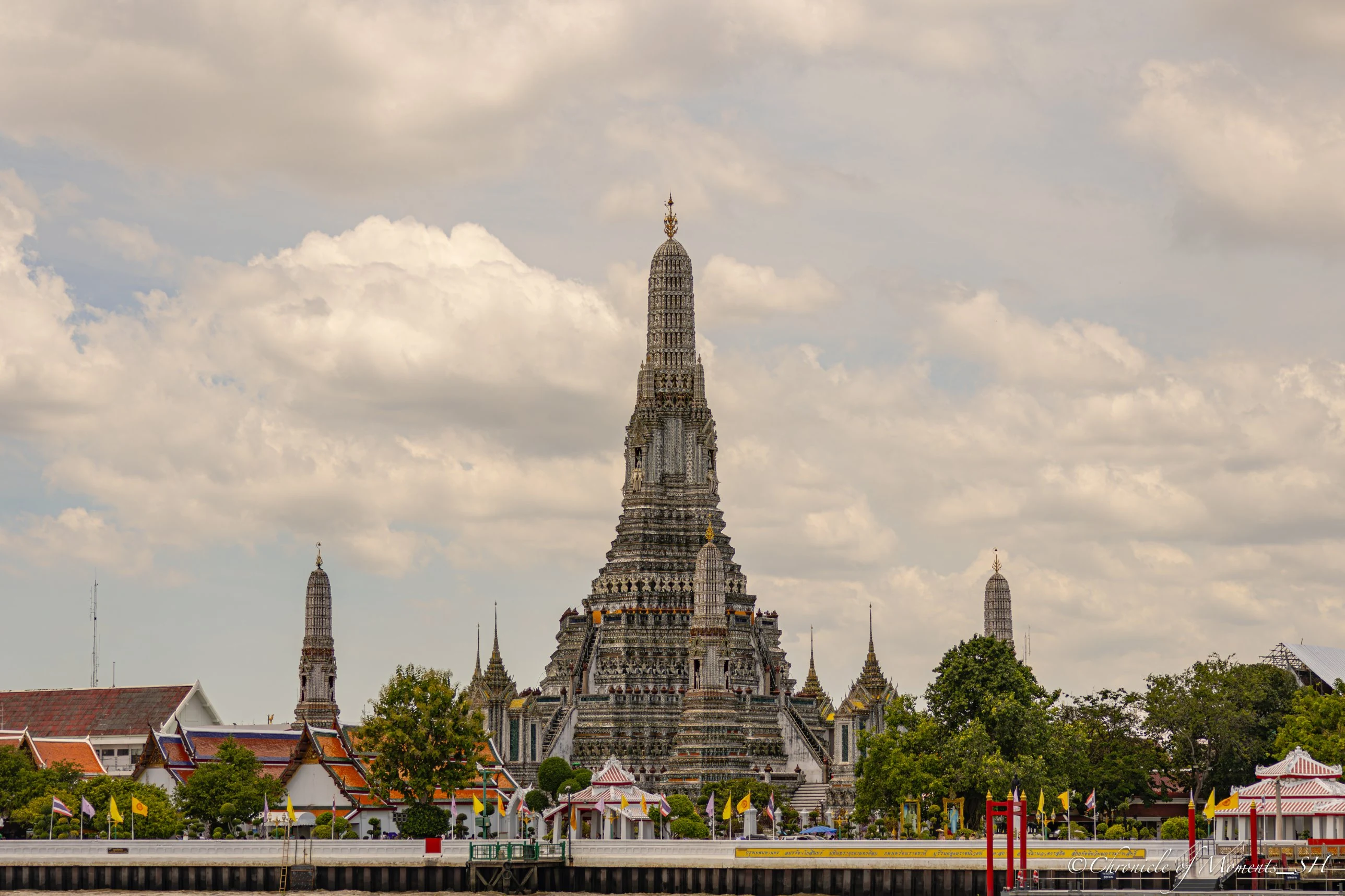
⑧ Canon EOS R7 · RF24-70mm F2.8 L IS USM · 48mm · f/2.8 · 1/3200 s · ISO 100
(Click the photo to view it at full size)
This gathers the tower across the river and the surrounding buildings under the clouds. When you shoot from far away with an angle close to telephoto, the distance between the buildings and the surrounding trees looks compressed, so the tower feels much bigger and more solid. A telephoto is also a lens that pulls in a distant landscape and compresses it.
Four Things That Change with the Lens for the Same Scenery
- Angle of view: decides whether you capture wide or pick out a part.
- Perspective: a wide angle makes the distance between foreground and background feel large; a telephoto looks compressed.
- Depth of field: at the same distance and the same aperture, the shorter the focal length, the deeper the depth of field. The Hyperfocal Distance Guide makes this easier to understand.
- Tidying the composition: with a wide angle you have to watch the edges; with a telephoto, shake and shutter speed.
Checklist
- Have you settled in one sentence what you want this photo to show?
- Are there no unneeded objects coming in at the edges of the frame?
- Is there something that can serve as a foreground? (leaves, rocks, a railing, etc.)
- If you step back or forward a step or two from where you stand, wouldn't there be a better composition?
- If you use a telephoto, have you secured a shutter speed that avoids shake?
Common Mistake: Wide Angle Because It's a Landscape
If you lock in a wide angle just because it's a landscape, you easily end up with a photo with too many elements where what you shot is blurry. Conversely, shooting only distant subjects with a telephoto can lose the broad feeling of a landscape. It is better not to choose the lens first, but to decide the intent you want to capture and then pick the angle of view that fits.
FAQ
Can I use a telephoto lens for landscapes?
Yes. It is actually advantageous for picking part of a distant landscape and showing it with the background compressed. Photos ⑦ and ⑧ in this post are examples.
If I use only one lens, which angle of view is good?
It depends on the scene you shoot. Of the 8 photos in this post, 4 were shot with the 15-35mm zoom, 3 with the 24-70mm zoom, and 1 with the 70-200mm zoom. Just as the same 15-35mm lens was a wide angle on a full-frame body and a standard angle on an APS-C body, it is best to choose looking at the lens and body combination together.
How should I read focal length on an APS-C camera?
The displayed focal length multiplied by about 1.6 is the full-frame equivalent focal length. Even the same lens gives a different angle of view depending on sensor size.
When is a wide-angle lens really necessary?
In a narrow space where you can't step back, when you must fit both sky and ground into one frame, or when you want to emphasize the sense of distance between foreground and background.
Putting It Together
A landscape doesn't mean a wide angle is the right answer. Wide is good for capturing broadly, standard is good for showing one scene naturally, and telephoto is good for picking only the part you need and compressing it. Before choosing a lens, decide first what you want to show with this photo.
Copyright Notice
All photos used in this post are works taken directly by the site operator (Chronicle of Moments_SH). Photographs are protected as photographic works under Article 4(1)(ix) of the Korean Copyright Act, and copyright arises from the moment of shooting without any registration or other procedure (Article 10(2)).
Without the copyright holder's prior permission, it is prohibited to reproduce the photos in this post (Article 16), to post or transmit them on blogs, forums, social media, or communities (public transmission, Article 18), or to modify or edit them into derivative works (Article 22). Removing or altering the copyright notice and frame in a photo can also infringe the right of attribution (Article 12) and the right to integrity (Article 13). Uses the law permits, such as fair quotation of a published work (Article 28) or use within a private or domestic scope (Article 30), are exceptions.
Unauthorized use can lead to injunction claims (Article 123) and damages claims (Article 125), and can be punished by imprisonment of up to 5 years or a fine of up to 50 million won (Article 136(1)). For-profit or habitual infringement can be punished even without a complaint (Article 140).
Photo-use inquiries: skysmoga@gmail.com
© Chronicle of Moments_SH. All rights reserved.