They say autumn is a great season for photos, but once you pick up the camera it is often hard to know what to shoot and how. The sky is high and clear, yet it looks flat in the picture; the flowers are lovely, yet the background comes out a mess.
This article uses 8 photos I took in the autumns of 2024 and 2025 to go through 6 scenes you can capture in autumn, along with the shooting settings (EXIF) for each. It covers cosmos, a path covered in fallen leaves, a dragonfly, a structure against the sky, and a pavilion with an airplane passing overhead.
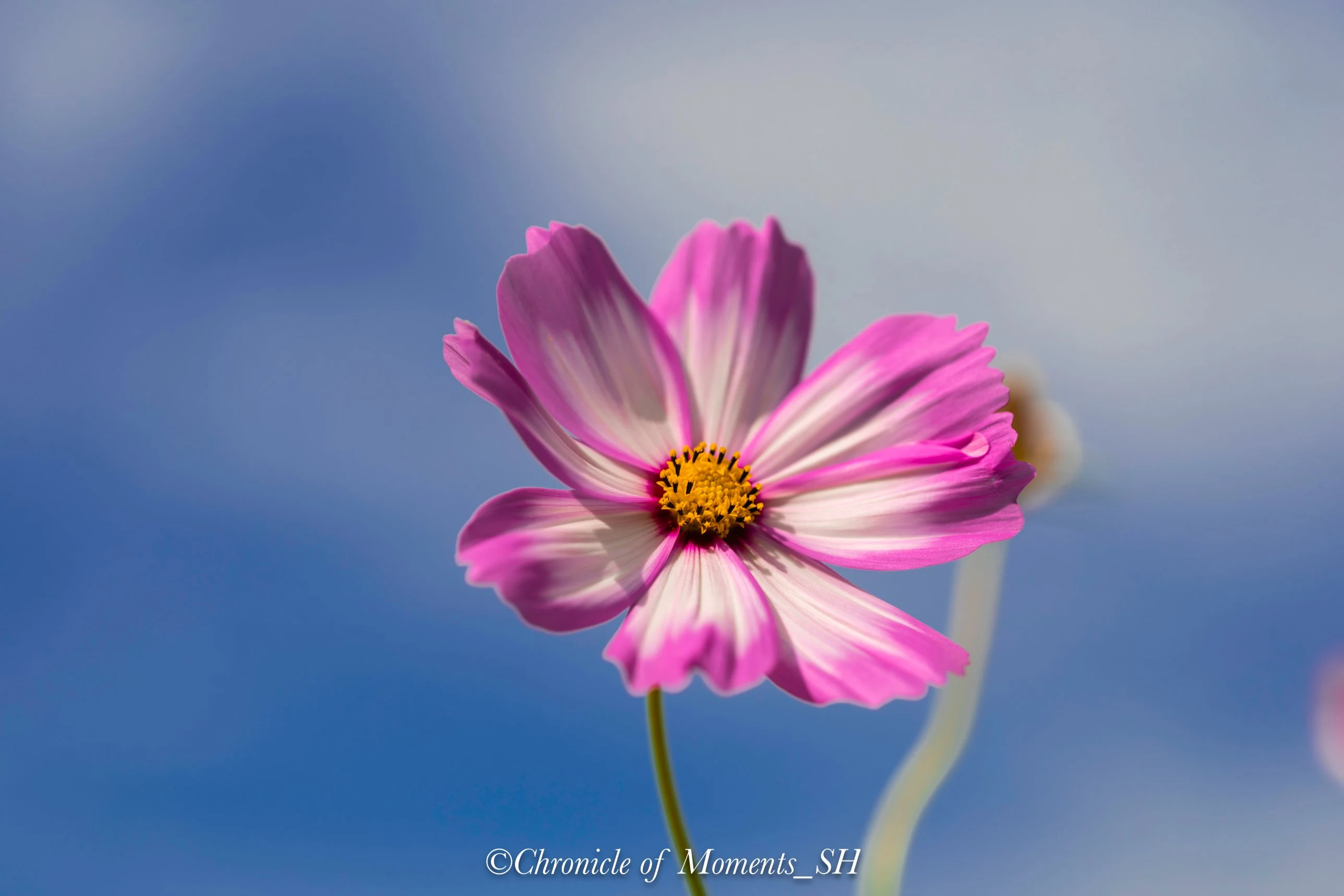
Canon EOS R5 Mark II · RF100mm F2.8 L MACRO IS USM · 100mm · F2.8 · ISO 50 · 1/2500 s · 2025-10-17
(Click the photo to view it at full size)
What Can You Shoot in an Autumn Landscape?
Autumn is when color and light are at their most distinct. The blue of the sky deepens, the colors of flowers and leaves sharpen, and as the sun sits lower, even the same place shows a different quality of light. The table below summarizes the 6 scenes in this article and their key settings at a glance.
| Autumn scene | Key idea | Example settings in this article |
|---|---|---|
| 1. Sky and cosmos | Shoot upward from below the flower, with the sky as the background | 100mm · F2.8 · 1/2500 s |
| 2. A single flower | Open the aperture to turn the background into blocks of color | 100mm · F3.2 · 1/500 s |
| 3. Flower field from below | Get close to the ground and include stems and flowers with the sky | 70mm · F8 · 1/400 s |
| 4. Leaf-covered path | Drop to ground level: blurred in front, a story in the distance | 100mm · F5.6 · 1/200 s |
| 5. Small subject under the sky | A dragonfly and a structure against blue sky | 200mm · F2.8 · 1/4000 s |
| 6. Pavilion and sky | A single airplane passing over the landscape | 100mm · F2.8–F3.2 · 1/1250 s or faster |
Capturing the Blue Autumn Sky Together With Cosmos
When the air is clear, the autumn sky turns a deep blue that makes the colors of flowers stand out. The method is to shoot upward from below the flower and use the sky as the background. In the photo above, a single cosmos is shot from below, so the background is filled with blue sky and clouds.
I opened the 100mm macro lens to F2.8 to soften the background and set a fast 1/2500 s shutter. When a lot of bright sky enters the frame, the camera tends to meter brighter and the sky can blow out to white. Check on the monitor that the blue of the sky is still there, and lower exposure compensation into the negative if needed.
There are many combinations that give the same brightness. F2.8 at 1/2500 s (ISO 50) has the same brightness as F5.6 at about 1/640 s or F8 at about 1/320 s. Choose the aperture based on how blurred you want the background, then adjust the shutter speed to match. The relationship between aperture and depth of field is covered in detail in the guide to understanding depth of field.
One Flower Big, the Background as Blocks of Color
Even when a flower field looks vast, focusing on a single bloom makes the photo clearer. As in the photo below, place one flower large in the middle of the frame and leave the flowers and grass in front and behind as blurred blocks of color.
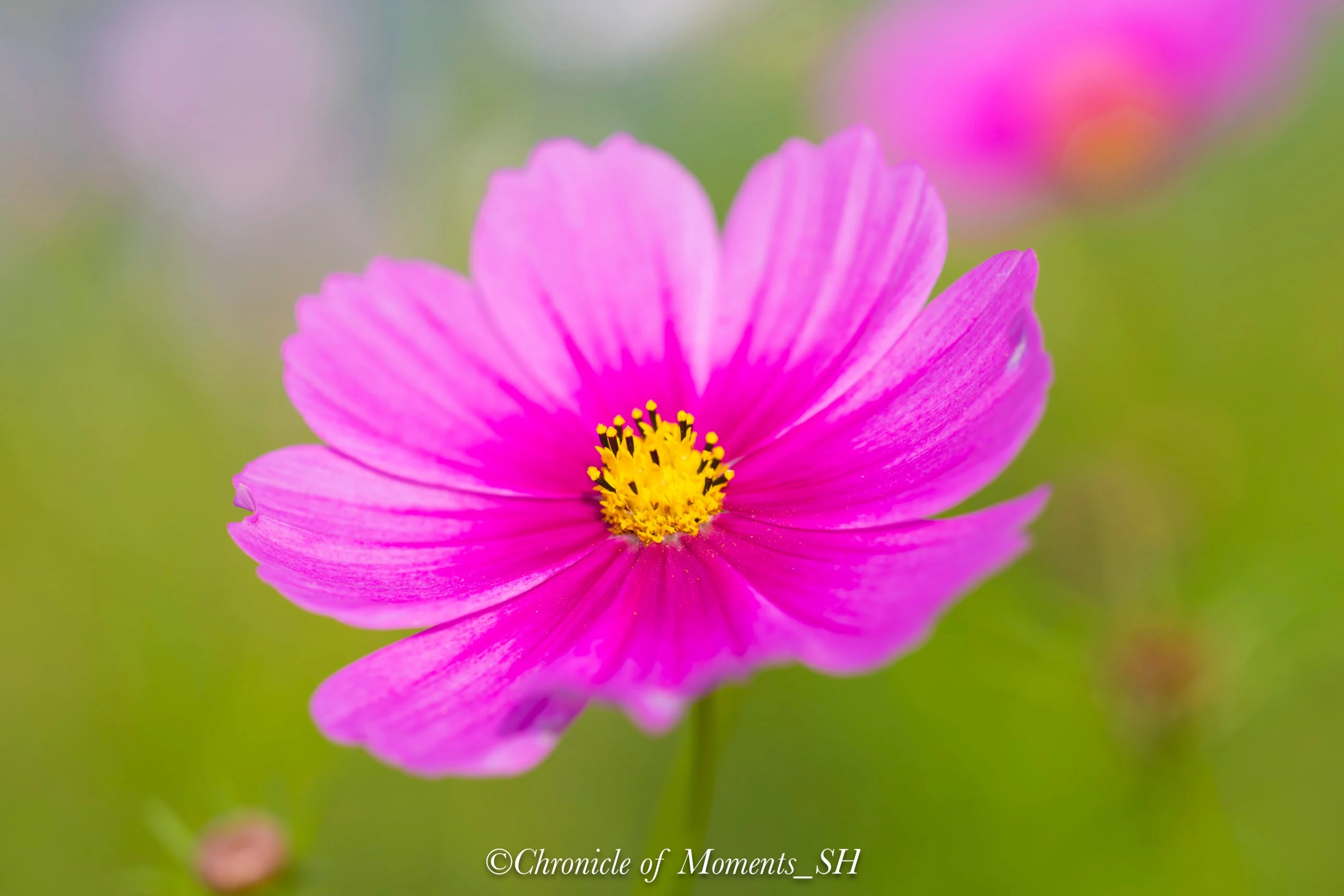
Canon EOS R5 Mark II · RF100mm F2.8 L MACRO IS USM · 100mm · F3.2 · ISO 50 · 1/500 s · 2025-10-17
(Click the photo to view it at full size)
I focused so the center of the flower is sharpest, and softened the background at F3.2. The wider the aperture, the thinner the range in focus, so if you want the whole flower sharp, keep the flower's face as parallel to the camera sensor as you can or stop down the aperture a little. For depth of field and diffraction in close-up shooting, the macro photography basics guide can help.
When the background settles into a green block of color, the deep pink flower stands out through complementary contrast. Before pressing the shutter, check whether anything other than the flower catches your eye in the frame.
Autumn From a Low Viewpoint: Looking Up at Flowers and a Leaf Path
Shooting from eye level gives a scene everyone has seen. Lower the camera close to the ground and the foreground blurs while the distance becomes the background, so even the same place becomes a different photo. Both photos below were shot from a low position, looking up and ahead.
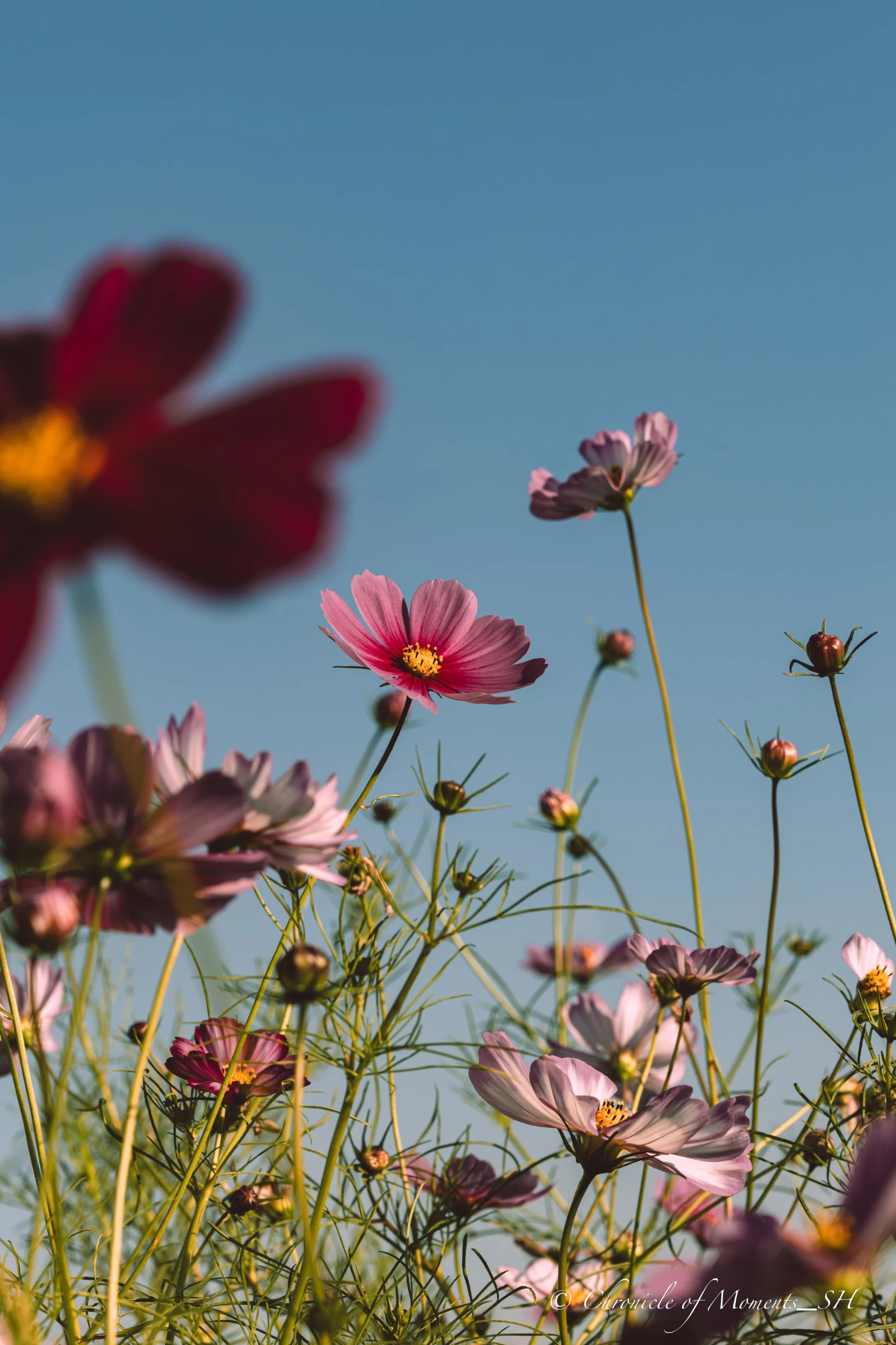
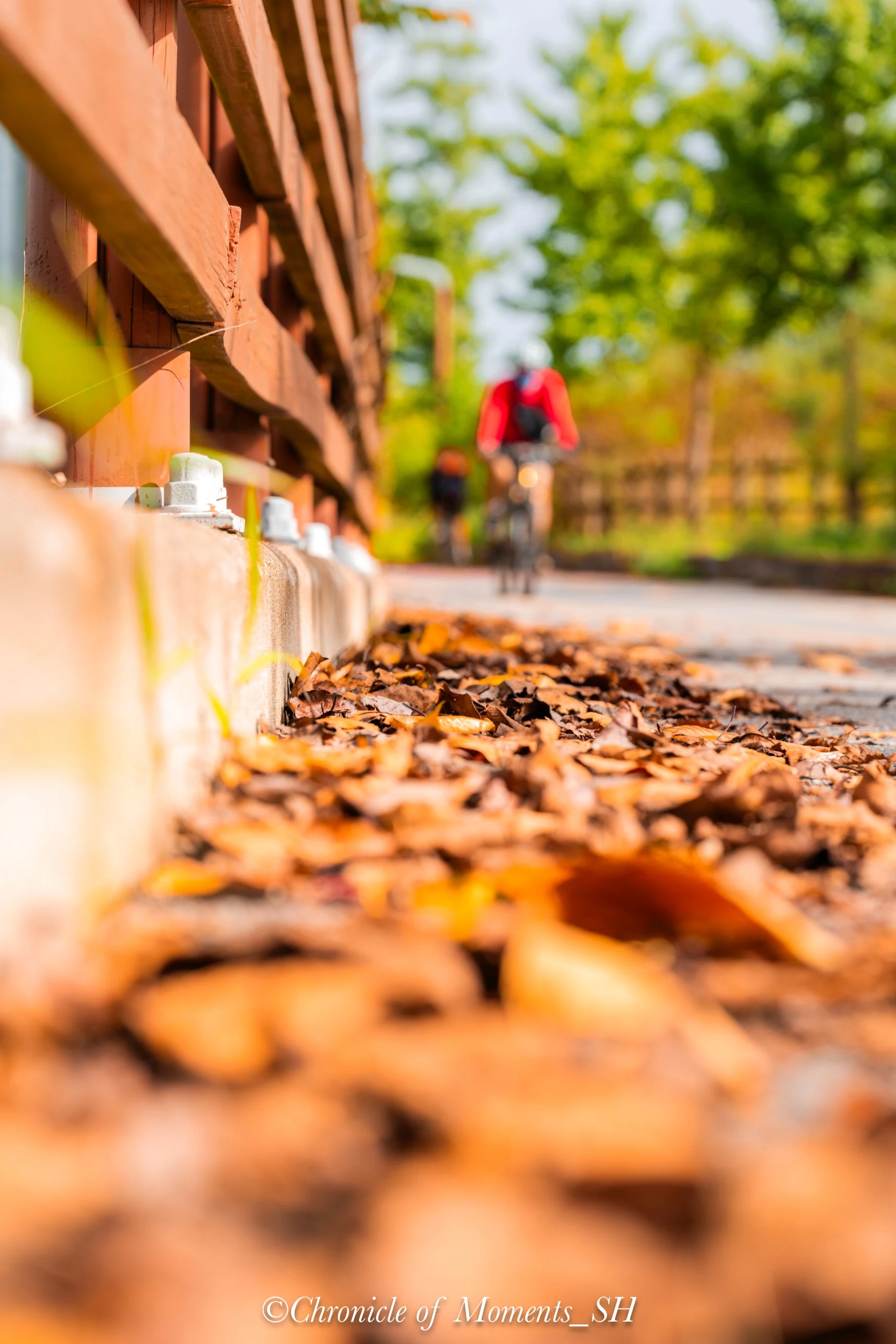
(Click a photo to view it at full size)
The photo on the left looks up at stems and flowers from inside the flower field. I stopped down to F8 at 70mm to keep the central flower and nearby stems fairly sharp, and let the deep red flower close to the front blur heavily to create depth. The R7 used here has an APS-C sensor, so this scene was captured at an angle of view of about 112mm in 35mm equivalent (70mm × 1.6). You can check the conversion with the crop factor calculator.
The photo on the right was taken with the camera lowered almost to ground level at the edge of a path covered in fallen leaves. The leaves in front blur softly, the focus is on the bolt under the railing and the leaves at a middle distance, and a person on a bicycle in the distance appears soft. With blur in front and a story in the distance, the color of the leaves guides the eye along the path from the front. I shot at F5.6 and 1/200 s to leave a moderate amount of blur.
When shooting from the ground, a vari-angle screen makes it much more comfortable, and it helps to bring a waterproof mat or plastic sheet so dirt or moisture does not stain your clothes and gear.
Small Subjects Under the Sky: A Dragonfly and a Structure
A blue sky makes a simple, clean background. Let the sky fill most of the frame and place just one small subject in it, and the eye goes straight there. Both photos below were taken in the late afternoon, when the sun was low, against a blue sky.
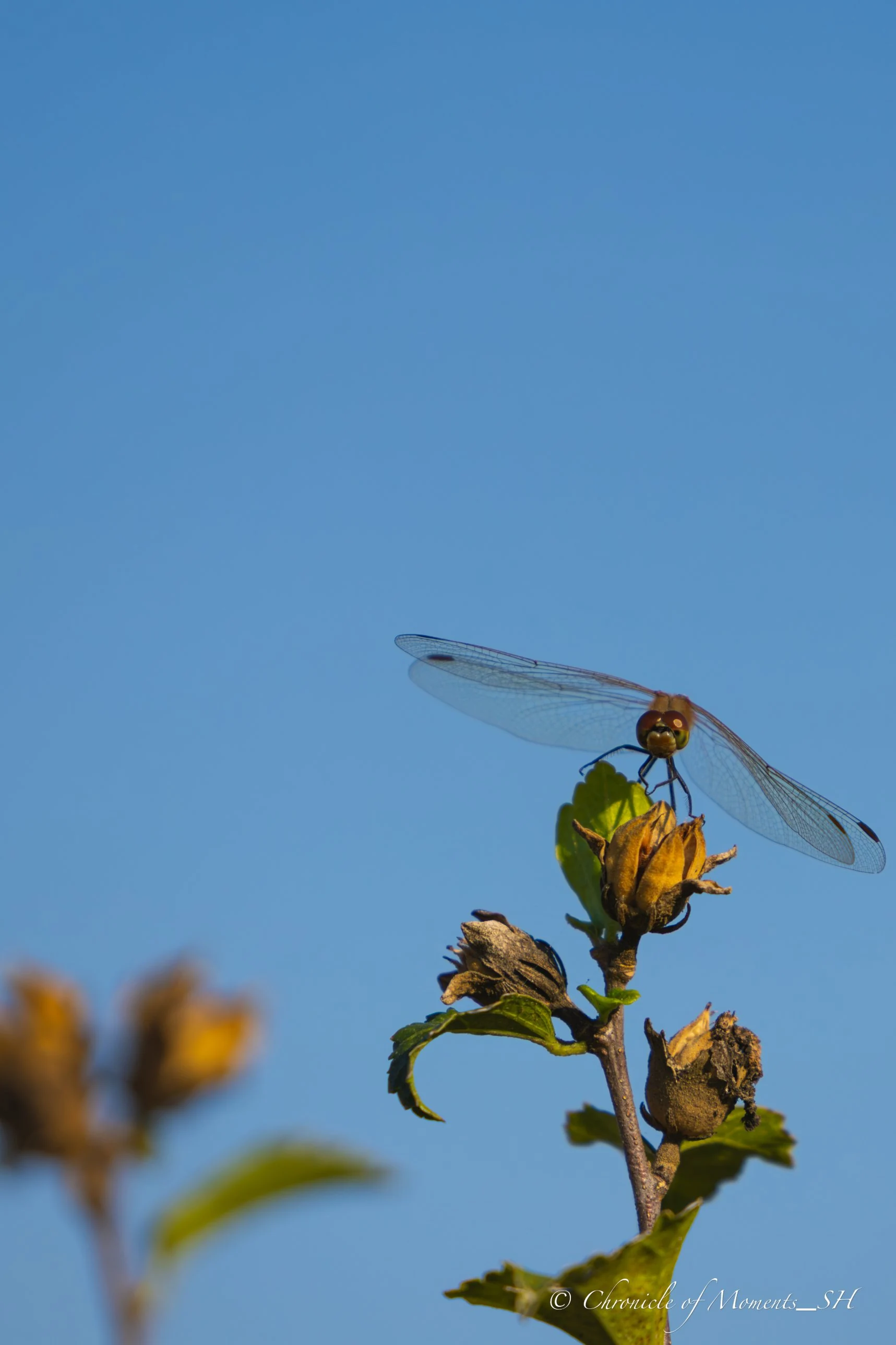
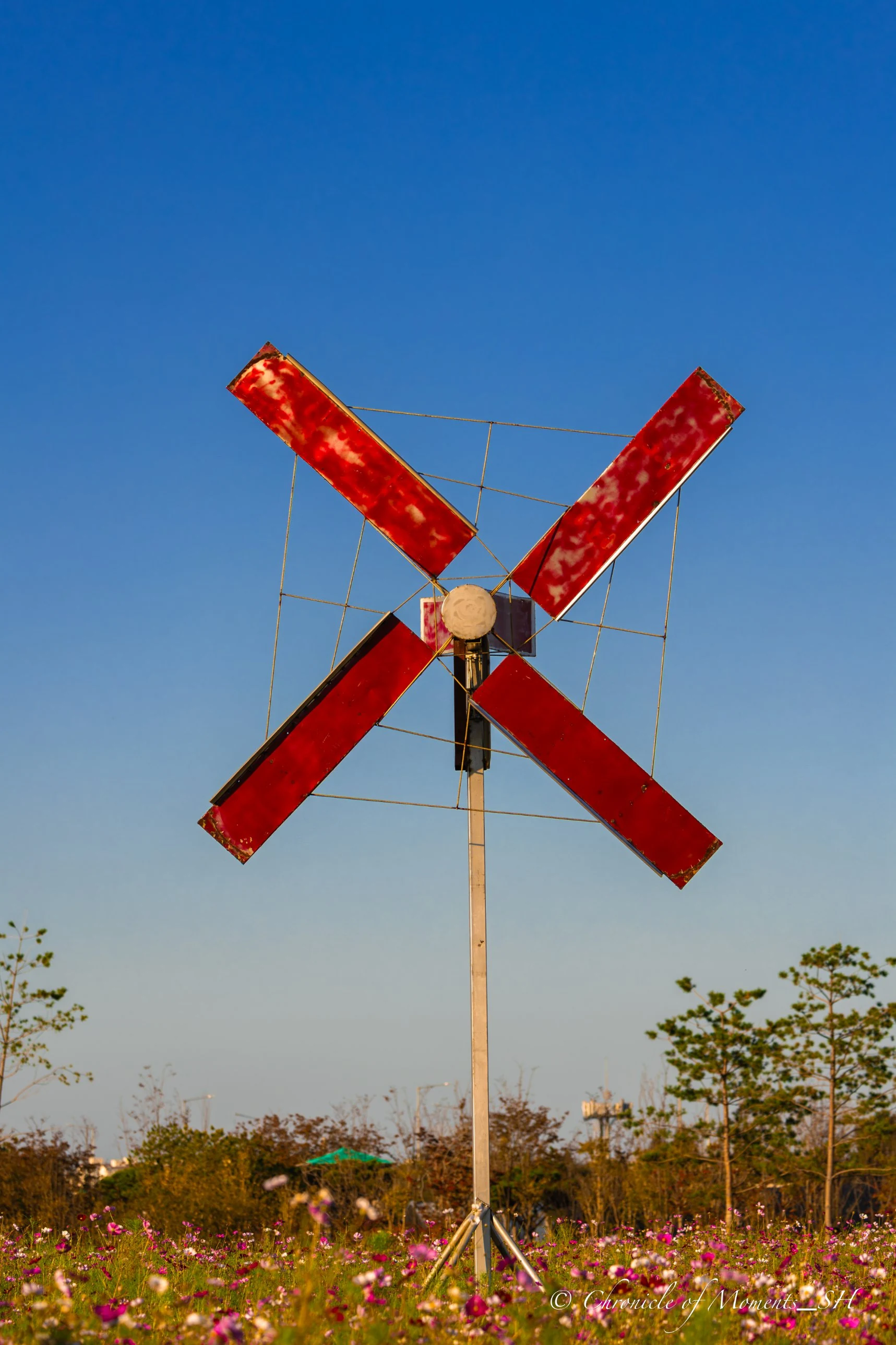
(Click a photo to view it at full size)
The photo on the left is a dragonfly perched on the tip of a dried fruit. At 200mm and F2.8, I softened both the sky behind and the fruit in front, and set a fast 1/4000 s to be ready for even tiny movements. With the APS-C R7, 200mm is about 320mm in 35mm equivalent, so you can capture an insect large without getting close to it.
The photo on the right is a front view of a structure with red blades. It was shot at 81mm (about 130mm equivalent), F2.8, 1/3200 s, and the cosmos field below remains as blurred pink dots, creating a layer of color between the blue sky and the red blades. Red and blue are close to complementary, so against the sky the red stands out well.
To make the blue sky deeper, you can also use a polarizing filter. The sky turns darker and the clouds come alive, but because it reduces light when attached to the front of the lens, keep in mind that the shutter speed gets slower by that amount.
A Pavilion and the Sky, With an Airplane Passing Through the Landscape
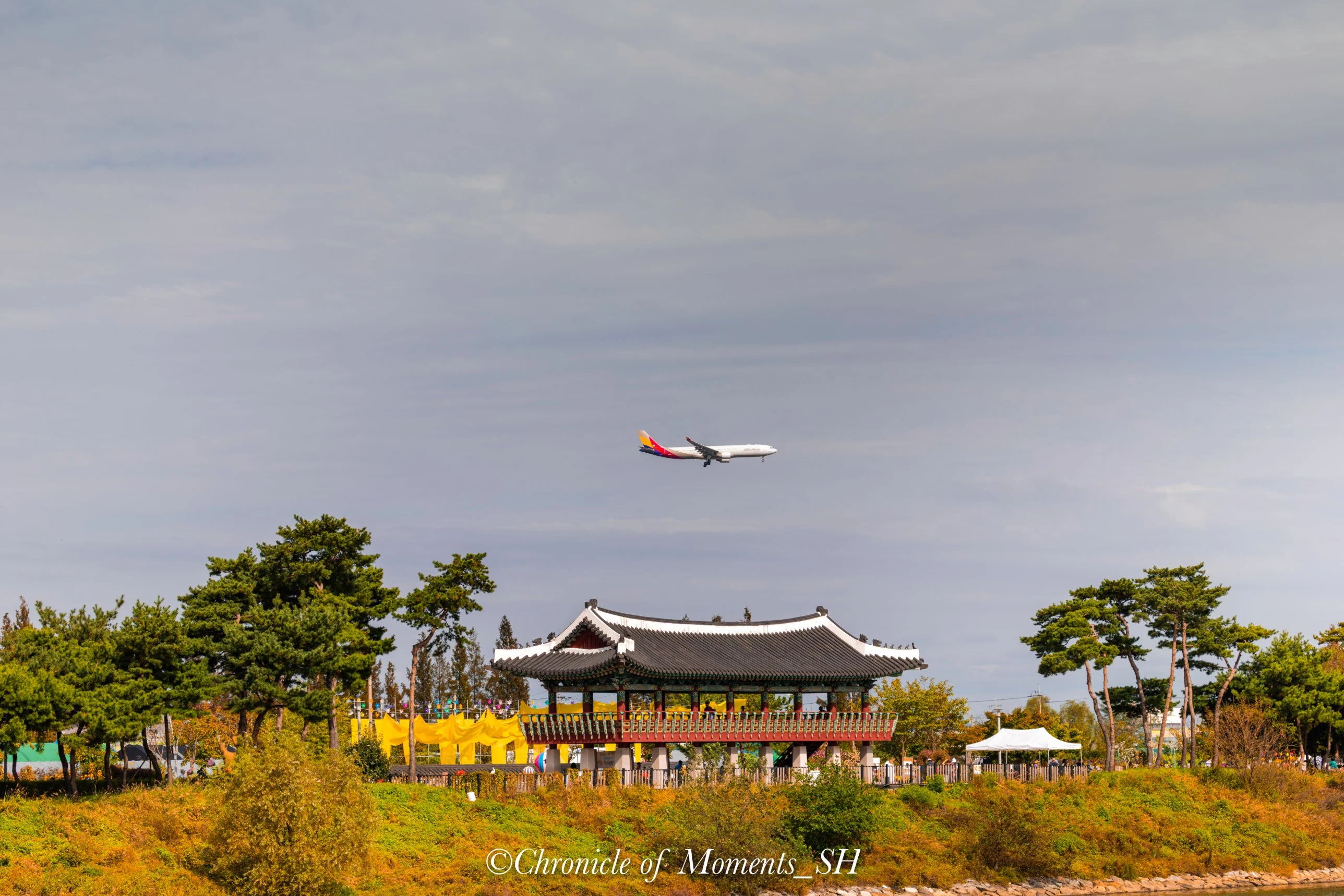
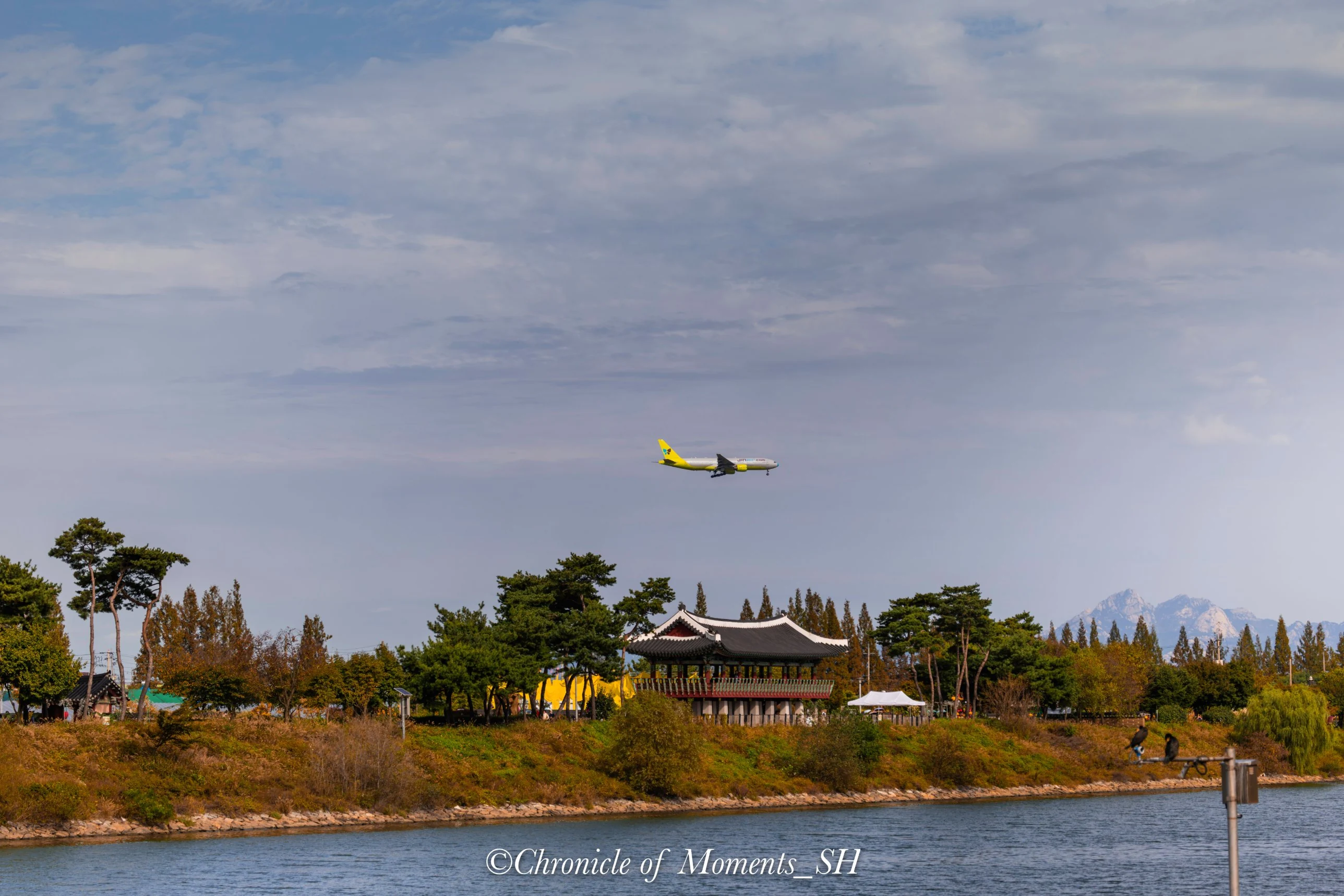
When one moving subject enters a landscape photo, a story appears. The two photos below show the same pavilion at different times, and in both an airliner passes low over the pavilion and the trees.
(Click a photo to view it at full size)
Both photos were taken at a 100mm telephoto angle of view. A telephoto lens compresses the distant pavilion and trees and makes them look closer together, so the distance between sky and pavilion shrinks and the airplane and the landscape fit in one frame. The shapes and colors of the clouds differ between the two, so even from the same spot the mood is completely different.
A moving subject like an airplane needs a fast shutter to come out sharp. In these photos I used 1/1250 s and 1/2000 s. Since you have to wait for the moment the airplane passes, set up the composition first, place the pavilion and trees in the lower part of the frame, and leave the sky wide open, which creates room for the airplane to enter.
Autumn Shooting Settings at a Glance
I gathered the settings of the 8 photos in this article into one table. Compare how, even at the same aperture, the feel differs with the subject and distance.
| Photo | Camera | Focal length | Aperture | Shutter | ISO |
|---|---|---|---|---|---|
| Cosmos and blue sky | R5 Mark II | 100mm | F2.8 | 1/2500 s | 50 |
| A single deep pink cosmos | R5 Mark II | 100mm | F3.2 | 1/500 s | 50 |
| Cosmos field from below | R7 | 70mm | F8 | 1/400 s | 100 |
| Leaf-covered path | R5 Mark II | 100mm | F5.6 | 1/200 s | 50 |
| Dragonfly | R7 | 200mm | F2.8 | 1/4000 s | 100 |
| Structure under the sky | R7 | 81mm | F2.8 | 1/3200 s | 100 |
| Pavilion and airplane (1) | R5 Mark II | 100mm | F3.2 | 1/1250 s | 50 |
| Pavilion and airplane (2) | R5 Mark II | 100mm | F2.8 | 1/2000 s | 50 |
Autumn sunlight is strong even in the daytime, which makes it a good season for keeping ISO low and using fast shutter speeds. All 8 photos were at ISO 50 or 100. The meaning of each setting is explained in the ISO, shutter speed, and aperture guide.
Checklist
- When you want flowers and sky together, did you lower the camera below the flower and shoot upward?
- If the background is busy, did you open the aperture to settle it into blocks of color?
- Did you check that the sky is not blown out to white and that enough blue remains?
- For moving subjects like dragonflies or airplanes, did you set the shutter to 1/1000 s or faster?
- When shooting close to the ground, did you deliberately decide what is in focus and what blurs?
Common Mistakes: Why Autumn Photos Look Flat
The most common mistake is trying to fit the whole landscape into one frame. Whether it is autumn foliage or a flower field, shooting wide often leaves no clear place to look. Choose a single flower or a single spot, shoot it large, and leave the rest as background, and the photo becomes clearer.
If you leave exposure to the camera on a day with a bright sky, the sky tends to blow out to white or the subject comes out dark. Check the histogram or highlight warning on the monitor and adjust exposure compensation a little at a time. Another common mistake is shooting moving subjects at slow shutter speeds of 1/250 s or lower. For insects and airplanes, 1/1000 s or faster is a safer baseline.
When shooting from a low viewpoint, grass or leaves very close to the lens often get into the frame unintentionally. Check whether what hangs into the frame helps the composition, and if it bothers you, move the camera position just a little. Finally, the light changes quickly as the sun gets low, so it helps to check the position of the sun and the time before you shoot. You can check sunrise, sunset, and golden hour times with the golden hour calculator.
FAQ
What time of day is best for autumn landscape photos?
Early morning and late afternoon, when the sun is low, give soft light and warm colors. The 3 R7 photos in this article were taken in the late afternoon and the R5 Mark II photos around midday; at midday the sky is blue with strong contrast, while in the late afternoon the light is low and the colors are deeper. Either way, just choose the light that suits the subject.
How do I make the autumn sky look blue in photos?
Lowering the exposure a little deepens the blue of the sky, and using a polarizing filter brings out the contrast between the blue sky and the clouds. Keep in mind that as the sky gets darker the subject can get darker too, so check both on the monitor.
How should I set the aperture to blur the background in flower photos?
Open the aperture to a small f-number (around F2.8 to F4), get close to the subject, and keep a large distance between the background and the subject, and the background blurs more. Because the range in focus becomes thin, focus on the most important part of the flower, such as its center or petals. You can check how depth of field changes with distance and aperture using the depth of field calculator.
What changes when I shoot telephoto with an APS-C camera?
With the same lens, an APS-C sensor narrows the angle of view, so it looks as if you shot from farther away. The Canon R7 has a 1.6x conversion factor, so a 200mm lens captures an angle of view of about 320mm in 35mm equivalent. It is an advantage for capturing insects or distant scenery large, and the conversion is explained in the sensor size and crop factor guide.
Putting It Together
Autumn landscapes are captured best when you use the blue of the sky, the colors of flowers and leaves, and the lowered sunlight. Shooting upward or from a low viewpoint turns the same place into a different photo, and opening the aperture to tidy the background makes the subject clearer. For moving subjects, set the shutter to 1/1000 s or faster. You can continue with settings for the direction and time of light in the sunrise and sunset camera settings guide.
Copyright Notice
All photos used in this post are works taken directly by the site operator (Chronicle of Moments_SH). Photographs are protected as photographic works under Article 4(1)(ix) of the Korean Copyright Act, and copyright arises from the moment of shooting without any registration or other procedure (Article 10(2)).
Without the copyright holder's prior permission, it is prohibited to reproduce the photos in this post (Article 16), to post or transmit them on blogs, forums, social media, or communities (public transmission, Article 18), or to modify or edit them into derivative works (Article 22). Removing or altering the copyright notice and frame in a photo can also infringe the right of attribution (Article 12) and the right to integrity (Article 13). Uses the law permits, such as fair quotation of a published work (Article 28) or use within a private or domestic scope (Article 30), are exceptions.
Unauthorized use can lead to injunction claims (Article 123) and damages claims (Article 125), and can be punished by imprisonment of up to 5 years or a fine of up to 50 million won (Article 136(1)). For-profit or habitual infringement can be punished even without a complaint (Article 140).
Photo-use inquiries: skysmoga@gmail.com
© Chronicle of Moments_SH. All rights reserved.