If you ask travelers to name one neighborhood in Seoul where traditional hanok houses cluster together, many will say Bukchon Hanok Village. In the middle of the city, tiled roofs, narrow alleys, and stone steps continue one after another, and N Seoul Tower can even be seen in the distance between them. This post is written so that international travelers planning a trip to Korea can read it too.
This post contains 12 photos taken on the afternoon of October 8, 2024, together with the shooting settings (EXIF) of each. Ten were taken in the alleys around Bukchon, and two are views from nearby. Alongside the photos, I have also gathered visiting information confirmed as of November 2026 (the hours when tourists may visit, the fine, and how to respect the residents), so please check it before you go.
Please read before you shoot. Portrait rights are protected strictly in Korea, so please compose your photos so that other people's faces are not clearly visible in the frame. In Bukchon, where residents actually live, wait for people to pass or choose a composition in which no one can be identified.
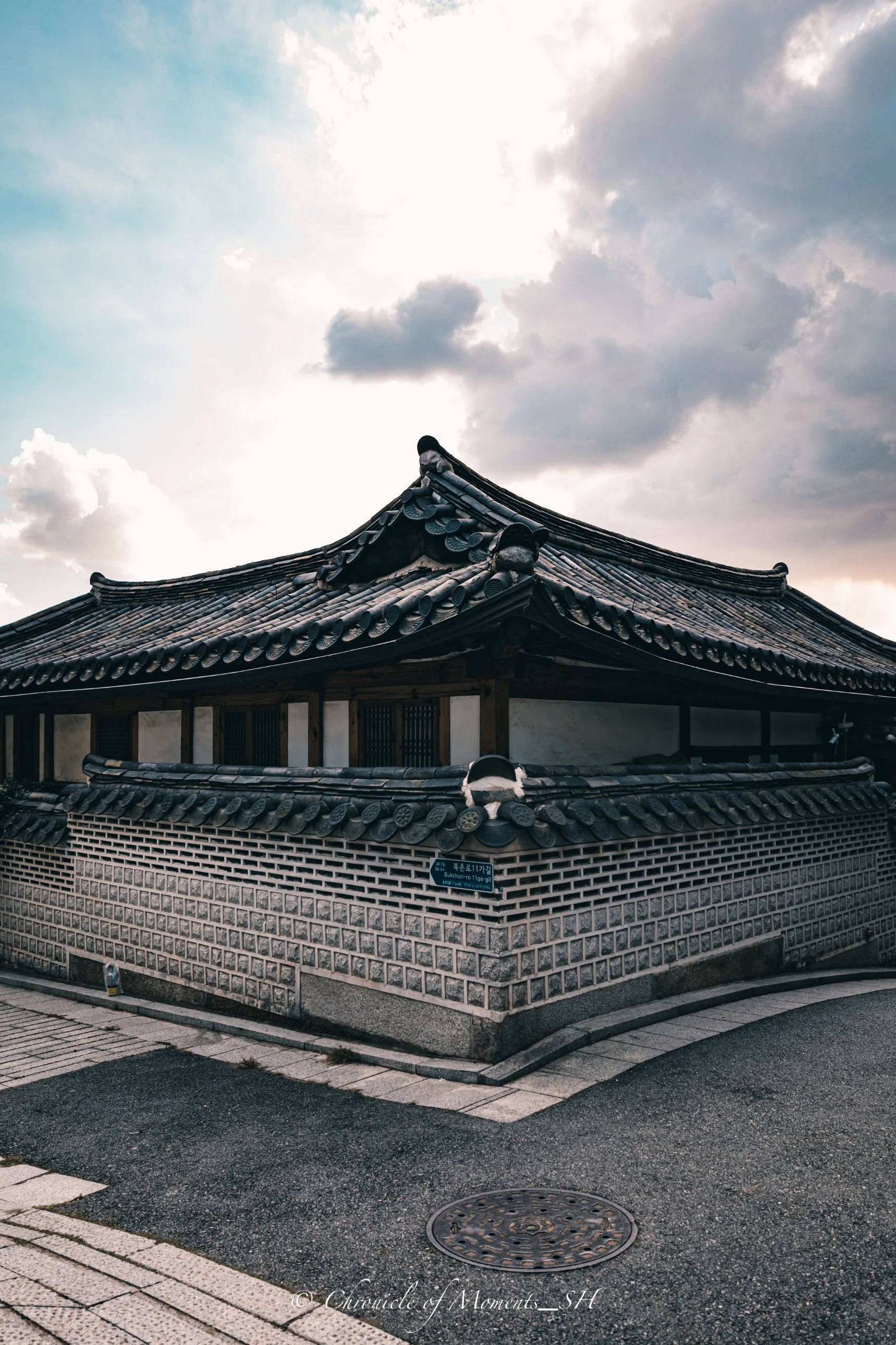
Canon EOS R7 · RF15-35mm F2.8 L IS USM · 15mm · F2.8 · ISO 100 · 1/160 s · 2024-10-08
(Click the photo to view it at full size)
What Kind of Place Is Bukchon Hanok Village in Seoul?
The name Bukchon (北村) comes from the idea of a village north of Cheonggyecheon Stream and Jongno, and today it is widely used for the area around Gahoe-dong, Gye-dong, and Samcheong-dong, where hanok and narrow alleys remain. According to a November 2024 citizen-reporter article from Seoul Metropolitan Government's Media Hub, the area between Gyeongbokgung and Changdeokgung that covers Sogyeok-dong, Hwa-dong, Anguk-dong, Samcheong-dong, Gahoe-dong, Gye-dong, and Wonseo-dong has been designated by Jongno-gu as a special management area, and about 6,000 residents live there.
That makes Bukchon both a tourist destination and a residential neighborhood where people actually live, unlike a museum or a palace. The doors, windows, and walls you meet in the alleys may all belong to someone's home, and that changes both how you walk the neighborhood and how you take photos. The scenes in the photos below were taken with that in mind.
Why International Travelers Love It, as Seen in Photos
If you asked why Bukchon is so popular with travelers, every person would answer a little differently, but once you start taking photos the reasons that show up in the frame are fairly clear. The first is that the details of the hanok are close at eye level. The curves of the roof tiles, the rafters lined up under the eaves, and the wooden lattice windows can all be seen simply by walking the alleys. The second is that every alley offers a different scene. Stone steps, stone walls, and every corner you turn bring a new composition. The third is that old rooflines and a modern city appear in the same frame.
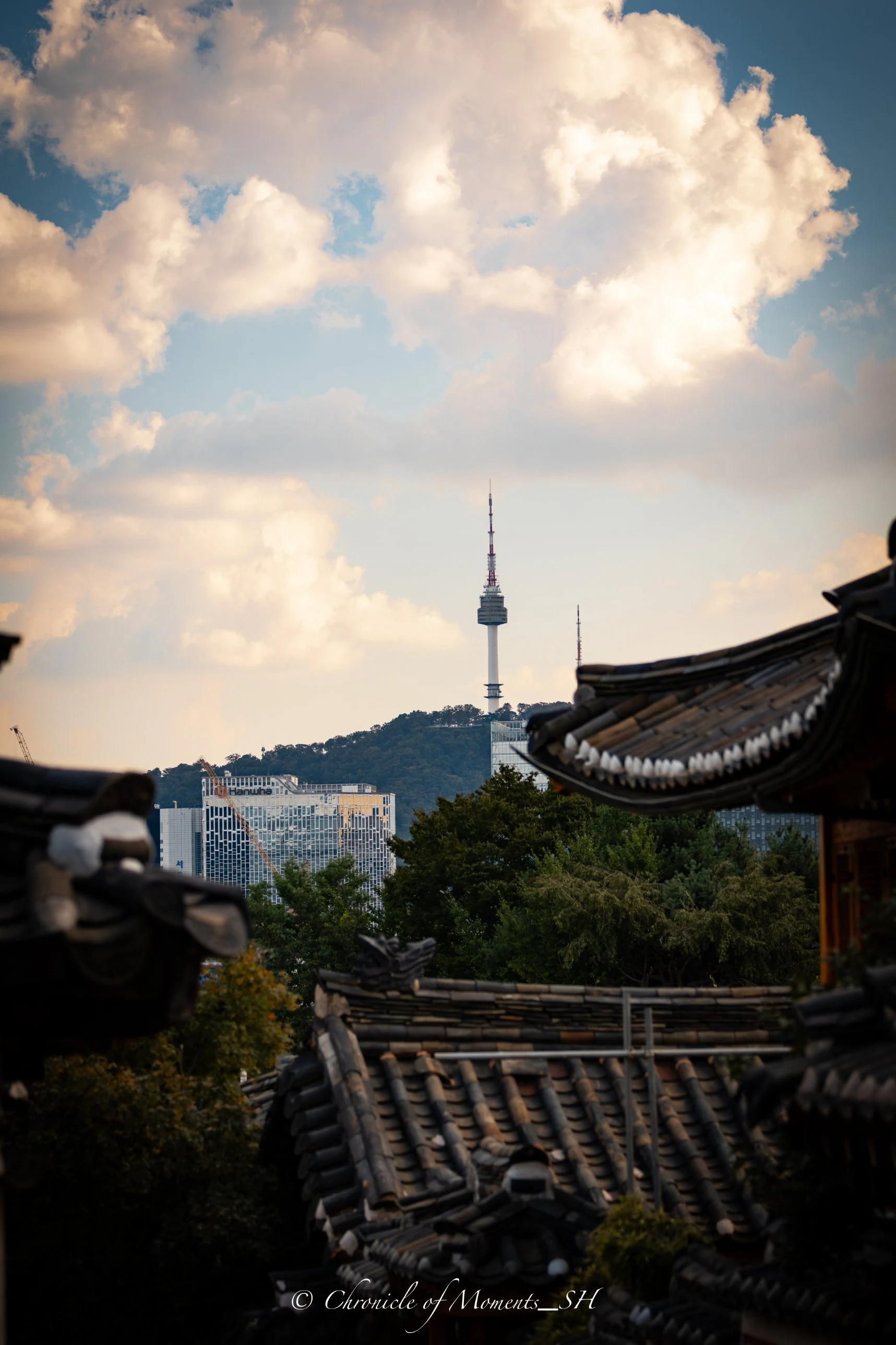
Canon EOS R7 · RF70-200mm F2.8 L IS USM · 70mm · F2.8 · ISO 100 · 1/500 s · 2024-10-08
(Click the photo to view it at full size)
The photo above shows N Seoul Tower in the distance between two hanok roofs. It was taken at 70mm, F2.8, ISO 100, 1/500 s, which corresponds to about 112mm in full-frame terms, so the distant tower, hill, and buildings were pulled into one frame while the eaves in front were left blurred to work like a picture frame. It was 4:07 p.m., and large clouds left the sky rich in detail. Placing part of an eave or roof tiles in the foreground on purpose makes the city look as if it is peeking through the hanok, which gives even a first-time visitor a photo that says Seoul at a glance.
The fourth reason is the everyday traces such as shops and signs. Even the hanok alleys have cafes and small shops, and these signs blend with the old buildings and give the photos a story. We will see some of those scenes later in this post. General tips for composition are covered first in Five Checks Before Pressing the Shutter.
Visiting Information to Know Before You Go (as of November 2026)
The information below summarizes the Seoul Media Hub article and the Bizhankook on-site report that I checked on November 12, 2026. Rules like these can change, so it is safest to check the Jongno-gu notices once more right before your visit.
| Item | Details |
|---|---|
| Area covered | Around Bukchon-ro 11-gil in Gahoe-dong (the red zone). Bukchon is managed in red, orange, and yellow zones |
| Hours tourists may visit | 10:00 a.m. to 5:00 p.m. (restricted hours are 5:00 p.m. to 10:00 a.m. the next day) |
| Timeline | Designated a special management area in July 2024, a guidance period from November 2024 to February 2025, and full enforcement from March 1, 2025 |
| Fine | Entering for tourism purposes during restricted hours can result in a fine of 100,000 won |
| Exceptions | People with a clear purpose, such as shop or museum customers and hotel guests, can pass after being checked |
| On-site guidance | "Bukchon Security Guards" provide guidance and warnings, and information on the exceptions is also available through QR codes |
| Residents | It is a place where people actually live, so move quietly and avoid opening gates or looking inside |
The Bizhankook article reports that shop owners asked for the summer visiting hours to be extended to 6:00 or 6:30 p.m., and that Jongno-gu only said it could consider a flexible approach. Nothing has been decided, so for now it is best to plan around 5:00 p.m. For details, see the Seoul Media Hub article (November 2024) and the Bizhankook on-site report (August 2026).
All the photos in this post were taken on October 8, 2024, so they are a record from before the restricted-hours system began. Still, the 10 photos taken around Bukchon were shot between 3:15 p.m. and 4:23 p.m., which falls within today's visiting hours. The times are the values I checked in each photo's EXIF.
Capturing Tiles, Eaves, and the Details of a Hanok
(사진을 클릭하면 원본 크기로 볼 수 있습니다)
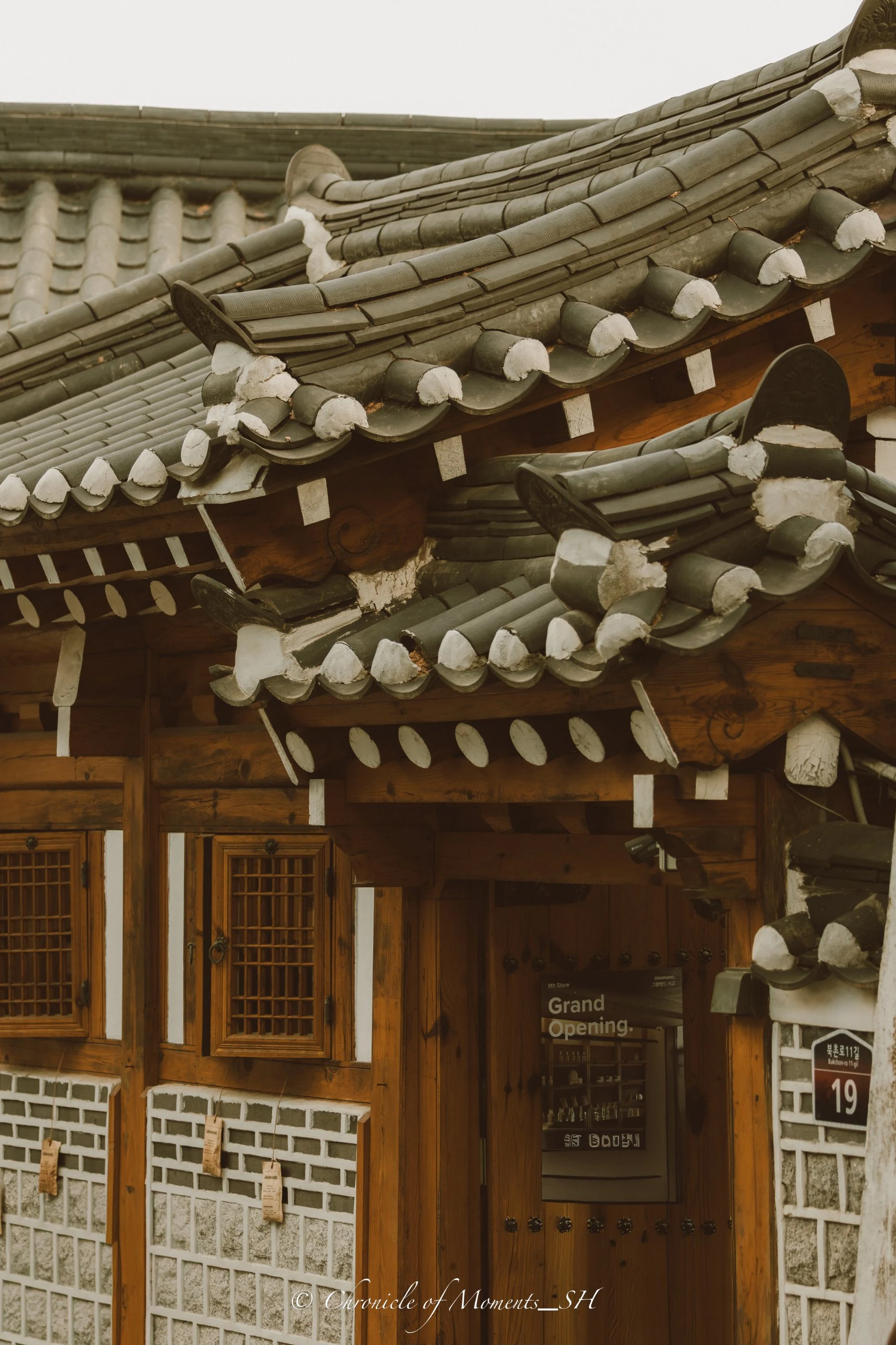
The photo on the left brings the eaves and tile ends close at 70mm. The round rafter ends under the eaves line up in white, and the overlapping roof tiles above them draw curves. At the bottom the frame also includes a window with lattice bars, a wooden door, and a wall that mixes gray brick and granite, so the materials that make up a hanok can be seen at a glance. The settings were F2.8, 1/160 s, and ISO 100.
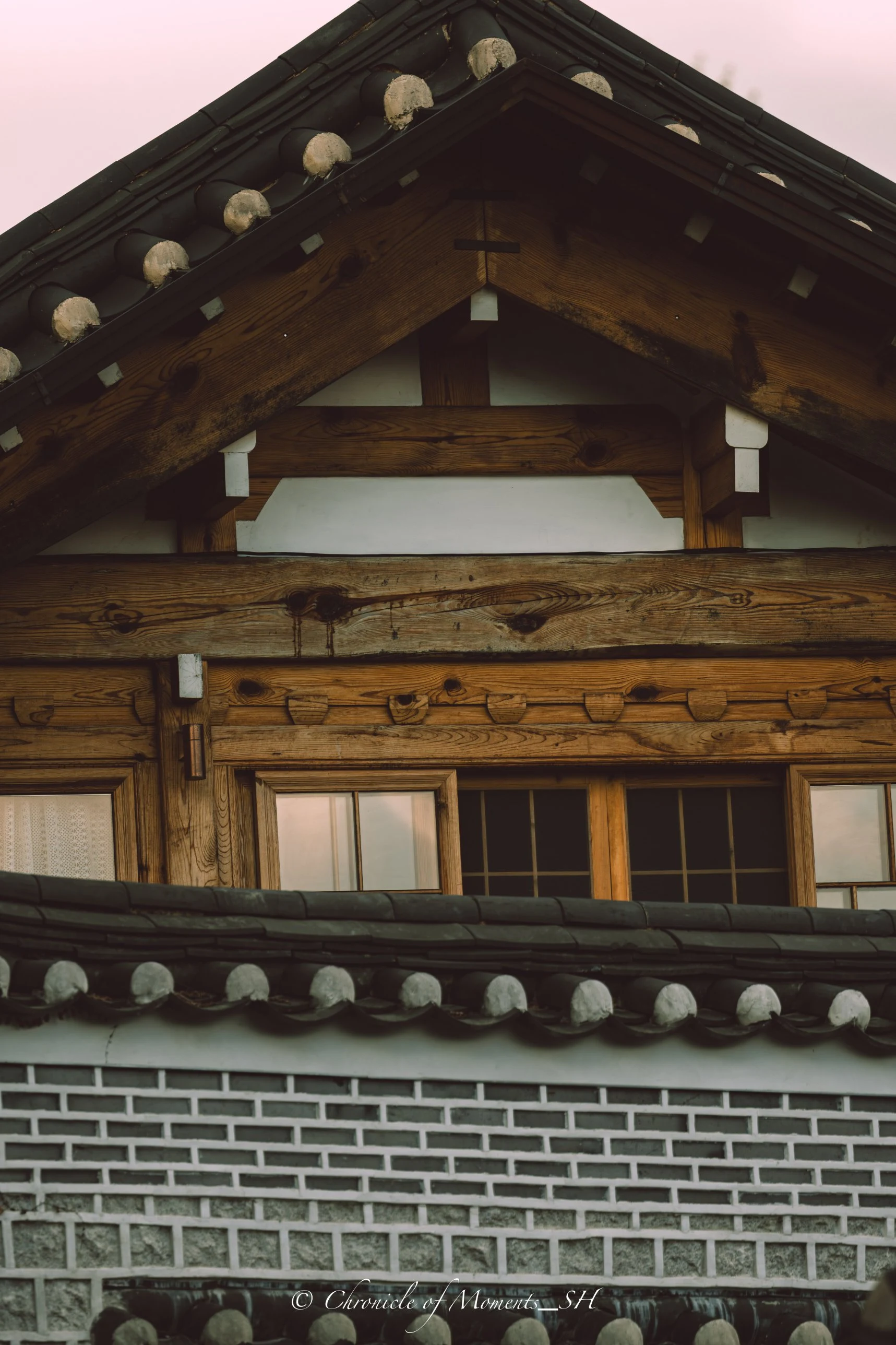
The photo on the right cuts out just one part of a gabled roof at 200mm. Thick timber beams with visible wood grain, window frames, and a brick wall topped with tiles form layers from top to bottom, and the light of a clear afternoon shows the grain of the wood surfaces sharply. A telephoto lens pulls distant subjects closer and compresses the distance between front and back, so it suits showing how a hanok is built up in layers. The settings were F2.8, 1/800 s, and ISO 100.
Both photos were taken with a Canon EOS R7. The R7 has an APS-C sensor rather than full frame, so 70mm corresponds to about 112mm and 200mm to about 320mm in full-frame terms. A common guideline for avoiding camera shake when shooting handheld with a telephoto lens is to use a shutter speed faster than the reciprocal of the equivalent focal length, so the 1/160 s of the first photo (about 112mm equivalent) and the 1/800 s of the second (about 320mm equivalent) are both faster than that guideline. You can work out the conversion yourself with the Sensor Size and Crop Factor guide and the Crop Factor Calculator. The difference between wide and telephoto is covered in more detail in the Wide-Angle vs Telephoto Focal Length guide.
Alleys and Stairs: Doors, Stone Steps, and Signs
(사진을 클릭하면 원본 크기로 볼 수 있습니다)
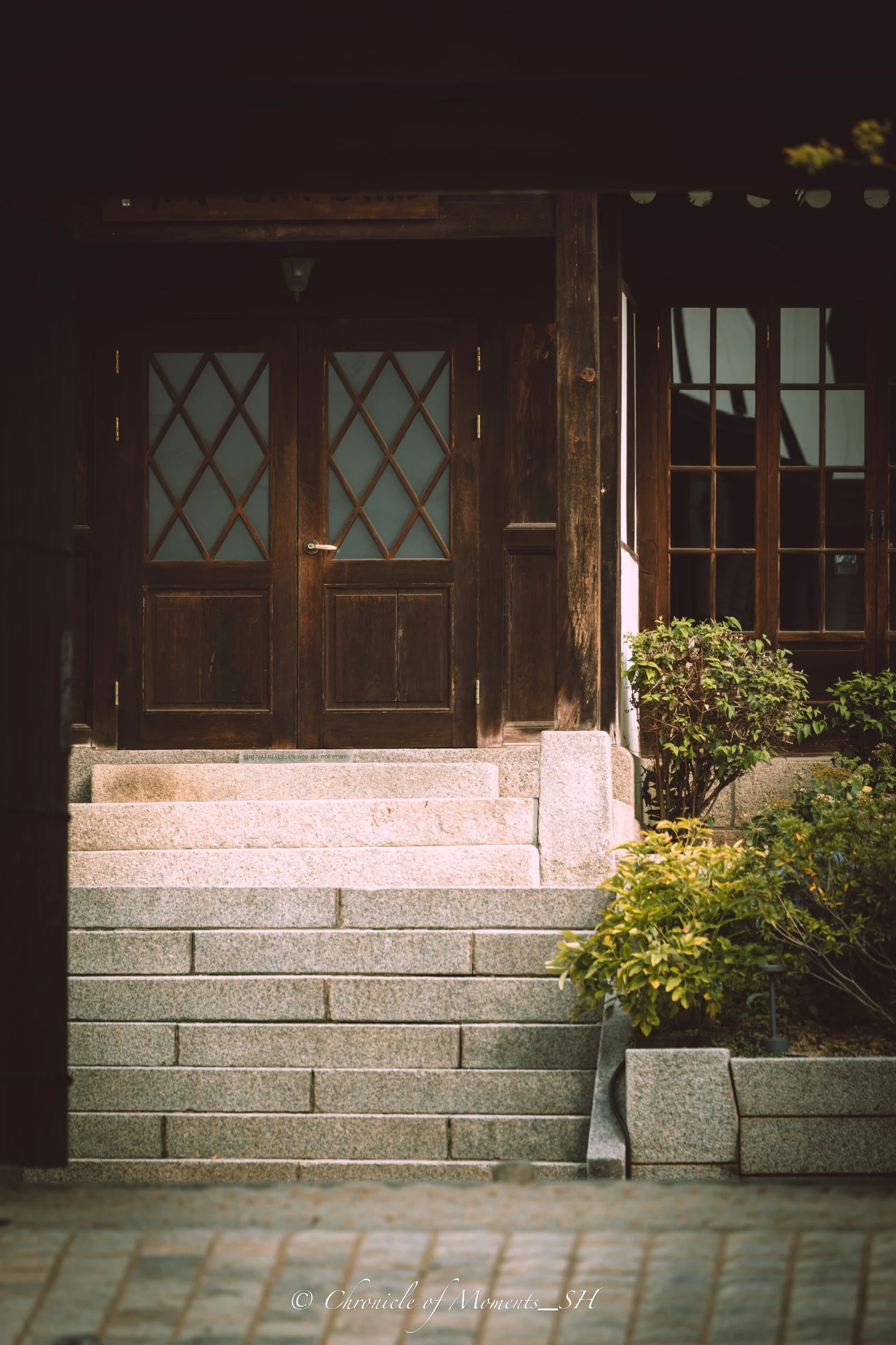
The photo on the left pulls in the granite steps in front of a hanok entrance at 200mm. Because the difference between the wooden door under the dark eaves and the sunlit steps is large, exposure here was set for the bright steps so that the door and eaves sink into darkness, and as a result the eye climbs from the bright steps up to the door. The yellow-green of the shrub on the right adds a touch of color. The settings were F2.8, 1/250 s, and ISO 100.
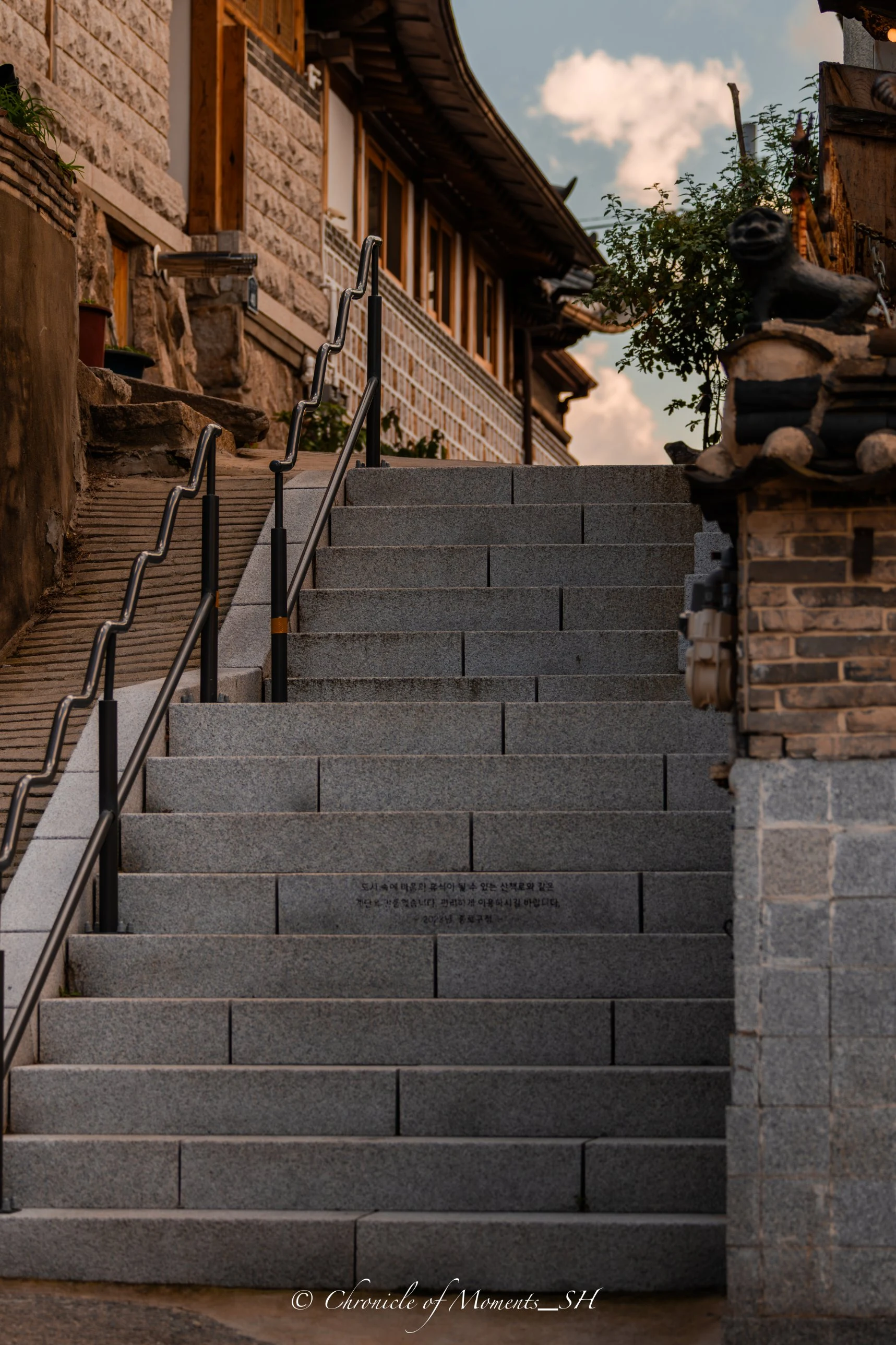
The photo on the right looks up a stairway at 70mm. A zigzagging metal handrail rises alongside the steps, and at the top you can see a hanok roof and clouds. With so many lines leading upward, the eye naturally continues to the sky at the top of the frame. The settings were F2.8, 1/400 s, and ISO 100. When you cannot decide whether a vertical or a horizontal composition suits a scene, see also Horizontal vs Vertical Composition: Choosing the Right Photo Orientation.
(사진을 클릭하면 원본 크기로 볼 수 있습니다)
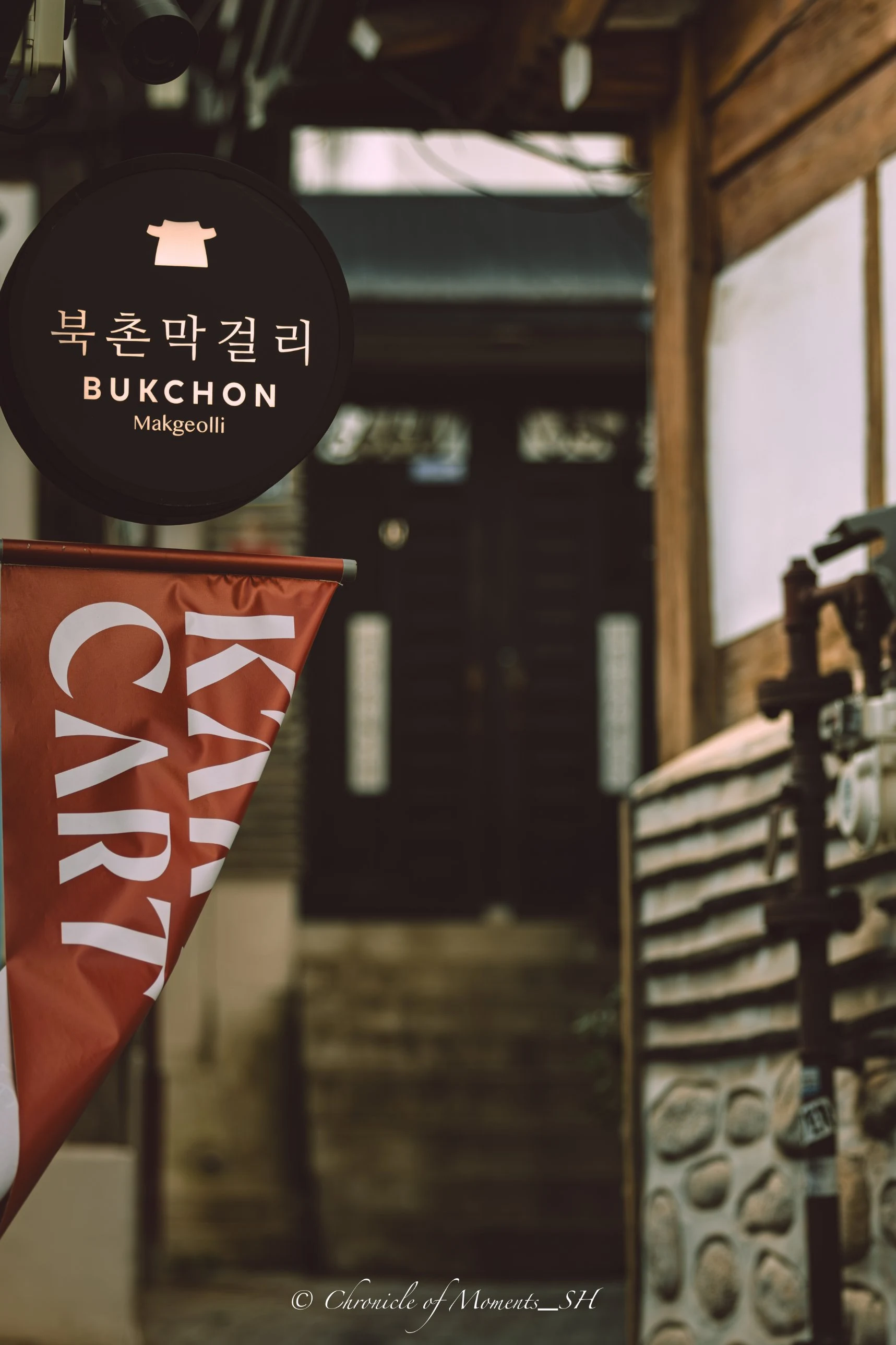
The photo on the left shows a sign hanging at the entrance of an alley. The sign reads 북촌막걸리 (Bukchon Makgeolli) in Korean, a red banner hangs beside it, and a hanok door continues softly out of focus behind. It was taken at 70mm, F2.8, 1/500 s, ISO 100, with focus on the sign and the background softened. Opening the aperture to blur the background makes the sign stand out while still keeping the hanok atmosphere behind it. How the range in focus changes is explained in the Understanding Depth of Field guide.
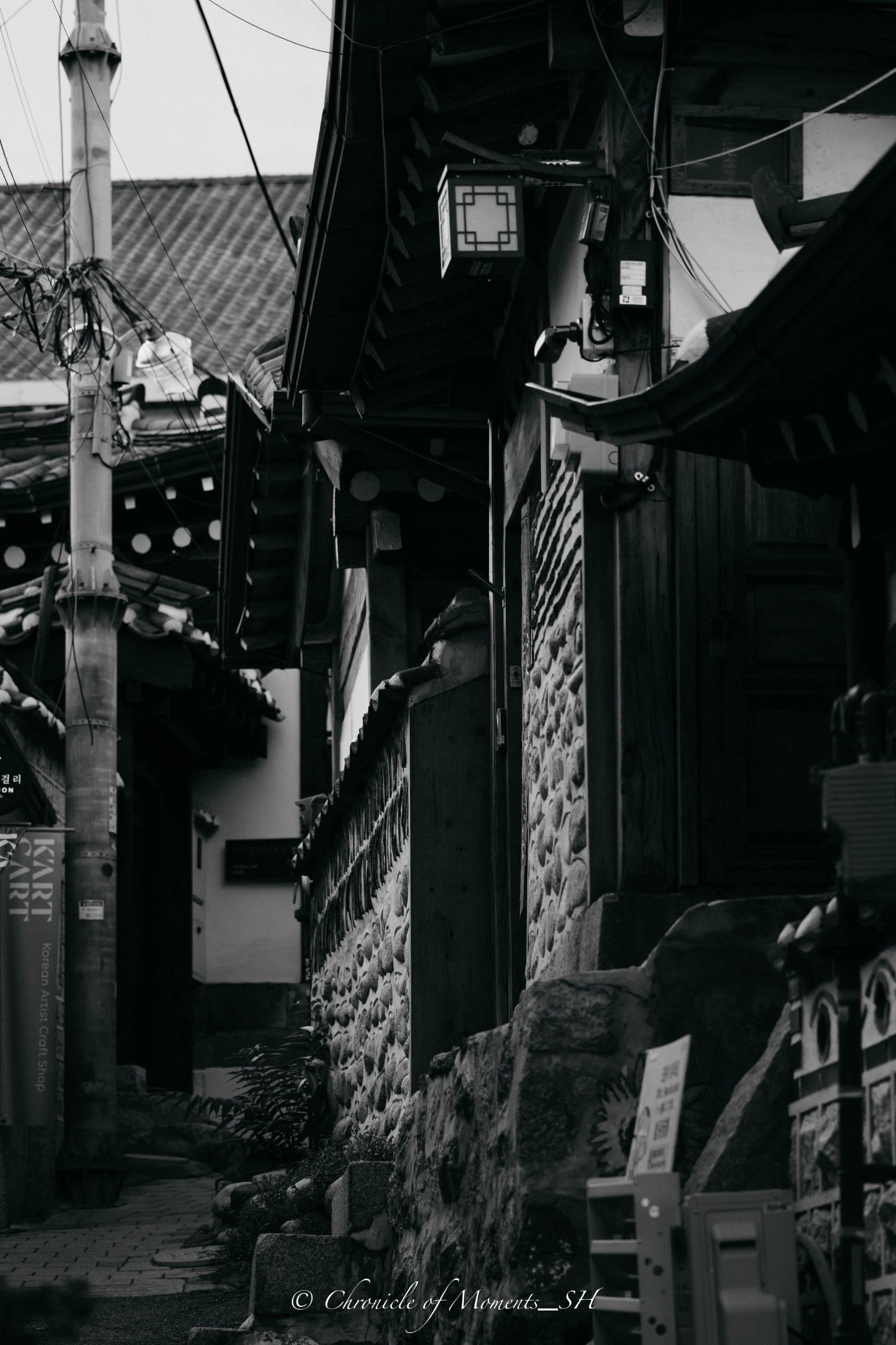
The photo on the right shows the same alley in black and white, taken one minute apart from the left photo (3:19 p.m. and 3:20 p.m.). The same banner at the edge of both frames also shows that it is the same alley. With the color taken away, the curves of the eaves, the texture of the stone wall, and the lines of the pole and wires become much clearer. The settings were 70mm, F2.8, 1/400 s, ISO 100. Which scenes suit black and white is covered separately in Why Black and White Photos Are So Appealing, and How to Choose Scenes That Suit Monochrome.
Light Approaching Sunset
(사진을 클릭하면 원본 크기로 볼 수 있습니다)
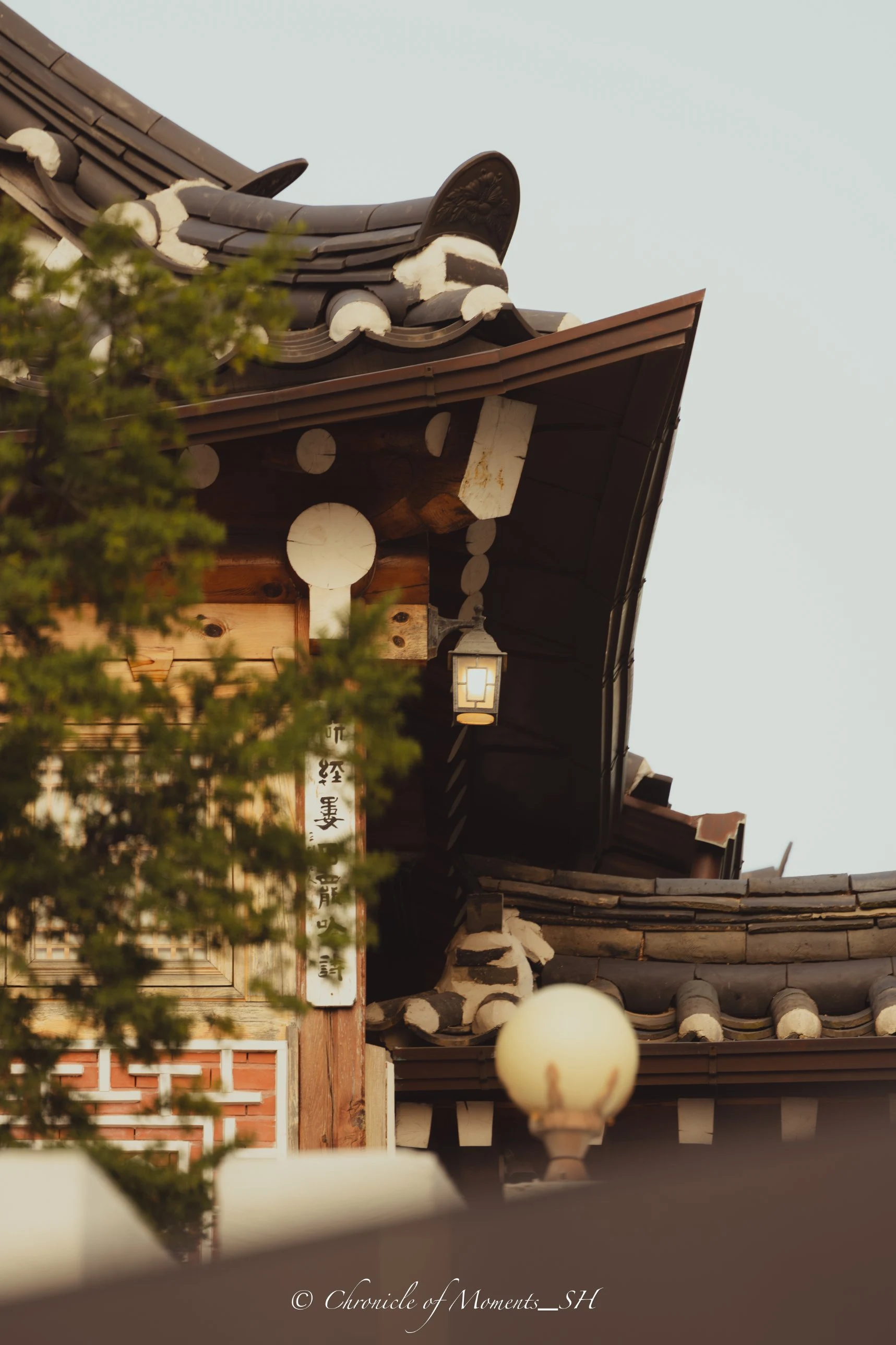
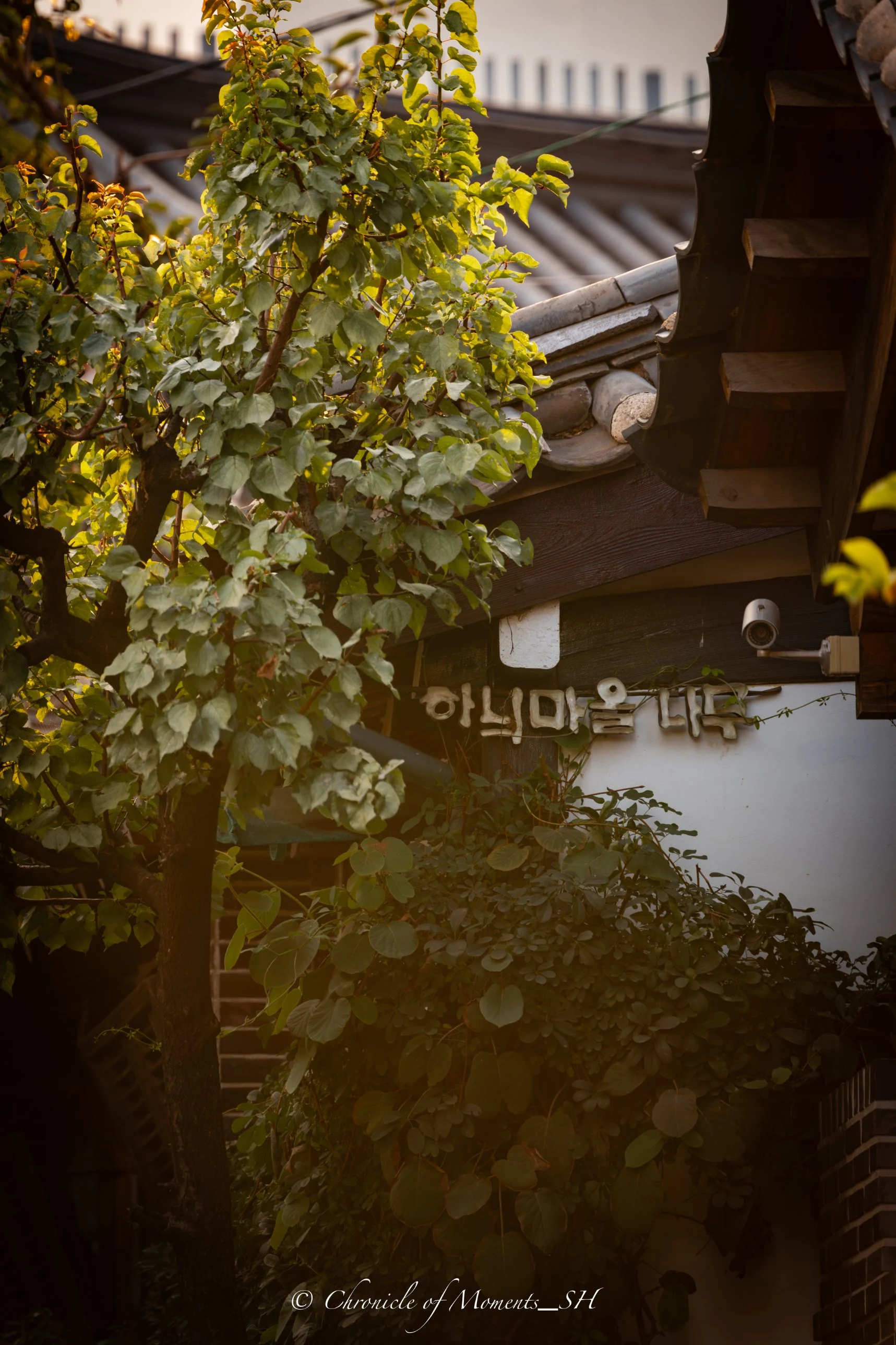
Both photos were taken at 200mm, F2.8, ISO 100, 1/100 s. The one on the left shows the end of an eave at 4:17 p.m., where a lit lantern becomes a warm dot between the roof tiles and the dark underside of the eave, and the blurred branches in front work like a frame around the scene. The one on the right was taken six minutes later, at 4:23 p.m. Warm late-afternoon light falls on the leaves, and a hanok roof and a white wall remain in the background.
200mm is about 320mm in full-frame terms, so 1/100 s is not a fast shutter speed for handheld shooting. This lens has image stabilization (IS), but with settings like these it is a good habit to zoom in on the photo and check for shake. When the light starts to fade, it is safer to raise ISO a little to secure the shutter speed. When you are not sure whether the exposure is right, see How to Read a Histogram.
Views From Nearby: Nakwon Musical Instrument Arcade and Boan Inn in Tongui-dong
(사진을 클릭하면 원본 크기로 볼 수 있습니다)
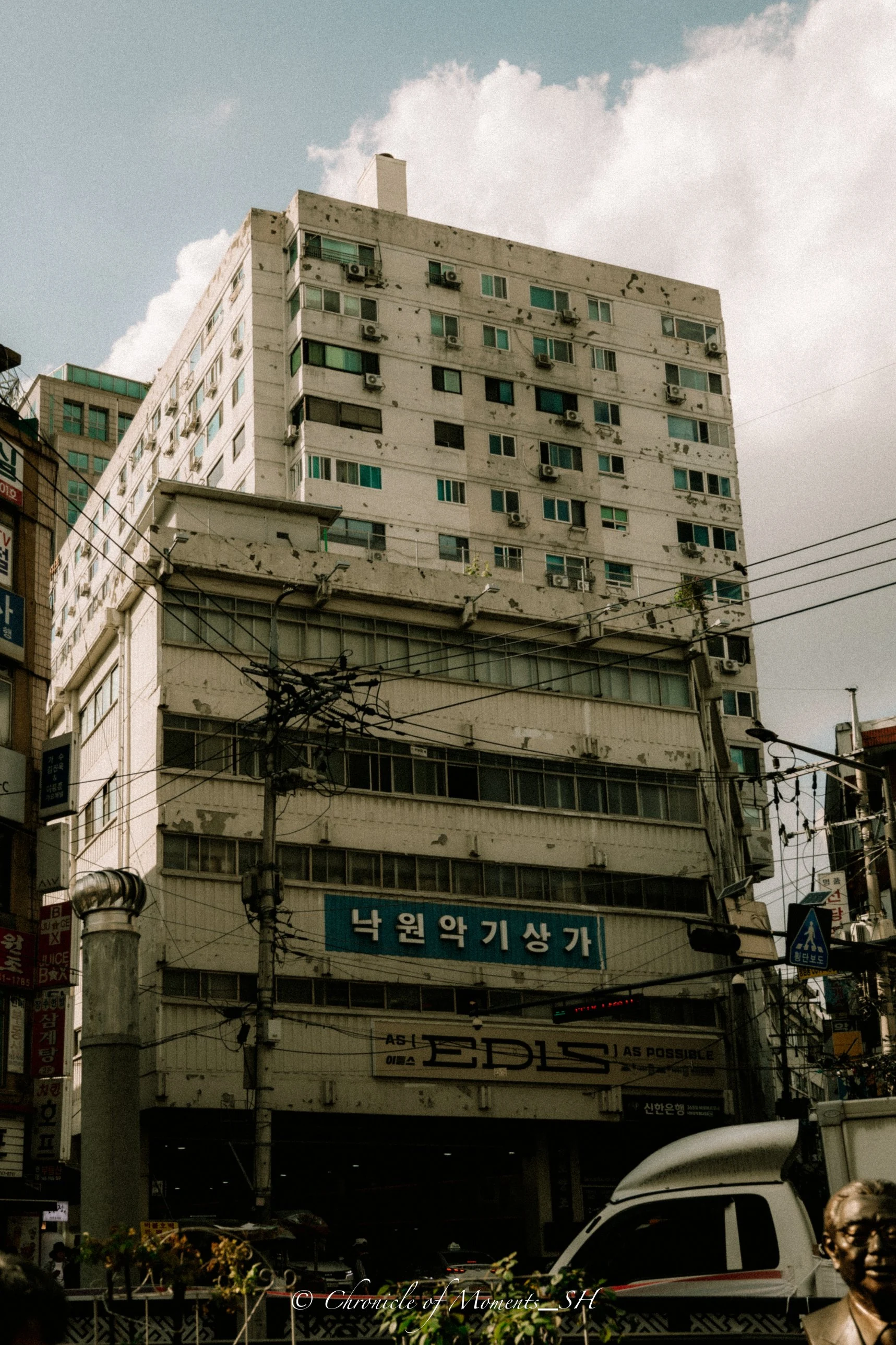
These two photos are views from the area near Bukchon Hanok Village, not inside it. The one on the left shows a building looking up from 23mm on the RF15-35mm at 2:42 p.m. The sign on the building reads 낙원악기상가 (Nakwon Musical Instrument Arcade), and the weathered walls, tangled power lines, and vehicles on the road make a city scene with a completely different texture from the hanok alleys. 23mm is about 37mm in full-frame terms. It was taken at F2.8, 1/3200 s, ISO 100, and because the aperture was left wide open in bright midday light, the shutter speed came out very fast.
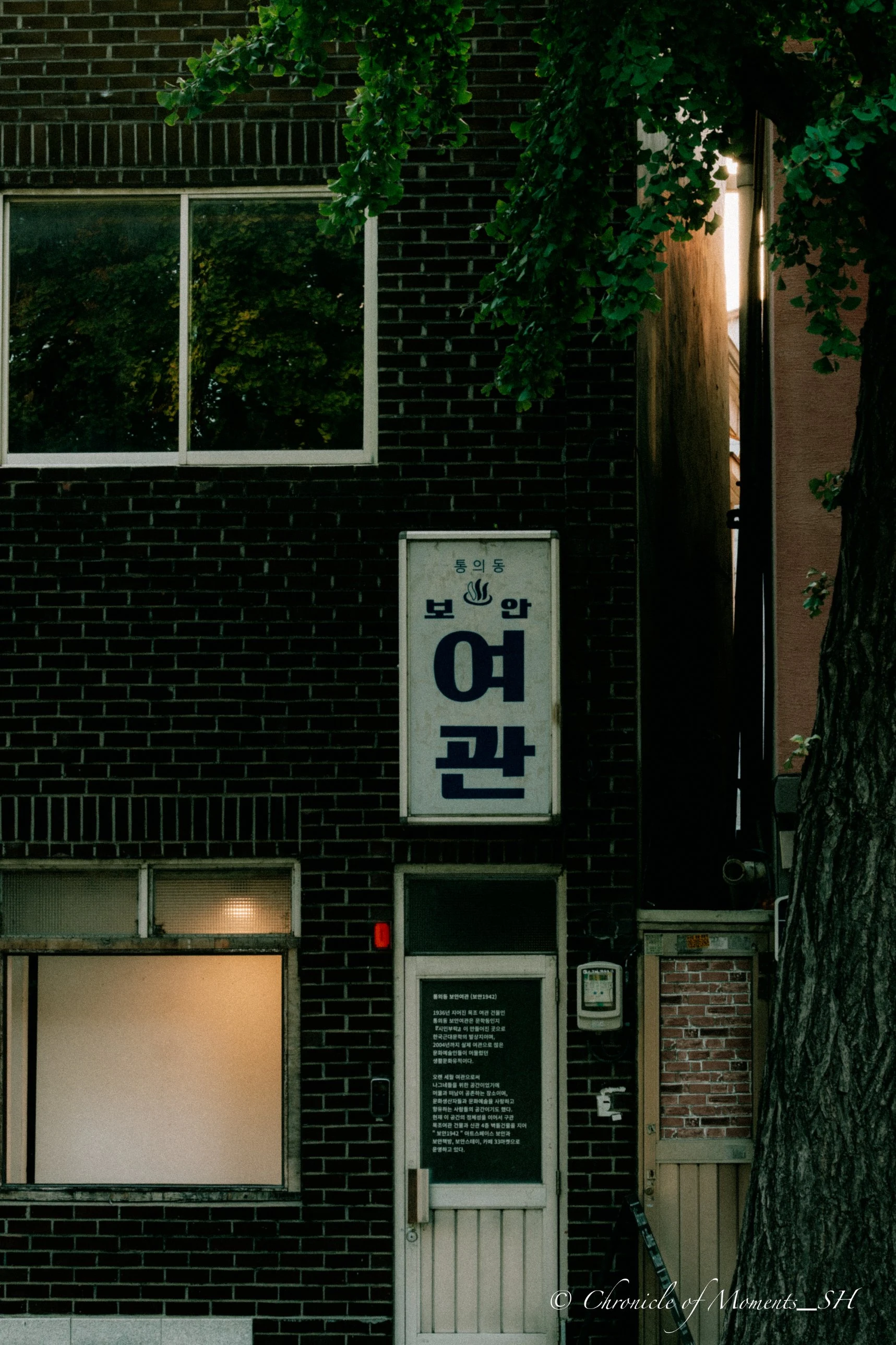
The one on the right is a sign for Boan Inn taken at 5:13 p.m. A sign reading 통의동 보안여관 (Tongui-dong Boan Inn) hangs on a black brick wall, and the notice on the door below says it is a wooden inn building built in 1936 that was used as an actual inn until 2004. Branches cover the upper part of the wall and the scene is in shade, so exposure was secured with F8, 1/3 s, ISO 100. Judging from the settings alone, it was a scene with little light. Tongui-dong is not included in the list of special management area neighborhoods in the Seoul article mentioned earlier (Sogyeok-dong, Hwa-dong, Anguk-dong, Samcheong-dong, Gahoe-dong, Gye-dong, Wonseo-dong), and this photo was taken outside Bukchon Hanok Village.
Tips for Photographing in Bukchon
Most of the 12 photos in this post were taken with the same lens and similar settings, but focal length, aperture, and shutter speed differ by scene. The table below summarizes the settings used in this post by scene.
| Scene | Settings in this post | Point |
|---|---|---|
| Corner hanok, whole alley | 15mm (about 24mm equivalent), F2.8, 1/160 s | Include roof, wall, and sky together and keep the horizon level |
| Eaves and tile details | 70-200mm, F2.8, 1/160-1/800 s | Pull in the layered structure up close |
| Stairs and doors | 70-200mm, F2.8, 1/250-1/400 s | Expose for the bright area and let the dark area fall |
| Signs and shops | 70mm, F2.8, 1/500 s | Focus on the sign and blur the background |
| City view and hanok | 70mm, F2.8, 1/500 s | Place the eaves in front like a frame |
Ten of the 12 photos in this post were taken with the RF70-200mm telephoto lens, most of them at F2.8, and both choices were intentional. First, Bukchon is visited by a great many tourists, so I used a telephoto lens to pull scenes in from a distance and keep people out of the frame. Second, opening the aperture wide blurs the front and back, so the eye is not scattered and gathers on the subject I wanted to show.
Pulling scenes in with a telephoto lens also lets you capture details such as eaves and doors without walking up close to a house, which is easier on the residents too. Still, avoid including the inside of gates or windows, and if a person ends up in the photo, keep the face from being recognizable. The Seoul article also stresses that quiet conversation matters in the narrow alleys, so lowering your voice and the sound of your movement while shooting is the basic courtesy.
There are moments when a wide angle is needed. As in the first photo of this post, where the corner hanok is taken at 15mm, a wide angle is handy when an alley is narrow or when a whole building has to fit in the frame. If you find it hard to pack both lenses, see Travel Photography: Prime Lens or Zoom Lens? for a comparison of which suits a trip.
Shooting Settings of the 12 Photos at a Glance
| Photo | Lens · Focal length | Aperture | Shutter speed | ISO | Time taken |
|---|---|---|---|---|---|
| Corner hanok | RF15-35mm · 15mm | F2.8 | 1/160 s | 100 | 15:45 |
| N Seoul Tower | RF70-200mm · 70mm | F2.8 | 1/500 s | 100 | 16:07 |
| Eaves and tiles | RF70-200mm · 70mm | F2.8 | 1/160 s | 100 | 15:23 |
| Gabled roof and brick wall | RF70-200mm · 200mm | F2.8 | 1/800 s | 100 | 15:25 |
| Door and stone steps | RF70-200mm · 200mm | F2.8 | 1/250 s | 100 | 15:15 |
| Stairs and handrail | RF70-200mm · 70mm | F2.8 | 1/400 s | 100 | 16:03 |
| Alley sign | RF70-200mm · 70mm | F2.8 | 1/500 s | 100 | 15:20 |
| Black and white alley | RF70-200mm · 70mm | F2.8 | 1/400 s | 100 | 15:19 |
| Lantern at the eave | RF70-200mm · 200mm | F2.8 | 1/100 s | 100 | 16:17 |
| Leaves and hanok | RF70-200mm · 200mm | F2.8 | 1/100 s | 100 | 16:23 |
| Nakwon Musical Instrument Arcade | RF15-35mm · 23mm | F2.8 | 1/3200 s | 100 | 14:42 |
| Boan Inn | RF70-200mm · 70mm | F8 | 1/3 s | 100 | 17:13 |
Checklist
- Did you check the visiting hours (until 5:00 p.m.) and the latest notices before leaving?
- Did you compose your shots so that the inside of residents' gates and windows is not in the frame?
- Are you avoiding talking loudly or standing in the alley to block the way while shooting?
- When shooting with a telephoto lens, did you secure a shutter speed that matches the equivalent focal length?
- In scenes with a bright sky and dark eaves together, are the highlights still intact?
Common Mistakes: Going to Shoot Without Checking the Visiting Hours and Residents' Daily Life
The most common mistake is going around sunset without checking the visiting hours. After 5:00 p.m., entry for tourism purposes is restricted and a fine may be imposed, so even if you want to photograph the sunset, it is safer to move your plan to earlier in the afternoon. The next is making noise in front of residents' homes or looking into gates. Remember that a hanok alley is someone's living space before it is scenery.
On the technical side, many people zoom to 200mm and use a slow shutter speed like 1/100 s and end up with blurred photos. Zoom in on the image to check, and raise ISO to increase the shutter speed if needed. Conversely, getting right up to a house with a wide angle can also be a burden on residents, so staying back and using a telephoto lens is easier for everyone.
FAQ
Until what time can I visit Bukchon Hanok Village?
According to reports checked as of November 2026, the hours when tourists may visit the red zone (around Bukchon-ro 11-gil in Gahoe-dong) are 10:00 a.m. to 5:00 p.m. There are exceptions such as shop or museum customers and hotel guests, and the hours may change, so check the Jongno-gu notices before your visit.
Which lens is good for photos in Bukchon?
In this post, 10 of the 12 photos were taken with a 70-200mm telephoto and 2 with a 15-35mm wide angle. The telephoto was useful for capturing details such as eaves and tiles from a distance, and the wide angle for corners and whole narrow alleys.
What time of day is best for photos?
The Bukchon photos in this post were taken between 3:00 p.m. and about 4:20 p.m. The clouds in the sky stood out, and the late-afternoon light gave the trees and tiles warm color. Because visiting hours end at 5:00 p.m., I recommend starting early in the afternoon.
Do Bukchon alleys also suit black and white photos?
The lines and textures made by eaves, stone walls, poles, and wires are clear, so they suit black and white well. A comparison of the same alley in color and in black and white appears in the middle of this post.
Putting It Together
Bukchon Hanok Village is a place where a single walk lets you meet many scenes: tiles and eaves, stone steps, signs in the alleys, and N Seoul Tower in the distance. At the same time, it is a neighborhood where people live, so it is best to check the visiting hours of until 5:00 p.m. and the manners of moving quietly before you go. For photography, a combination of a telephoto lens for details from a distance and a wide angle for corners and whole alleys worked well. Use the settings in this post as a reference when choosing the lens and time of day that fit your travel plan.
Copyright Notice
All photos used in this post are works taken directly by the site operator (Chronicle of Moments_SH). Photographs are protected as photographic works under Article 4(1)(ix) of the Korean Copyright Act, and copyright arises from the moment of shooting without any registration or other procedure (Article 10(2)).
Without the copyright holder's prior permission, it is prohibited to reproduce the photos in this post (Article 16), to post or transmit them on blogs, forums, social media, or communities (public transmission, Article 18), or to modify or edit them into derivative works (Article 22). Removing or altering the copyright notice and frame in a photo can also infringe the right of attribution (Article 12) and the right to integrity (Article 13). Uses the law permits, such as fair quotation of a published work (Article 28) or use within a private or domestic scope (Article 30), are exceptions.
Unauthorized use can lead to injunction claims (Article 123) and damages claims (Article 125), and can be punished by imprisonment of up to 5 years or a fine of up to 50 million won (Article 136(1)). For-profit or habitual infringement can be punished even without a complaint (Article 140).
Photo-use inquiries: skysmoga@gmail.com
© Chronicle of Moments_SH. All rights reserved.